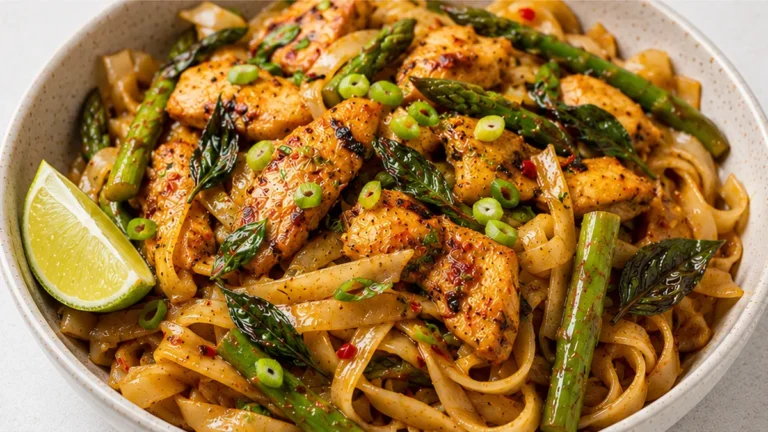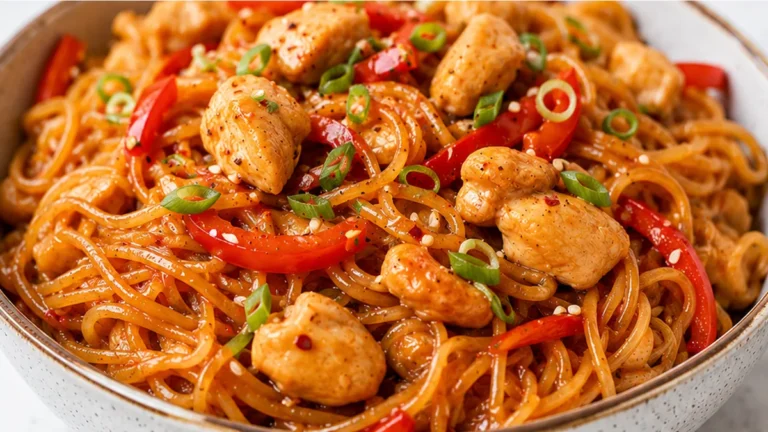

Chicken noodles need one crucial bit of restraint: stop boiling while the egg noodles are still slightly underdone. They keep absorbing the thickened broth off the heat, which creates the saucy texture that separates this dish from standard chicken noodle soup. The first time I made chicken noodles this way, I noticed how quickly fully cooked noodles turned soft while resting. Pulling them earlier preserved their shape and left enough buttery broth to coat the chicken and vegetables.
Key takeaways
- Cook the egg noodles right in the broth so their starch, plus the cornstarch slurry, thickens the liquid into a clinging sauce.
- Whisk the cornstarch into cold water first and add it to simmering, not boiling, broth to avoid gummy lumps.
- Stir the 2 tablespoons butter in off a hard boil so the emulsion stays glossy instead of greasy.
- The sauce keeps thickening off the heat; loosen leftovers with hot broth or water and reheat cooked chicken to 74 C (165 F).

Chicken Soup Noodles That Turn Broth Into Sauce
Ingredients
- 1 tablespoon olive oil
- 3 large carrots, peeled and sliced thinly
- 3 celery stalks, sliced thinly
- 3/4 cup chopped onion
- 49 ounces chicken broth (about 6 cups)
- 1 tablespoon cornstarch
- 1/3 cup cold water
- 1 lb package egg noodles
- 2 tablespoons butter
- 2 teaspoon thyme
- 2 teaspoon parsley
- 2 cups cooked, shredded chicken
- 3-4 green onions, thinly sliced
Instructions
- Warm 1 tbs. olive oil in a large soup pot over medium high heat. Add the vegetables and sauté for about 3-5 minutes, adjusting for how thinly they are sliced, until they are tender but still crisp. Pour in the chicken broth and let it simmer for about 20 minutes.
- Stir the cornstarch into the cold water until dissolved, then pour that mixture into the broth. Add the noodles and bring everything to a rolling boil. Check them every few minutes and take the pot off the heat once the noodles are mostly cooked. They will keep softening after boiling stops, so boiling too long can make them mushy and prone to breaking.
- Stir in the butter and herbs until combined. Fold in the chicken, then season with salt and pepper. As the mixture cools, it should thicken slightly into enough broth to coat everything without becoming runny. Mix in the green onions immediately before serving.
Notes
How egg noodles turn 6 cups of broth into a sauce that clings
The thing that separates this bowl from ordinary soup is deliberate starch release. A 1 lb. package of egg noodles cooked directly in the 49 ounces of broth sheds amylose and amylopectin straight into the liquid instead of into a pot of plain water you pour down the drain. That shed starch is what pasta water is prized for: it acts as a surfactant that binds fat and liquid into a glossy, clinging coat rather than a thin film source.
The 1 tablespoon of cornstarch stirred into 1/3 cup cold water is the second lever. Cornstarch granules begin to swell around 62 to 72 C (144 to 162 F) and thicken fully near 95 C (203 F), which is why the slurry must go into broth that is actively simmering, and why it must be premixed cold so the granules disperse before they hit heat and clump source. One tablespoon of cornstarch across roughly six cups of liquid is a light hand on purpose: it nudges the broth from watery toward nappe, letting it pool and coat the noodles without turning into gravy.
Finishing with 2 tablespoons of butter is not a garnish. Butter is an emulsion of water, milkfat, and milk proteins, and those milk proteins plus the noodle starch are what give the sauce body and a faint sheen. Stir it in off direct boiling heat and swirl until it disappears; boiled hard, the emulsion can break and leave oily beads instead of a unified sauce.
Why the broth goes cloudy and starchy, and how to steer it
Cooking noodles in the broth is a trade: you gain a clinging sauce but you lose crystal clarity, because the starch that thickens the liquid is the same starch that clouds it. That is expected here and is the whole point. The failures worth fixing are the ones that go past pleasant cloudiness into gluey or bland.
- Sauce turns to paste. Cause: the noodles sat in the hot broth too long and kept pumping out starch while also drinking liquid. Fix: cook the egg noodles just to the package time, kill the heat, and serve promptly; if it must hold, loosen with a splash of hot broth or water right before serving.
- Slurry leaves gummy lumps. Cause: cornstarch added to already-hot liquid, so the outer granules gelatinized and sealed the dry core. Fix: always whisk the 1 tablespoon cornstarch into the 1/3 cup cold water first, then stream it into simmering broth while stirring.
- Butter looks greasy, not glossy. Cause: added during a hard boil, breaking the emulsion. Fix: drop the heat to a bare simmer, add the 2 tablespoons butter, and swirl until it melts into the sauce rather than floating on top.
- Everything tastes flat. Cause: under-seasoning masked by a starchy mouthfeel; starch dulls perceived salt. Fix: taste after the slurry and butter go in, not before, and adjust then. If using full-sodium broth, note that one cup of packaged chicken broth commonly carries 700 to 900 mg sodium, so you may need little or no added salt source.
Swapping the egg noodles, broth, and herbs without losing the cling
Each substitution changes how much starch and salt land in the pot, so none of them is truly free.
- Egg noodles to dried pasta (fusilli, ditalini). Expected result: holds shape longer and sheds plenty of starch. Trade-off: durum pasta releases less of the silky amylose that egg noodles give, so the sauce clings a touch less and you may want the full tablespoon of cornstarch rather than less.
- Egg noodles to rice noodles or gluten-free pasta. Expected result: works for gluten-free eaters. Trade-off: rice noodles release different starch and turn soft fast, so cook them barely under and expect a thinner coat; lean on the cornstarch slurry to compensate.
- Store-bought broth to low-sodium. Expected result: you control the salt and avoid the 700 to 900 mg per cup of standard broth source. Trade-off: less built-in savoriness, so season deliberately at the end.
- Dried thyme and parsley to fresh. Expected result: brighter, greener finish. Trade-off: fresh herbs are milder by volume, so roughly triple the amount and add the parsley at the very end, since its aroma fades with heat.
- Butter to olive oil only. Expected result: dairy-free and still glossy from the starch. Trade-off: you lose the milk proteins that give butter its rounded body, so the sauce reads slightly leaner.
Food safety for the shredded chicken folded in at the end
Because the 2 cups of chicken go in already cooked and shredded, the broth’s job is to reheat it through, not to cook it. Poultry, including previously cooked chicken being reheated, should reach 74 C (165 F) to be safe; fold the shredded chicken into the simmering broth and let it come back up to a steady simmer before serving so the pieces heat all the way through source.
If you are cooking the chicken specifically for this recipe rather than using leftovers, the same 74 C (165 F) minimum applies to all poultry parts before you shred it source. The 3 large carrots, 3 celery stalks, and 3/4 cup onion softened first in the 1 tablespoon olive oil give the broth its backbone; slicing them thinly, as the recipe calls for, means they finish cooking in the time the noodles need rather than staying raw in the center.
Make-ahead reality: this sauce keeps thickening after the burner is off
This is the one behavior that defines this dish and almost no clear chicken soup: the starch-bound broth is not static. Noodles keep absorbing liquid and starch keeps setting as the pot cools, so a bowl that was perfectly saucy at the stove can look thick and claggy an hour later, and nearly solid the next day from the fridge. That is physics, not a mistake.
The practical move is to loosen on reheat. Warm leftovers gently and stir in hot broth or water a splash at a time until the sauce flows again; the cornstarch re-softens as it warms. If you plan to store a batch, cooking the noodles separately and combining at serving keeps them from bloating into the broth overnight, which is a common recommendation for egg-noodle soups meant to be kept source. Scatter the 3 to 4 green onions over each bowl at the table rather than stirring them into the pot, so they stay sharp and fresh against the rich, clinging sauce.
Freezing this chicken noodles dish, and why the pound of egg noodles decides whether you can
This recipe lives on a 1 lb. package of egg noodles thickening roughly six cups of broth, which is exactly what makes it a poor straight-to-freezer candidate. Cooked noodles keep absorbing liquid during freezing, thawing, and reheating, so a batch frozen whole thaws into swollen, pasty strands sitting in a broth that has lost most of its cling. The cornstarch gel adds a second problem: chilled cornstarch undergoes retrogradation and can split into a watery layer, a phenomenon called syneresis, so cornstarch-thickened mixtures are a weak choice for long cold storage. Serious Eats documents both effects.
The reliable workaround is to freeze the base without the noodles. Build the pot through the broth, carrots, celery, onion, cornstarch slurry, butter, thyme, parsley, and shredded chicken, then stop before the egg noodles go in. That base freezes cleanly for two to three months because the vegetables and 2 cups of shredded chicken tolerate the cold far better than gelatinized starch does. On serving day, bring the base back to a simmer, thin with a splash of fresh broth if the cornstarch has set up stiff, then boil a fresh portion of egg noodles straight into it so they swell in the pot and throw their surface starch exactly as the recipe intends. If you already froze it whole, reheat gently rather than hard-boiling, since prolonged high heat degrades swollen starch and thins the sauce you worked to build.
Scaling the pot up for a crowd and choosing a wide enough pan to protect the butter-enriched broth
Every quantity here scales linearly, but two things do not. The first is your pot. Six cups of broth plus a pound of noodles already fills a standard saucepan; double it and you need an 8-quart stockpot. Reach for one with a heavy, aluminum-cored or tri-ply base rather than thin single-ply aluminum, because the 2 tablespoons of butter and the released noodle starch both settle and scorch against a hot thin bottom. A conductive base spreads heat evenly and gives you a wider margin before anything catches, which matters once the liquid starts clinging. Bon Appetit notes an aluminum core for conductivity under a stainless surface for even heating.
The second thing that does not scale neatly is the aromatics. The 3 carrots, 3 celery stalks, and three-quarter cup onion sit near a classic mirepoix, and the conventional 2:1:1 ratio by weight is two parts onion to one part each carrot and celery, as The Forked Spoon describes. This recipe runs heavier on carrot and celery, which suits a chicken noodle bowl, so when you double the batch, double the vegetables with it rather than letting the noodles outnumber them in a bigger pot. One scaling trap deserves a warning: the pound of egg noodles will drink a surprising amount of your added broth as the batch grows, so hold back a cup of stock at the end and stir it in only if the enlarged pot has tightened past a sauce into a paste. Season the finished pot after the noodles have swelled, since a larger volume concentrates the thyme and parsley unevenly as it sits.
Pro tips
- Stop boiling while the egg noodles are mostly cooked; residual heat finishes them without turning them mushy.
- I watch the broth cling to a noodle before judging thickness rather than waiting for it to look heavy in the pot.
- Refrigerate leftovers promptly and reheat gently. If cooking chicken from raw for this recipe, bring poultry to 165°F before shredding.
Chicken noodles work best when the broth stays thick enough to coat rather than flood the bowl. Serve them promptly and keep that noodle texture intact.
Frequently asked questions
Can I cook the egg noodles separately instead of in the broth?
You can, and it is smart if you plan to store leftovers, since noodles cooked apart will not bloat and soak up the broth overnight. The trade-off is a thinner sauce, because the broth loses the starch the noodles would have shed into it. Lean a little harder on the cornstarch slurry to make up the body.
Why did my broth turn cloudy and thick?
That is the design of this recipe, not a flaw. Egg noodles release amylose starch as they cook in the broth, which clouds the liquid and lets it cling to each strand. If it crosses into paste, the noodles likely cooked too long; serve promptly and loosen with a splash of hot broth or water right before plating.
My leftovers set almost solid overnight. Did I do something wrong?
No. Cornstarch and noodle starch keep setting as the pot cools, and the noodles keep drinking liquid, so a saucy pot stiffens in the fridge. Reheat gently and stir in hot broth or water a splash at a time until it flows again. The starch re-softens with warmth and the sauce comes right back.
Do I need to add salt if I use regular chicken broth?
Probably little or none at first. Standard packaged chicken broth often carries 700 to 900 mg of sodium per cup, so with roughly six cups the salt adds up fast. Starch also dulls perceived saltiness, so taste only after the slurry and butter are in, then adjust. Low-sodium broth gives you full control if you prefer.
More from Baked Pasta Recipes →