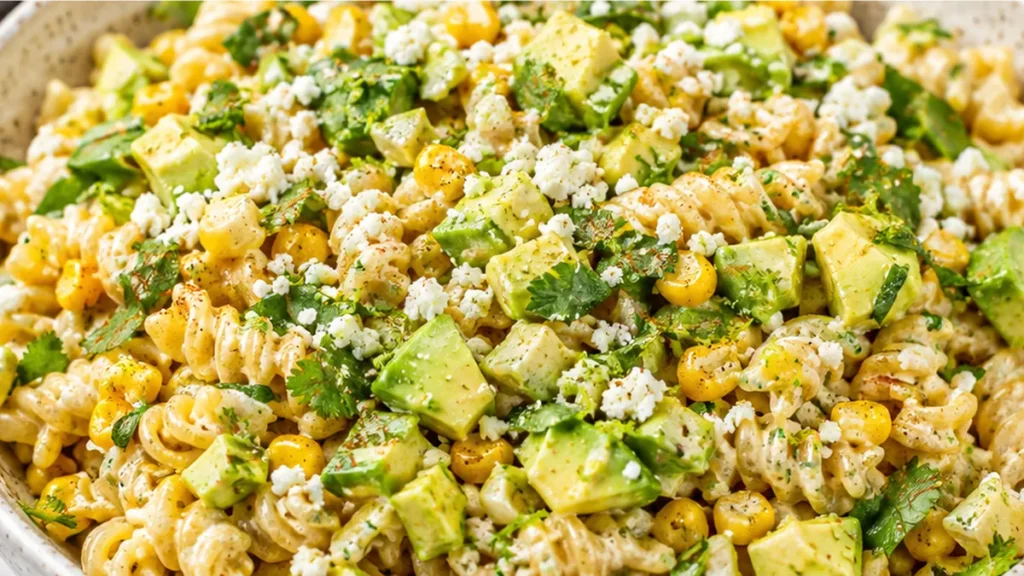
Elote pasta salad transforms the beloved Mexican street corn into a hearty, crowd-pleasing pasta dish. This recipe captures the smoky char of grilled corn, the creamy tang of the traditional elote crema, and the freshness of cilantro and lime, all tossed with perfectly cooked pasta. This elote pasta salad is more than just a side dish; it’s a celebration of bright, fresh flavor. Forget bland pasta salads – this one is packed with texture and zest, making it ideal for BBQs, potlucks, or a satisfying weeknight meal.
Key takeaways
- Use raw or dry-charred fresh corn for snap and sweetness; boiling leaches sugar and softens the kernels.
- Cool the pasta completely before dressing so hot surface starch cannot turn the yogurt-mayo emulsion gluey.
- Reserve about a quarter of the dressing and the Cotija to stir in cold at serving, the way elote is finished to order.
- Add avocado last with a little of the lime juice, and leave it out entirely if you are making the salad a day ahead.
Elote Pasta Salad: Your NEW Summer Obsession!
Ingredients
- 8 ounces rotini or bowtie pasta, use gluten free if needed
- 3 medium ears corn, cut from the cob (about 2 cups)
- 1 cup fresh cilantro leaves, loosely packed, chopped
- 1 medium avocado, diced
- ⅓ cup finely diced red onion
- ⅓ cup crumbled or grated Cotija cheese
- ¾ cup siggi’s whole milk plain yogurt
- 3 tablespoons mayonnaise
- Zest and juice of 2 small limes
- 2 teaspoons chili powder
Instructions
- Cook pasta in boiling salted water until al dente. Drain, rinse with cold water, and chill in the fridge.
- Heat a cast-iron skillet over medium-high heat. Add 1 tbsp oil and swirl.
- Add corn kernels to the hot skillet and cook for 5-6 minutes until charred and fragrant.
- Remove corn and let it cool to room temperature.
- Whisk together yogurt, mayonnaise, lime zest, lime juice, chili powder, salt, and pepper for the dressing.
- Combine cooled pasta, charred corn, cilantro, avocado, red onion, and Cotija cheese in a large bowl. Pour dressing over and gently stir.
- Garnish with extra Cotija cheese, cilantro, and chili powder before serving.
Video
Notes
Elote pasta salad works because it borrows the exact flavor logic of Mexican grilled street corn and bolts it onto a starchy carrier that can absorb and hold that dressing for days. Traditional elote, the corn sold on a stick from carts across Mexico, is built on four load-bearing elements: sweet corn, a creamy binder (usually mayonnaise plus Mexican crema), salty crumbled Cotija, and an acid-and-heat finish of lime and chili powder. This recipe keeps all four and swaps in siggi’s whole milk plain yogurt for most of the crema, which is the single change that decides whether the finished bowl tastes fresh or heavy. Rotini and bowtie both have ridges and folds that trap dressing in a way smooth shapes cannot, so nearly every bite carries corn, cheese, and lime at once.
Raw corn versus cooked: why the kernels stay crisp and sweet
Raw sweet corn cut straight from three medium ears gives this salad its signature snap, and it is not a shortcut. Sweet corn is harvested while the kernels are still tender and their sugars have not yet converted to starch, which is why a fresh ear can be eaten uncooked and tastes candy-sweet. According to Serious Eats, corn loses sweetness quickly after picking because enzymatic reactions turn its simple sugars into less-sweet starch, so the fresher the ear, the better raw kernels perform here. If you prefer a smoky note closer to a street cart, char the ears dry in a hot skillet or over a flame for two to three minutes until spots blacken, then cool before cutting; do not boil, which leaches sugar into the water and softens the pop you want against the pasta. To strip kernels cleanly, stand each de-stemmed cob upright in a wide bowl and slice downward; the bowl catches the two cups without kernels rolling across the counter.
Charred, raw, or frozen: what each does to the bowl
Raw fresh: maximum sweetness and crunch, zero cooking, best in peak summer when ears are just-picked.
Dry-charred: adds Maillard bitterness and smoke that mimics grilled elote, at the cost of some crispness.
Thawed frozen: reliable off-season, but drain and pat dry hard, since surface water dilutes the dressing.
Why siggi’s yogurt plus mayonnaise beats straight mayo here
The dressing is a two-part emulsion: three-quarters cup of siggi’s whole milk plain yogurt for tang and body, and three tablespoons of mayonnaise for the fat and cling that yogurt alone cannot supply. siggi’s skyr is strained Icelandic-style yogurt made with roughly four times the milk of ordinary yogurt, so it arrives thick and high in protein with less tang than Greek yogurt, which is exactly why it stands in for Mexican crema without turning sour. Mayonnaise matters because it is a stable oil-in-water emulsion; it coats each rotini spiral and keeps the yogurt from weeping as the salad chills. Using the whole-milk version rather than nonfat is deliberate, since the milkfat carries the chili powder and lime oils that are fat-soluble. Zest and juice of two small limes and two teaspoons of chili powder go into this base, not on top, so the acid and spice distribute evenly instead of streaking. For more on why a cultured dairy base reads brighter than mayonnaise alone, our guide to cooking with strained skyr covers the protein and moisture numbers.
When to add the avocado and how to stop it browning
Fold the diced avocado in last, off to one side, and only if you are serving within a few hours, because avocado browns through enzymatic oxidation the moment cut flesh meets air. The lime already in the recipe helps: citrus is rich in ascorbic acid, which the food-science community at Serious Eats and Cook’s Illustrated notes slows the browning enzyme, so tossing the diced avocado in a little of the lime juice before folding buys you real time. Do not stir it in aggressively, or the flesh mashes and greys the whole bowl. If you are making this a day ahead, leave the avocado out entirely and add it at the table; the pasta, corn, cheese, and dressing hold beautifully overnight, but no acid fully stops a diced avocado from dulling after twelve hours. Red onion, at a third of a cup finely diced, is the other timing lever: soak it in cold water for ten minutes first if you want to keep its color and cut its raw bite.
Common failures and the actual fix
Salad tastes dry the next day: the pasta kept absorbing dressing. Reserve a quarter of the yogurt-mayo mix and stir it in cold, right before serving.
Dressing is thin and slides off: the pasta went in warm. Cool rotini fully first, since hot surface starch gelatinizes and turns gluey, thinning the emulsion.
Flavor is flat: Cotija and lime need salt to bloom; taste after chilling, when cold mutes seasoning, and correct then rather than at mixing time.
Everything clumps: the pasta was over-rinsed of all starch or under-dressed; a light starch film helps the dressing cling.
Cotija, and the smart swaps when you cannot find it
Cotija is the ingredient that makes this taste like elote rather than a generic corn salad. It is an aged cow’s-milk cheese named for the town of Cotija in Michoacan, Mexico, traditionally made from raw milk and aged three to twelve months; the aged style is firm, dry, and assertively salty, which is why a third of a cup crumbled over eight ounces of pasta seasons the whole dish. Feta is the closest widely available substitute because it shares that salty, crumbly, tangy profile, though it is moister and milder, so add a pinch more salt and expect a softer bite. Aged Parmesan or Pecorino Romano gives the salt and dry crumble but a nuttier, less lactic flavor. Grated versus crumbled changes texture only: grated melts into the dressing for even saltiness, while crumbled leaves briny pockets. Whatever you choose, add it after the dressing so the salt sits on the surface where you taste it first. For the acid-and-heat finish, our breakdown of classic elote seasoning explains why chili powder plus fresh lime outperforms a pre-mixed chile-lime salt here: the fresh zest brings aromatic oils a shelf-stable blend has lost.
One thing sets this dish apart from almost every other pasta salad: it is seasoned to be eaten cold and slightly under-dressed at mixing, then finished with reserved dressing and cheese at the table, exactly the way a street vendor slathers and dusts an ear of corn to order rather than in advance. That two-stage assembly is what keeps a make-ahead bowl from going pasty. If you want a starchier vegetable base instead of pasta, the same yogurt-lime-Cotija treatment carries a Mexican street corn potato salad, and for a grain version try our elote orzo with charred corn, both of which use the identical two-stage dressing method.
How elote pasta salad holds up overnight and what the lime does to the pasta by morning
Elote pasta salad behaves differently at hour one than at hour twelve, and knowing the shift lets you dress it at the right moment. Cooked rotini keeps absorbing liquid as it sits, so the acid-heavy coating from two limes and the whole milk yogurt gradually soaks into the starch. After a night in the fridge the pasta reads drier and the flavor reads flatter, because both moisture and acid have migrated inward. Toss the pasta in a spoonful of neutral oil before it fully cools to slow that absorption. Hold back roughly a third of the yogurt-mayonnaise dressing and the reserved lime juice, then re-loosen and re-season the next day; salt and acid dull first in cold food. Cotija survives storage well since it is a firm, salty, low-moisture cheese, but stir it through just before serving rather than at mixing so the crumbles stay distinct instead of dissolving into the dressing. Two components will not wait: diced avocado oxidizes and browns within a few hours even under lime, and chopped cilantro wilts and darkens. For a salad you want to eat across two or three days, store the base undressed, and fold in fresh avocado, cilantro, and the held-back dressing per portion. Kept sealed and cold at or below 4C (40F), the dairy-based dressing is safe roughly three to four days; corn, cheese, and pasta are the shelf-stable parts, and the perishable garnishes are what set the practical window.
Doubling the bowl for a cookout without it turning to paste
Scaling from three ears of corn to a crowd is mostly about surface area and timing, not just larger numbers. Corn kernels cut from six or nine ears will not char evenly in one crowded skillet; kernels steam instead of browning when the pan is packed, so work in batches that keep a single sparse layer, or spread them across a sheet pan under the broiler. Double the pasta and you double the risk of clumping, so cook it in plenty of water, drain, then spread it on a tray to stop the carryover cooking that leaves a big batch soft. Dressing does not always scale one to one: a triple batch usually needs slightly less than triple the yogurt and mayonnaise, because a larger mass retains coating more efficiently than a small one. Start at 80 percent of the multiplied dressing, toss, and add the rest only if the pasta looks dry. Lime and chili powder, by contrast, should be adjusted by taste rather than measured up, since two limes’ worth of acid can vanish across eight cups of pasta. Salt the pasta water heavily so the noodles are seasoned from the inside, which matters far more at volume than a surface sprinkle. Fold avocado in last for every batch size, and for a party, keep the cheese and cilantro in bowls alongside so guests finish their own portions and the salad never sits fully dressed and warming on a table.
Pro tips
- For extra smoky flavor, grill the corn on the cob before cutting off the kernels.
- If fresh corn isn’t available, use frozen corn kernels, thawed and patted dry, before charring.
- Let the pasta and corn cool completely before mixing to prevent the avocado from browning and the cheese from melting into an unappealing mass.
- Adjust the chili powder and lime juice to your preference for spice and tang.
Enjoy this fresh and flavorful Elote Pasta Salad as a refreshing addition to any meal. It’s a guaranteed hit for picnics and gatherings!
More from Baked Pasta Recipes →