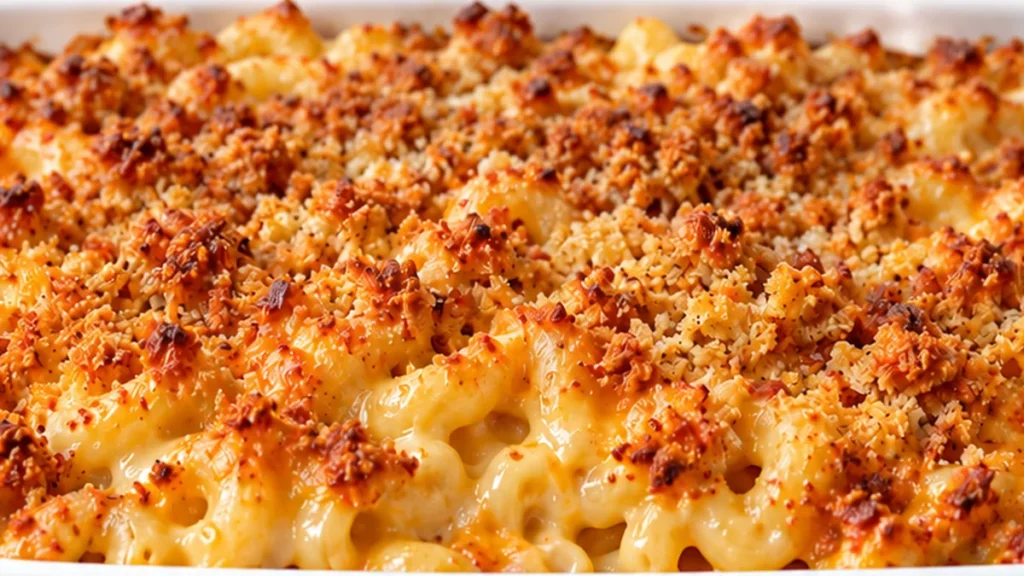
Baked mac and cheese succeeds when the sauce stays smooth before the eggs and pasta ever enter the pan. Here, cheddar and a second smooth-melting cheese create the rich base, while tempered eggs give the finished casserole its distinctive set. The first time I made baked mac this way, the firmer center surprised me; it cuts more cleanly than stovetop versions. I would not skip the breadcrumb layer, because its dry crunch is the contrast this casserole needs.
Key takeaways
- Grate blocks yourself and keep the 8 ounces of American or Gruyere intact; its emulsifiers stop the cheddar from breaking into grease.
- Beat the eggs into the cold milk first, then pull the dish once the center is just set so the custard never pushes past its coagulation point and turns grainy.
- Toast the white bread before crumbing it and bind with reserved butter so the top crisps instead of steaming soggy.
- Reheat with a splash of milk stirred in over low heat to re-emulsify a sauce the pasta has dried out overnight.
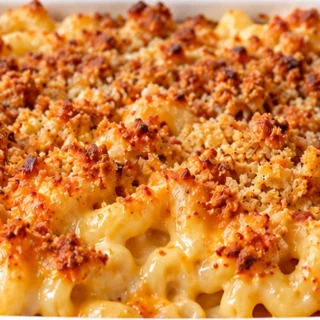
Baked Mac and Cheese You’ll Dream About
Ingredients
- 1 lb elbow macaroni
- 2-3 slices white bread, toasted
- 7 tablespoons butter, divided
- 2 tablespoons flour
- 1 12-ounce can evaporated milk
- 1/2 cup whole milk
- 1 teaspoon ground mustard
- 1 1/2 pounds cheddar cheese, grated
- 8 ounces American, Gruyere, or any other smooth melting cheese, grated or cut into chunks
- 2 eggs, beaten
Instructions
- Heat the oven to 375 degrees. Put the macaroni in a large bowl, cover it with hot water, and mix in a big pinch of salt. Leave the pasta to soak for about 30 minutes while preparing everything else.
- Melt two tablespoons of the butter. Process the toasted bread in a food processor, then mix in the melted butter and set the crumbs aside.
- Melt the remaining butter in a large saucepan. Stir in the flour continuously until it becomes light golden blonde. Slowly whisk in the evaporated milk and whole milk until the sauce is smooth and thick. Mix in the ground mustard, bring it to a simmer over medium heat, then take it off the heat. Add both cheeses and stir until melted, then season to taste.
- In another bowl, whisk about a cup of the sauce into the beaten eggs so their temperature rises gradually. Stir this mixture back into the remaining sauce. Drain the macaroni, mix it into the sauce, and transfer everything to a greased rectangular or square baking dish.
- Scatter the breadcrumbs over the top, cover with foil, and bake for 30 minutes. Take off the foil and continue baking for another 5 minutes so the crumbs become nicely toasted. Serve with salt, pepper, hot sauce, or your preferred baked mac and cheese accompaniments.
Notes
Why cheddar alone breaks into oil and American or Gruyere rescues it
The two-cheese split in this recipe is not about flavor hedging. It is physics. Cheddar is built from casein proteins bundled into micelles and glued together with calcium into a matrix that traps fat and water. Heat that matrix and, at roughly 32C (90F), the milk fat liquefies and pools; keep heating and the proteins tangle into stringy strands and squeeze the fat out entirely, leaving you with a greasy slick over a watery layer. Aged, drier cheddar breaks worst because its degraded protein network holds less oil to begin with.
The 8 ounces of American or Gruyere carry the fix. Processed American already contains sodium citrate, an emulsifying salt that disrupts the casein network so fat stays suspended in water instead of weeping out, which is why it melts into a lump-free gloss where cheddar curdles. Sodium citrate is a common ingredient in pasteurized process cheese for exactly this reason (source). Cut your 1.5 pounds of flavorful cheddar with that smooth melter and you get cheddar’s depth riding on American’s stability. Gruyere behaves differently; it melts cleanly because it is a good melter in its own right rather than because it is emulsified, so it leans nutty rather than silky-slick.
Grate everything yourself from blocks. Pre-shredded bags are dusted with cellulose and anti-caking starch that interferes with a clean melt and can leave the sauce gritty.
How the eggs turn a sauce into a sliceable custard without scrambling
The 2 beaten eggs are what separate this baked version from a stovetop one. As the dish bakes, egg proteins denature, unravel, and link into a three-dimensional network, thickening the evaporated-milk mixture into a loose custard that sets around the macaroni so you can cut clean squares. Whole-egg protein coagulates between 62.2C and 70C (144F and 158F), and because the eggs are diluted by milk and cheese, full set lands near the top of that band (source).
The danger is scrambling. Pour hot pasta or hot butter straight onto beaten eggs and the exposed yolk proteins seize into visible curds before the milk can buffer them. Beat the eggs fully and whisk them into the evaporated milk and whole milk first; the dilution raises the coagulation point and keeps the proteins apart until oven heat sets them gently and evenly. Pull the dish once the center is just set and no longer jiggly. Push it well past 74C (165F) in the middle and the same proteins that gave you custard will tighten, weep moisture, and turn the interior grainy.
The roux, evaporated milk, and mustard working as three stabilizers at once
Three ingredients here all guard the emulsion, each by a different mechanism. The 2 tablespoons of flour cooked in butter make a roux whose swollen starch granules physically hold fat and water apart, so the fat cannot coalesce and break out. Evaporated milk pulls double duty: it is concentrated, so it delivers extra milk proteins that stabilize the mix, and it has already been through heat processing that makes its own proteins resistant to curdling. That is why it curdles far less readily than fresh cream under baking temperatures.
The 1 teaspoon of ground mustard is not only seasoning. Mustard contains natural emulsifying compounds and mucilage that help bind fat to water, and its sharpness cuts the richness of 1.5 pounds of cheddar so the dish reads savory rather than cloying. A short roux-and-dairy workflow to keep in view:
- Cook the roux first. Let the flour and butter bubble a minute or two to lose the raw-flour taste before any liquid goes in; a raw roux leaves a pasty edge.
- Add dairy off blistering heat. Bring the sauce base to a gentle simmer, not a rolling boil, so the proteins never over-tighten.
- Melt cheese low and slow. Stir cheese in off direct high heat; above roughly 82C (180F) even good melters start to split.
Toasted white bread on top instead of raw crumbs
The 2 to 3 slices of toasted white bread are specified toasted for a reason most crumb toppings miss. Toasting first drives off surface moisture and starts Maillard browning, so when you pulse or crush the slices and bind them with some of the divided butter, they crisp in the oven instead of steaming soggy against the custard. Fresh untoasted bread dumps water onto the top layer and sinks into a pale, damp crust. Tear the toast, pulse to coarse crumbs, and toss with a few tablespoons of the butter you set aside so each crumb carries fat and browns to a deep gold. Scatter in an even layer; a thick heap insulates the middle and browns unevenly before the crumbs underneath ever crisp.
Four failures and their actual causes
- Greasy pools on top: the cheddar’s fat broke out from overheating or from too little emulsifier. Keep the American or Gruyere portion intact and avoid baking far past a set center.
- Grainy, curdled interior: the eggs overcooked. The custard went beyond its coagulation window; pull it the moment the center stops jiggling rather than baking to a firm, dry middle.
- Watery sauce pooling at the edges: undercooked roux or too little starch to bind the liquid, or macaroni boiled so long it leached starch and then released water. Cook the pasta just to barely al dente.
- Dull, pasty flavor: raw flour from a roux cooked too briefly, or no mustard to lift the dairy. Give the roux its minute and keep the ground mustard in.
Swaps that change the result, and what you trade
- Gruyere instead of American: nuttier, more grown-up flavor and a cleaner melt, but you lose the sodium-citrate safety net (source), so your technique has to be tighter to avoid breaking.
- Whole milk swapped for more evaporated milk: richer and even more curdle-resistant, but denser and heavier; the 1/2 cup of whole milk thins the custard to a softer set.
- Young mild cheddar for sharp: melts smoother with less risk of splitting because it holds more moisture, but milder flavor, so you may want to push the mustard.
- Cornstarch for the flour roux: a pure starch thickens without any flour taste and stays glossier, but you lose the buttery body a cooked roux contributes to a baked dish.
The reheating problem that is baked into this dish
Leftover mac and cheese reheats badly, and it is the pasta’s fault, not the sauce’s. Cooked elbows keep absorbing moisture overnight in the fridge, which throws off the fat-to-water ratio that kept the emulsion stable; reheat it and the now fat-heavy sauce breaks and turns grainy (source). The fix is to add the water back. Stir in a few tablespoons of milk per portion and warm it gently, stirring as you go; the water corrects the ratio and the milk proteins help the sauce re-emulsify. The macaroni will be softer than it was fresh, but the sauce comes back together instead of weeping oil.
Assembling it tonight to bake tomorrow, and what the fridge does to the custard
This dish takes to a make-ahead schedule better than most baked pastas because the egg custard that binds it is still raw when the pan goes cold. You can boil the macaroni, build the roux with the two tablespoons of flour and the evaporated milk, fold in the cheddar and the smooth cheese, stir in the two beaten eggs, and layer the whole thing into the dish a full day ahead. Cover it tightly and refrigerate within two hours of cooking the pasta, the window the USDA sets before bacteria multiply in the 40 to 140 F (4 to 60 C) danger zone (FSIS).
Two things shift overnight. The elbows keep drinking liquid, so a sauce that looked loose going in sets up noticeably tighter by morning; loosen it with a splash more whole milk before baking. And a dish taken straight from the fridge is roughly 4 C at its core instead of room temperature, so the custard needs longer in the oven to reach the 71 to 74 C (160 to 165 F) at which beaten eggs coagulate into a sliceable set. Add ten to fifteen minutes to the bake and check the center, not the bubbling edge. Keep the toasted bread topping off until the pan goes into the oven, otherwise it sits against cold sauce absorbing moisture and loses the crisp contrast it is there to provide. Leftovers, fully baked, hold three to four days refrigerated (Serious Eats).
Why a shallow wide pan browns the whole top and a deep one leaves the center pale
Pan geometry decides how this specific mac bakes, because the toasted-bread crown and the egg set both depend on how heat reaches the surface and the core. The one pound of macaroni plus nearly three pounds of cheese and dairy fills a standard 9 by 13 inch dish, about 3 quarts, to a useful depth of roughly 5 cm. In that pan the surface area is wide, the layer is shallow, and radiant oven heat crisps the bread across the entire top while the custard underneath climbs to its set temperature at an even pace.
Move the same volume into a deep 2.5 quart casserole or a loaf-style pan and the physics change. The surface narrows, the depth jumps past 7 cm, and the top browns well before the dense core reaches 71 C, so you either pull it with a cold center or overbake the edges into oil-weeping toughness. The trade is real: a wider pan gives more crust and faster, more even setting; a deeper pan gives a creamier, saucier interior with less browned surface. If you only own a deep dish, drop the oven about 10 C and extend the time, and tent the top with foil once the bread colors so the center can catch up. Glass and ceramic hold heat and keep the finished dish warm at the table; thin metal browns the base faster, which matters because the layer touching the pan sets first (America’s Test Kitchen). Match the pan to the depth of about 5 cm and the recipe’s timing behaves as written.
Pro tips
- Temper the eggs with about a cup of warm sauce before returning them to the pan; direct contact with very hot sauce can set them unevenly.
- Pull the sauce from the heat before stirring in the cheeses for smoother melting.
- Look for a toasted breadcrumb surface after the final uncovered bake.
- Refrigerate leftovers promptly and reheat portions until hot throughout.
Baked mac is especially satisfying when the creamy interior and crisp breadcrumb layer stay distinct. Serve it hot and keep the final uncovered bake.
Frequently asked questions
Can I skip the eggs in this baked mac and cheese?
You can, but you lose the custard set that lets you cut firm squares; the result will be looser and more like a stovetop sauce. The 2 eggs are what thicken the evaporated-milk base into a structure that holds around the macaroni. If you leave them out, expect a creamier, soupier dish rather than a sliceable one.
Why does the recipe use evaporated milk instead of just whole milk?
Evaporated milk is concentrated, delivering extra milk proteins that stabilize the sauce, and its heat processing makes it far more resistant to curdling under oven temperatures than fresh milk or cream. The 1/2 cup of whole milk simply thins that concentrated base to a softer set. Using all evaporated milk would make the dish richer but noticeably denser.
Do I really need two kinds of cheese?
For reliability, yes. The 1.5 pounds of cheddar carries the flavor but splits into oil when overheated, while the 8 ounces of American or Gruyere melts smoothly and, in American’s case, brings sodium citrate that keeps the fat emulsified. Together they give you cheddar’s depth on a stable melt. All cheddar risks a greasy, broken sauce.
How do I keep the breadcrumb topping from going soggy?
Toast the 2 to 3 slices of white bread before you crush them, which drives off moisture and starts browning. Then toss the coarse crumbs with some of the reserved butter so each piece carries fat and crisps in the oven. Spread them in a thin, even layer; a thick pile traps steam and browns unevenly before the bottom crumbs ever crisp.
More from Baked Pasta Recipes →