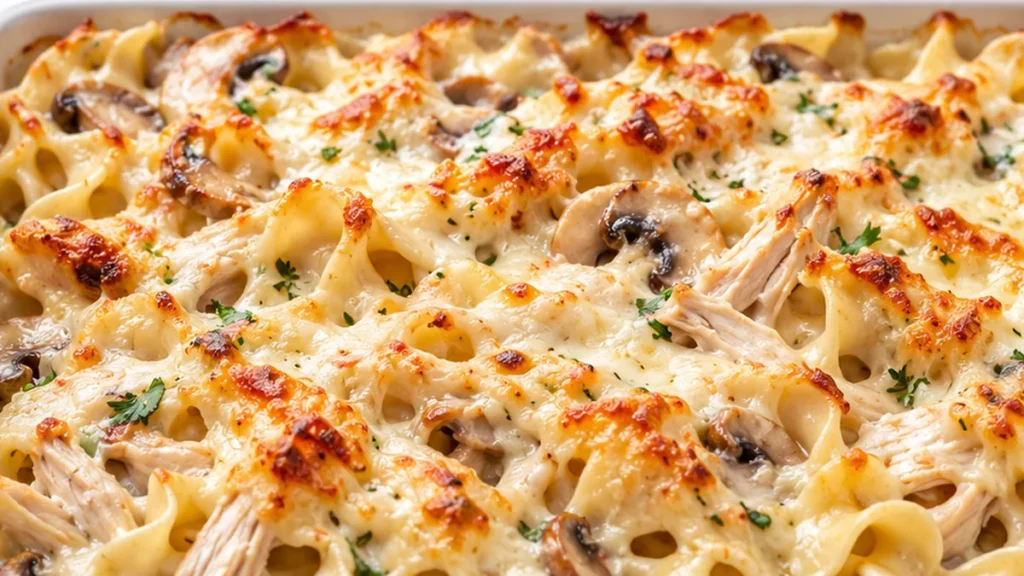
Chicken tetrazzini depends on building the cream sauce slowly; rush the liquid into the flour and you risk lumps instead of a smooth coating for the noodles. This version pairs rotisserie chicken, sautéed mushrooms and Parmesan with dry white wine. The first time I made chicken tetrazzini, I noticed how quickly the sauce loosened when broth was added too fast, so I now whisk each addition smooth before pouring more. That controlled sauce is what keeps every layer creamy after baking.
Key takeaways
- Cook the mushrooms until the pan is dry and the edges brown before they touch the sauce, or their water thins the velouté during baking.
- Build the sauce looser than looks right; it tightens as it bakes and as the egg noodles keep absorbing liquid.
- Fold the already-cooked rotisserie chicken in gently and bake only until the center hits 165F, since overbaking dries the shred.
- Keep the Parmesan on top rather than stirred through, so it browns into the signature bubbling gratin crust.

Chicken Tetrazzini That Bubbles Under Parmesan
Ingredients
- one 3-pound rotisserie chicken, meat pulled and shredded
- 1 pound cooked egg noodles (I like the Alberto’s brand)
- 1 pound sliced mushrooms, sautéed
- 3-4 cups tetrazzini sauce (see below)
- 1/4 cup Parmesan cheese
- 1/4 cup melted butter
- 1/3 cup flour
- 2 cups milk or cream (I used 1 cup heavy whipping cream and 1 cup whole milk, but I think half and half would also work)
- 1 1/2 cups chicken broth (more as needed)
- 1 1/2 teaspoons salt (to taste)
- 1/4 cup dry white wine
Instructions
- Prep.
- Heat the oven to 350 degrees. Get everything ready by pulling the chicken meat, cooking the noodles, and sautéing the mushrooms.
- Sauce:
- Warm the melted butter in a small saucepan over medium heat. Whisk in the flour until fully blended, then cook it for a few minutes so the raw flour flavor disappears. Gradually pour in the milk and broth, adding only a little at once and whisking between additions, until the sauce becomes smooth and thick. Add the salt, then mix in the wine. Taste and adjust with additional salt, wine, or broth for a thinner consistency as needed.
- Assemble.
- Coat the noodles with about a cup of sauce. In a greased 9×13 pan, arrange the sauced noodles first, followed by mushrooms, half the sauce, chicken, the remaining sauce, and Parmesan.
- Bake:
- Bake for 30 minutes, until the casserole is melted and bubbling. Broil for 5 minutes so the surface turns brown. Finish with salt and pepper to taste when serving. YUM-O.
Notes
The velouté under the Parmesan: why 1/3 cup flour to 1/4 cup butter is deliberate
Most white-sauce roux run equal parts fat and flour by weight. This tetrazzini sauce leans flour-heavy on purpose: 1/3 cup flour against 1/4 cup melted butter gives you more thickening power per spoonful of fat, which matters because the sauce has to hold 3 to 4 cups of pulled chicken and a pound of mushrooms without turning soupy in the dish.
Cook the flour into the butter for a full 60 to 90 seconds before any liquid goes in. That cooks out the raw-flour taste and lets the starch granules start swelling. Flour-based sauces begin to gelatinize and thicken around 60°C (140°F), and the process is essentially complete near 85°C (185°F) source. If your sauce never reaches a gentle simmer, it will look thin no matter how long you stir.
The 2 cups of dairy plus 1 1/2 cups broth is where the body comes from. A classic reference ratio is about 1 1/2 tablespoons each of flour and butter per cup of milk for a pourable sauce source; this recipe uses more liquid relative to flour precisely because you want it loose going into the oven, since it tightens as it bakes and as the noodles keep drinking it in.
Why the cream-and-milk split behaves differently from all-milk
The note that 1 cup heavy cream plus 1 cup whole milk works, and that half-and-half would too, is not interchangeable with all-milk. Cream’s higher fat coats the starch and resists curdling when the sauce sits hot under broth and Parmesan. All skim or 2% milk will still thicken, but it breaks more easily if the dish is held hot or reheated hard, which is why the fattier split is the safer call for a casserole that bakes and often gets reheated.
Getting the mushrooms dry before they ever touch the sauce
Mushrooms are roughly 90 percent water by weight source. A raw pound dumped into the casserole would weep that water straight into your velouté and thin it back out, which is the single most common reason a tetrazzini turns watery. Sautéing them first drives that moisture off: expect a pound of sliced mushrooms to cook down to well under half its raw volume as the water releases, steams off, and the slices finally start to brown.
Keep the pan hot and avoid crowding. Mushrooms release their water around the boiling point, and only once that water has evaporated does the surface climb hot enough to brown. Maillard browning, the chemistry that builds the savory, roasted flavor, proceeds in earnest from about 140 to 165°C (280 to 330°F) source, which a wet pan simply cannot reach. Cook them until the liquid is gone and the edges are gold, not until they are merely limp.
Where the dry white wine earns its place
Add the 1/4 cup dry white wine after the mushrooms have browned, scraping the fond off the pan. The wine lifts those browned bits into the sauce and adds acidity that cuts the richness of cream and Parmesan. If you are cooking for anyone avoiding alcohol, know that it does not fully cook off: a sauce with alcohol stirred into hot liquid retains around 85 percent of it, and even food baked 25 minutes without stirring keeps roughly 45 percent source. Swap in an extra splash of broth with a squeeze of lemon if that matters.
Keeping already-cooked rotisserie chicken from drying into strings
The chicken is the one component that is fully cooked before the dish is even assembled, and that changes how you treat it. Rotisserie meat has already lost moisture under the heat lamp; a long second bake can wring out the rest and leave you with dry shreds in a creamy sauce. Fold the shredded meat in off the heat and let the sauce carry it, rather than simmering it for extra minutes it does not need.
Food safety still applies to the finished, reheated casserole. Cooked poultry and casseroles should reach an internal temperature of 165°F (74°C) when reheated, measured with a thermometer at the center source. Bake just until the center hits that mark and the sauce bubbles at the edges; chasing a longer bake only trades moisture for a thicker crust you do not need. For a cold, fully assembled dish, a 350°F oven covered with foil until hot in the center is the standard approach.
Common failures and the actual cause behind each
- Watery sauce pooling at the bottom: mushrooms went in under-sautéed and released their water during baking. Cook them until the pan is dry and browned before they meet the sauce.
- Grainy or curdled sauce: dairy was pushed to a hard boil or the lower-fat milk broke under heat. Hold it at a simmer, not a rolling boil, and favor the cream split for a dish that gets reheated.
- Gummy, paste-like noodles: the sauce was already tight when it hit the pasta, so the noodles kept drinking liquid with none to spare. Build the sauce looser than looks right; it firms as it bakes.
- Raw flour taste: the roux was not cooked long enough before the liquid went in. Give it that full 60 to 90 seconds of bubbling first.
Smart swaps and what each one costs you
Every substitution in a dish this rich carries a trade-off worth knowing before you commit.
- Egg noodles for spaghetti or linguine: traditional tetrazzini uses long pasta. Egg noodles hold more sauce in their folds and feel more tender, but you lose the classic twirl and the dish eats more like a creamy bake than a pasta.
- Rotisserie chicken for raw cooked chicken breast: poaching your own gives you control over moisture and salt, but you lose the rendered, seasoned depth the rotisserie skin and drippings carry into the shred.
- All whole milk for the cream-and-milk split: lighter and less costly, but the sauce is thinner and more prone to breaking when reheated, so plan to serve it fresh.
- Added panko with the Parmesan topping: gives a crisper, more durable crust, since bread crumbs and Parmesan brown reliably around 175 to 200°C (350 to 400°F) in the oven source. The cost is that you move away from the pure bubbling-cheese top this recipe is built around.
The one thing that sets tetrazzini apart from every other chicken pasta bake
What makes this dish tetrazzini and not just chicken Alfredo with mushrooms is the sherry-or-wine-laced cream velouté finished with Parmesan and baked until the top blisters. It is a dish named for an opera singer and built as a gratin, not a saucy pasta: the Parmesan is not stirred through for flavor so much as laid on top to brown and bubble, forming the signature crust. That is why the 1/4 cup Parmesan goes on the surface and why you want the sauce loose underneath. The contrast between the browned, savory cheese cap and the soft, cream-bound noodles beneath it is the entire point, and no amount of extra cheese inside the mix recreates it.
Building it tonight to bake on Thursday: how tetrazzini behaves in the fridge and freezer
This is a dish that actually improves with a head start, because the veloute keeps hydrating the noodles while it sits. Assemble it fully, stop before the final bake, cover tightly, and refrigerate up to 48 hours. The catch is drainage: egg noodles keep drinking liquid overnight, and a sauce that looked perfect at assembly can read tight and pasty by morning. Build it one notch looser than you want it, around the thinner end of that 3-to-4-cup sauce range, and hold back a splash of the chicken broth to stir across the top before it goes in the oven.
Get it into the fridge within two hours of cooking, and keep that fridge at or below 4C (40F) to stay out of the bacterial danger zone of 4C to 60C (40F to 140F) (FSIS). Refrigerated, it holds 3 to 4 days. Reheat leftovers to 74C (165F) internal, the same target USDA sets for casseroles containing poultry (FoodSafety.gov).
Freezing is where people get burned. The cream-and-milk sauce can break and weep on thaw, and the noodles turn woolly because cooled starch recrystallizes, a process called retrogradation. Freeze it unbaked, cook the noodles a minute shy of done so they survive the second heating, and build with the full cream rather than leaning on the whole milk. Thaw overnight in the fridge before baking rather than going from freezer to oven, which gives you an icy center and a scorched top.
One wide dish beats one deep one: pan choice, doubling the batch, and what to pour it with
Tetrazzini lives or dies on surface area. A shallow, wide dish gives more browned Parmesan crust per serving and lets steam escape so the sauce reduces instead of staying soupy. This batch of a 3-pound chicken, a pound of noodles, and a pound of mushrooms fills a 23-by-33-cm (9-by-13-inch) dish almost to the rim; spreading it thin matters more than the exact footprint.
Material changes your timing. Metal heats fast and browns the Parmesan quickly, so watch it. Glass and ceramic take longer to come up but hold heat and keep bubbling after you pull them (Serious Eats), which is why a ceramic dish is forgiving for a table that eats slowly. If you double the recipe, do not pile it into one deep dish; the middle never bubbles before the top burns. Use two 9-by-13 dishes or stagger the bake.
The white wine in the sauce is doing real work here. Its acidity cuts the richness of cream plus Parmesan, and because the dish bakes only long enough to brown, a meaningful share of raw alcohol survives short heating: USDA data shows roughly 40 percent remains after 15 minutes (USDA via Food Network). Simmer the wine into the sauce for a few minutes before it hits the dish so it reads as brightness, not booze. For the glass: a crisp unoaked white, a dry sparkling, or a squeeze of lemon on a bitter leaf salad all mirror that same acidity on the plate.
Parmigiano Reggiano is low enough in moisture that it browns and crisps rather than melting into strings, which is exactly why it belongs on top rather than buried in the sauce.
Pro tips
- Whisk each addition of milk or broth completely smooth before adding more; this keeps the flour-thickened sauce uniform.
- I watch the broiler rather than walking away: Parmesan can move from browned to scorched quickly.
- For make-ahead chicken tetrazzini, slightly undercook the noodles, assemble without baking, and freeze as the source suggests.
- Reheated chicken casserole should reach 165°F (74°C) in the center.
Chicken tetrazzini works best when the sauce stays smooth and the Parmesan gets a browned finish. Serve it hot while the noodles are creamy and the top is crisp.
Frequently asked questions
Can I assemble chicken tetrazzini the night before and bake it later?
Yes. Build it, cool it, cover, and refrigerate up to a day. Bake from cold covered with foil at 350F until the center reaches 165F, then uncover briefly to brown the Parmesan. Loosen with a splash of broth before baking, since the noodles tighten the sauce overnight.
Why did my sauce turn out thin even after baking?
The usual culprit is under-sautéed mushrooms releasing their water in the oven, since mushrooms are about 90 percent water. The other cause is a sauce that never reached a simmer, so the flour starch never fully gelatinized, which needs roughly 85C. Brown the mushrooms dry first and simmer the sauce before assembling.
Do I have to use the white wine?
No, but it adds the acidity and depth that define tetrazzini. Replace the quarter cup with extra chicken broth plus a small squeeze of lemon for brightness. Note that wine does not fully cook off; stirred into hot sauce it keeps around 85 percent of its alcohol, so broth is the better call for children or anyone avoiding it.
Can I freeze the leftovers?
You can, though cream-based sauces can separate slightly on thawing. Freeze in a sealed container up to two months, thaw overnight in the fridge, and reheat covered until the center hits 165F. Stir in a little milk or broth as it warms to bring a broken sauce back together and loosen the noodles.
More from Baked Pasta Recipes →