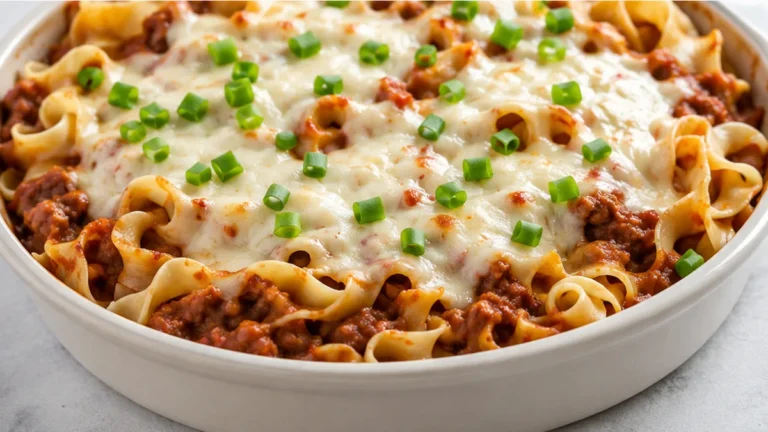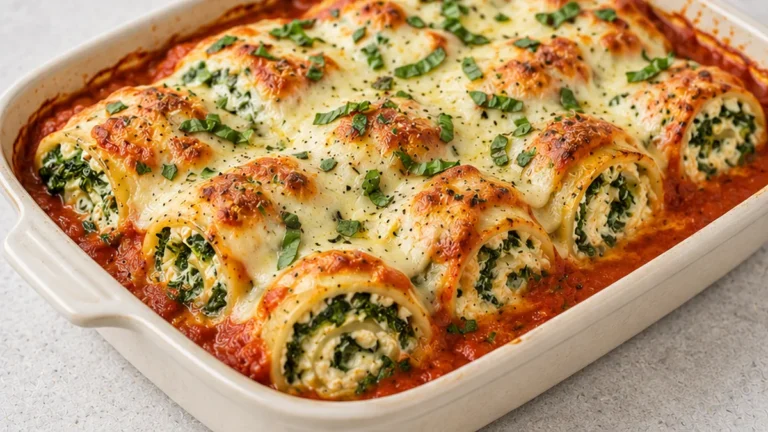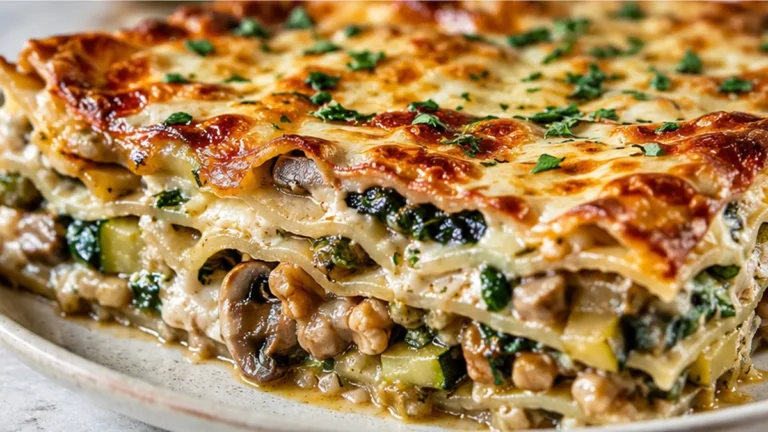

Creamy chicken lasagna holds together best when its sauce is smooth before the chicken ever reaches the pan. The flour-thickened milk base, cream cheese, Parmesan and Caesar dressing create enough body to coat the noodles without leaving the layers watery. This chicken lasagna pairs that creamy filling with greens, sun dried tomatoes and mozzarella. The first time I cut a creamy lasagna too soon, the layers slid apart; the specified 10-minute rest gives this one a cleaner slice and keeps more sauce between the noodles.
Key takeaways
- Build the roux with the full 3 tablespoons flour, cook it 60 to 90 seconds, then add milk in stages so the sauce stays thick enough to cling to the noodles.
- Fold cream cheese, Caesar dressing, and Parmesan in on low heat off the boil, or the egg-and-oil emulsion in the dressing will split and turn grainy.
- Squeeze the wilted spinach or kale hard and blot the oil-packed sun-dried tomatoes so hidden water and oil do not pool under the bottom layer.
- Use low-moisture shredded mozzarella, bring the assembled dish to 165 degrees F, and rest it 15 to 20 minutes before cutting for clean squares.

Creamy Chicken Caesar Lasagna You’ll Crave
Ingredients
- 2 tablespoons butter
- 3 tablespoons flour
- 1 1/2 cups milk
- 4 ounces light cream cheese
- 1/2 teaspoon salt
- ground black pepper to taste
- 1/2 cup Marzetti Simply Dressed Caesar Dressing
- 1/2 cup Parmesan cheese
- 9 lasagna noodles
- 3 cups cooked, shredded chicken
- 3 cups Mozzarella cheese
- 3 cups chopped spinach or kale
- 1/2 cup sun dried tomatoes packed in oil
Instructions
- Melt the butter over medium-high heat, then stir in the flour and cook for 2-3 minutes. Gradually pour in the milk while stirring until smooth and creamy. Whisk in the cream cheese, Parmesan, and Caesar dressing until the sauce is completely smooth. Taste and adjust as needed.
- Prepare the lasagna noodles following the package directions. Stir the chicken into the sauce and leave the mixture over medium-low heat.
- Grease a 9×13 pan and heat the oven to 375 degrees. Lay down 3 lasagna noodles, then add 1/2 the chicken mixture, 1 1/2 cups kale, 1/4 cup sundried tomatoes, and 1 cup mozzarella. Add 3 more noodles and repeat the layers. Finish with the final noodles and the remaining 1 cup cheese.
- Cover with greased foil and bake for 30 minutes. Take off the foil and continue baking for 5-10 minutes, until the cheese browns. Rest the lasagna for 10 minutes before slicing.
Notes
Why a Caesar-dressing bechamel is the whole point of this chicken lasagna
The sauce here is a hybrid: a classic bechamel built from 2 tablespoons butter and 3 tablespoons flour cooked into a roux, loosened with 1 1/2 cups milk, then enriched with light cream cheese and finished with Caesar dressing. That flour-to-milk ratio matters. Serious Eats pegs a pourable bechamel at roughly 1 1/2 tablespoons each of flour and butter per cup of milk; this recipe runs slightly leaner on butter and heavier on flour, which gives a thicker, cling-to-the-noodle sauce that will not run to the edges of the pan. Serious Eats notes that extra flour yields a stiffer result, which is exactly what you want in a layered bake.
Cook the raw roux for about 60 to 90 seconds before the milk goes in. That short cook drives off the floury taste without browning the butter, which would tint the white sauce and mute its dairy flavor. Add the milk in stages, whisking between each, so the starch granules hydrate evenly instead of seizing into lumps.
The order you add dairy decides whether the sauce breaks
Cream cheese and Caesar dressing are the two most heat-sensitive things in the pot, so they go in last and off a hard boil. Food52’s kitchen rescue guidance is blunt: high heat curdles dairy sauces, and you should never let a dairy-based sauce boil. Food52 recommends low and slow. Drop the heat to low, stir the 4 ounces of cream cheese in until smooth, then fold the 1/2 cup Caesar dressing and 1/2 cup Parmesan off direct heat. The emulsified egg and oil in bottled Caesar dressing will split and look greasy if you boil them, so warm them through rather than cooking them.
How to stop this chicken lasagna from turning watery under the noodles
Three ingredients in this build carry hidden water, and all three can pool at the bottom of the pan. Spinach is roughly 90 percent water and dumps most of it when heated. The Kitchn is direct about it: fresh spinach releases a lot of water as it cooks and leaves a soggy lasagna unless you drive that moisture off first. The Kitchn suggests sauteing until the water has cooked away. Wilt your 3 cups of chopped spinach or kale, then press it hard in a sieve or twist it in a clean towel before it touches the sauce.
The noodles are the second lever. If you use standard boiled lasagna noodles, drain them well so sheet-clinging water does not dilute the sauce. If you reach for oven-ready sheets instead, note that they absorb up to 50 percent more liquid than regular noodles, so the sauce needs to stay loose enough to hydrate them. Always Room for Ice Cream documents that absorption gap. With this thicker bechamel, boiled-then-drained noodles are the safer default.
Watery bottom layer: caused by spinach or kale going in wet. Fix it by squeezing the greens until no more liquid drips, which can be several tablespoons from 3 cups.
Greasy pools on top: caused by sun-dried tomatoes carrying packing oil. Lift the 1/2 cup from the jar with a fork and blot, rather than spooning oil in with them.
Grainy, split sauce: caused by boiling after the cream cheese and Caesar dressing went in. Pull the pan off heat, add a splash of cold milk, and whisk hard to bring it back.
Sauce too thick to spread: caused by the roux over-reducing. Thin with warm milk a tablespoon at a time until it coats a spoon but still drops off.
What each swap in this Caesar chicken lasagna actually costs you
The ingredient list is specific for a reason, but a few substitutions work if you know the trade-off going in.
Marzetti Simply Dressed Caesar for a shelf-stable Caesar: you keep the garlic-anchovy backbone, but most shelf-stable dressings carry more sugar and stabilizers, so the sauce reads sweeter and less sharp. Taste and add a squeeze of lemon to compensate.
Low-moisture mozzarella for fresh mozzarella: the recipe’s 3 cups of shredded mozzarella melt into even sheets. Fresh mozzarella tastes excellent and melts well, but a chef cited by Tasting Table warns it releases more water in a bake and low-moisture is better for layering. Tasting Table. Swap in fresh only if you slice it thin and pat it dry.
Kale for spinach: kale holds its bite and adds chew, but it needs a longer wilt and a firmer squeeze because its sturdier leaves trap water in the ribs. Strip the stems first.
Grana Padano or pre-grated Parmesan for the 1/2 cup Parmesan: real Parmigiano-Reggiano brings the salty, nutty crystalline bite described by The Kitchn. Pre-grated tubs contain anti-caking agents that can leave the sauce slightly chalky, so grate your own if you can.
Why the shredded chicken belongs cooked and cool, not raw
This recipe calls for 3 cups of already cooked, shredded chicken, which is unusual for a lasagna that often starts with raw ground meat. Because the chicken is pre-cooked, the bake is really about melting cheese and hydrating noodles, not cooking protein. Still, the finished casserole should reach a safe internal temperature. The USDA sets 165 degrees F (74 degrees C) as the safe minimum for poultry and for casseroles. FoodSafety.gov. Rotisserie or poached breast both shred cleanly; let the meat cool before layering so it does not thin the sauce with residual steam.
The Caesar-dressing move that sets this lasagna apart from every other white chicken lasagna
Plenty of recipes layer a bechamel over chicken. Almost none fold a finished Caesar dressing into that sauce. The dressing does two jobs at once that a plain white sauce cannot: it seasons the bechamel with garlic and anchovy umami without a separate aromatics step, and because it is already an oil-and-egg emulsion, it adds body and a faint tang that cuts the richness of 3 cups of mozzarella. That is why this reads as a Caesar salad in lasagna form rather than a generic creamy chicken bake.
The 1/2 cup of oil-packed sun-dried tomatoes is the counterweight. Drying concentrates tomato flavor into an intense, slightly sweet-savory note, and the oil pack keeps them soft enough to layer without rehydrating. Olio Carli. Scattered thin through the layers, they punctuate the creamy sauce with acidity so no bite tastes flat. Let the finished lasagna rest 15 to 20 minutes before cutting; the thick bechamel firms as it cools, and resting is the difference between clean squares and a slumping slice.
Assembling this caesar chicken lasagna a day ahead without the noodles turning to paste
This dish is built for make-ahead, but the cream cheese bechamel and the no-boil noodles behave differently overnight than a classic ricotta-and-marinara build. The noodles keep drawing moisture from the sauce in the fridge, so a pan assembled Monday and baked Tuesday will have softer, more fully hydrated noodles and a slightly thicker sauce. That is an advantage here, not a flaw, as long as you account for it.
Assemble the full pan, cover it tightly against the surface with plastic, then foil, and refrigerate up to 24 hours before baking. Add a thin extra skim of the caesar bechamel across the top layer before you cover it; the top noodle is the one most likely to dry and curl, and that buffer keeps it supple. Because the dish starts fridge-cold rather than room temperature, bake it covered longer and pull the foil only for the final browning.
The non-negotiable number is doneness: the center must reach 165°F (74°C) on an instant-read thermometer, the USDA threshold for anything containing poultry, even though the chicken here went in already cooked (USDA FSIS). A chilled pan can read hot at the edges while the middle is still 120°F, so probe the geometric center. Let the baked lasagna rest 15 minutes before cutting so the cream cheese sauce sets enough to hold a clean square instead of flooding the plate.
Scaling the pan, swapping the dish, and why your oven’s hot spots matter here
The nine-noodle, three-cup-chicken build is sized for a standard 9×13-inch (23×33 cm) pan at three layers. Doubling it is not simply twice the ingredients: a deeper bake traps steam, and this sauce is already dairy-rich, so a tall four-layer stack reheats its own middle slowly and raises your watery-center risk. If you need more servings, run two 9×13 pans rather than one deep one, and stagger them on separate oven racks with space for air to move.
Glass and ceramic dishes hold heat and keep browning the edges after you pull the pan, which suits the caesar bechamel’s tendency to tighten as it cools. Thin metal pans heat faster and can scorch the exposed top noodle before the center hits temperature, so if metal is all you have, keep it foil-covered longer and check the center early. Convection ovens pull surface moisture fast and brown the parmesan top aggressively; drop the temperature guidance by about 25°F (15°C) and watch the last ten minutes.
Ingredient quality moves the dial more than quantity. Oil-packed sun-dried tomatoes carry a little of their oil into the layers, enriching the sauce; patting them lightly keeps the dish from going greasy while still contributing flavor and antioxidant lycopene, which is more concentrated in the dried fruit than in fresh tomato (NIH research). For the greens, mature winter kale brings more structure and a firmer bite than tender spring spinach, so chop it finer and expect it to hold its shape; delicate spinach collapses to almost nothing and should go in slightly more generously than it looks.
Pro tips
- Add the milk gradually to the butter-flour mixture; rushing it encourages small flour lumps.
- Keep the chicken mixture over medium-low heat once combined rather than aggressively boiling the dairy sauce.
- Rest the baked chicken lasagna for the full 10 minutes before cutting.
- Refrigerate leftovers promptly; reheat chicken-containing portions to 165°F in the center.
Serve the chicken lasagna after its full resting period for cleaner layers and a creamier interior. Save any leftovers for an easy reheated meal.
More from Baked Pasta Recipes →