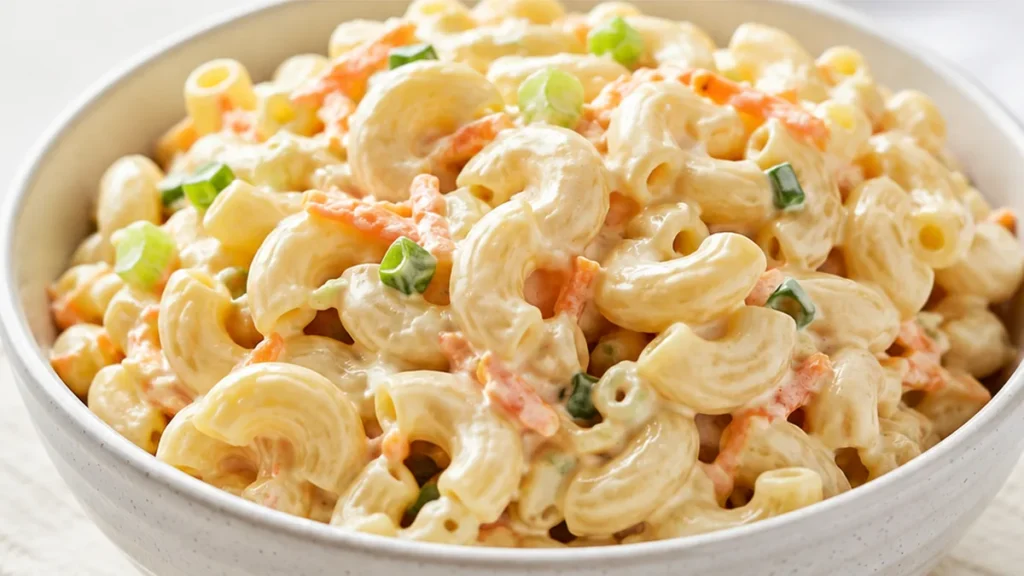
Hawaiian macaroni salad gets its authentic flavor from a perfect balance of creamy mayonnaise, tangy vinegar, and a hint of sweetness, all combined with crisp vegetables. It is a taste of aloha that graces every luau and backyard barbecue across the islands. Unlike heavier pasta dishes, this lighter version captures the essence of island comfort food, ensuring you can recreate that beloved taste of Hawaii at home.
Key takeaways
- Overcook the elbow macaroni 3 to 4 minutes past al dente so the soft noodles absorb the dressing.
- Toss vinegar and sugar onto the hot drained pasta, then add mayonnaise only after it cools so the emulsion stays creamy.
- Grate the onion to near-liquid rather than chopping it, which spreads its flavor evenly through the dressing.
- Expect the chilled salad to dry out, and reloosen it with extra mayonnaise or a splash of milk right before serving.
Taste of Paradise: Viral Hawaiian Macaroni Salad!
Ingredients
- 8 ounces elbow macaroni
- 1 ¼ cup mayonnaise
- ¼ cup whole milk
- ¼ cup grated yellow onion
- 1 tablespoon apple cider vinegar
- 1 teaspoon sugar
- 1 large shredded carrot
- ½ cup chopped celery
- ¼ cup chopped green onion
- salt and pepper (to taste)
Instructions
- Cook the macaroni according to the package directions, opting for slightly overcooked instead of al dente (it is better for pasta salad this way). Drain and rinse under cold water until cool.
- In a large bowl, whisk together mayonnaise, milk, grated onion, vinegar, and sugar.
- Gently stir in the macaroni, carrot, celery, and green onion until combined. Add salt and pepper to taste.
- Cover and refrigerate for 30 minutes. Stir and adjust seasoning before serving.
Video
Notes
The overcooked-noodle rule that separates island mac salad from mainland versions
Hawaiian macaroni salad depends on one counterintuitive move: boil the 8 ounces of elbow macaroni 3 to 4 minutes past the package’s al dente time, until the noodles look faintly bloated and give no resistance. Mainland macaroni salad wants firm pasta; the island version wants the opposite. A soft, swollen noodle has a looser, more porous starch matrix, so it drinks up the mayonnaise-milk dressing instead of shedding it. That absorption is the entire point. Chef Alana Kysar, author of Aloha Kitchen, and Maui chef Sheldon Simeon both build their recipes on this slack texture. Aim for roughly 11 to 13 minutes of boiling in well-salted water for standard elbows.
Salt the water hard, around 1 tablespoon per 4 quarts, because the noodle interior is the only stage where you can season the pasta itself. Once it cools it turns bland fast, and no amount of surface dressing fixes an under-salted core.
Why you toss vinegar onto hot pasta but hold the mayonnaise until it cools
Timing the 1 tablespoon of apple cider vinegar and the 1 1/4 cups of mayonnaise correctly is what gives this salad its tang without turning it greasy. Add the vinegar and the 1 teaspoon of sugar the instant the macaroni drains, while it is still steaming near 70 to 80 degrees C (160 to 175 degrees F). Hot, open starch soaks acid deep into the noodle, so the tang reads from the inside, not just the surface. Then let the pasta drop to room temperature or lower before the mayonnaise goes in. Mayonnaise is an oil-in-water emulsion held by egg yolk lecithin, and heat above roughly 50 degrees C (122 degrees F) thins and breaks it, leaving an oily slick instead of a creamy coat. Whisk the 1/4 cup whole milk into the mayonnaise first to loosen it to a pourable, cling-friendly consistency. This vinegar-hot, mayo-cold sequence is close to universal across authentic recipes and is the step most home cooks skip.
Grated onion, not chopped: the liquid that makes the dressing taste like Hawaii
The 1/4 cup of grated yellow onion is doing something a knife-diced onion cannot. Grating ruptures the cell walls and releases onion juice and its sulfur compounds directly into the dressing, so the flavor disperses evenly instead of arriving in sharp raw bites. On the Taste Cooking recipe, the instruction is to grate the onion until it is nearly liquefied; that near-puree is a signature of the plate-lunch style. The trade-off is shelf life. Grated onion oxidizes and turns harsh within a day or two, which is one reason island cooks say the salad is best eaten the day it is made. Keep the 1 large shredded carrot and 1/2 cup chopped celery in slightly larger pieces than the noodle for contrast, and reserve the 1/4 cup chopped green onion so its color and bite stay fresh.
Common failures and the fix for each
Dressing pooling at the bottom, noodles dry: the pasta was too firm to absorb, or the mayonnaise went on while the pasta was warm and broke. Overcook the elbows fully next time and cool them before dressing.
Salad tastes flat despite plenty of mayonnaise: you skipped the hot-vinegar step or under-salted the boiling water. Season the water and hit the drained pasta with the acid immediately.
Sharp raw-onion punch: the onion was chopped, not grated. Grate it to a pulp so the juice blends into the dressing.
Salad dried out and stiff after a night in the fridge: chilled pasta keeps absorbing dressing. Fold in a few extra spoonfuls of mayonnaise or a splash of milk to loosen it back to a creamy coat right before serving.
Swaps that still read as island-style, and what each one costs you
Every family in Hawaii runs its own version, so substitutions are fair game as long as you know the payoff and the price of each.
Best Foods or Hellmann’s for a generic mayonnaise: these two are the standard island choice for their tangy, full-fat body. A lighter or off-brand mayo tastes thinner and less rich, and low-fat versions weep water as the salad sits.
Whole milk swapped for evaporated milk: a small amount of evaporated milk pushes the dressing slightly sweeter and richer, closer to some diner styles. The cost is a heavier mouthfeel that can mute the vinegar.
Grated onion swapped for onion powder in a pinch: you keep the flavor and gain shelf life, but you lose the moisture that thins and carries the dressing, so add an extra splash of milk.
Celery left out for peas or grated cucumber: peas add island-diner sweetness and cucumber adds crunch, but cucumber sheds water and can loosen the dressing, so salt and drain it first.
The one thing true of this salad and almost no other pasta dish
Most pasta cooks spend their careers avoiding mushy noodles; this is the rare dish where mushy is the goal and firm is the mistake. That single inversion, plus the day-of freshness driven by grated onion, is why Hawaiian macaroni salad behaves unlike Italian pasta salads. It is engineered as a sidekick, not a star, meant to neutralize the salty, sweet, sauce-heavy proteins of a plate lunch: teriyaki beef, chicken katsu, shoyu chicken, kalua pork. Zippy’s, Hawaii’s beloved diner chain, moves about 46,000 pounds of the stuff every month, which tells you how load-bearing this humble scoop really is. For deeper context on how the dish evolved from plantation-era pantries, the reporting at Taste Cooking’s history of Hawaiian mac salad is worth reading, and the food-science of why overcooking helps absorption is covered well by Serious Eats.
Why Hawaiian mac salad keeps absorbing dressing overnight and how to plan for it
This salad drinks its dressing. Elbow macaroni cooked past the al dente stage keeps soaking up mayonnaise, milk, and vinegar for 12 to 24 hours after mixing, which is exactly why plate-lunch counters dress it in two stages and refrigerate it overnight before serving. Mix a first coat when the pasta is warm, chill the salad, then loosen it with a few extra spoonfuls of mayonnaise and a splash of whole milk right before it hits the table. Store it in an airtight container at or below 4 degrees Celsius (40 degrees Fahrenheit); the United States Department of Agriculture caps mayonnaise-based salads at two hours in the danger zone of 4 to 60 degrees Celsius, so keep the bowl cold at picnics. Made this way, the salad holds three to four days. It does not freeze: thawing splits the emulsion and turns the elbows to mush. If you notice the salad looking dry and matte on day two, that is the starch pulling moisture inward, not a spoilage sign. A tablespoon of milk stirred in per two cups of salad restores the glossy, spoon-coating texture. Keep the grated onion and green onion volume modest if you plan to hold it several days, because raw allium sharpens as it sits and can overtake the sugar and apple cider vinegar balance by day three.
Scaling from a side dish to a plate-lunch crowd without breaking the ratio
The workhorse ratio here is roughly 8 ounces of dry macaroni to 1 and one-quarter cups mayonnaise, and it holds when you multiply. For a party of 12 to 16, quadruple everything to 2 pounds of elbow macaroni and 5 cups mayonnaise; that yields close to 3 quarts, or about sixteen half-cup servings. Two things break at scale. First, boil in batches or in a genuinely large pot: 2 pounds of pasta needs at least 6 quarts of water to stay at a rolling boil, or the elbows clump and cook unevenly. Second, grate the onion and carrot on a box grater rather than a food processor even at volume, because the processor pulps the onion into bitter juice and shreds the carrot too fine to hold its snap against the celery. Season the dressing before folding, then correct salt after the salad has chilled, since cold blunts perceived saltiness by a noticeable margin. Fold in thirds off the heat so the mayonnaise coats without smearing the elbows. For a full spread, this pairs with the classic two-scoop plate: pair it with our huli huli chicken thighs recipe and a scoop of short-grain white rice, which is how it is served across Oahu. Bring it to the table just below fridge temperature; ice-cold mutes the vinegar tang that defines the dish.
Pro tips
- Cook macaroni slightly past al dente and rinse well with cold water. This prevents it from becoming mushy and absorbing all the dressing.
- Grate the onion finely or use a microplane to distribute its flavor evenly without large chunks.
- Let the salad chill for at least 30 minutes. This allows the flavors to meld beautifully.
This Hawaiian Macaroni Salad is a crowd-pleaser that brings a taste of paradise to any table. Enjoy this delightful recipe!
More from Baked Pasta Recipes →