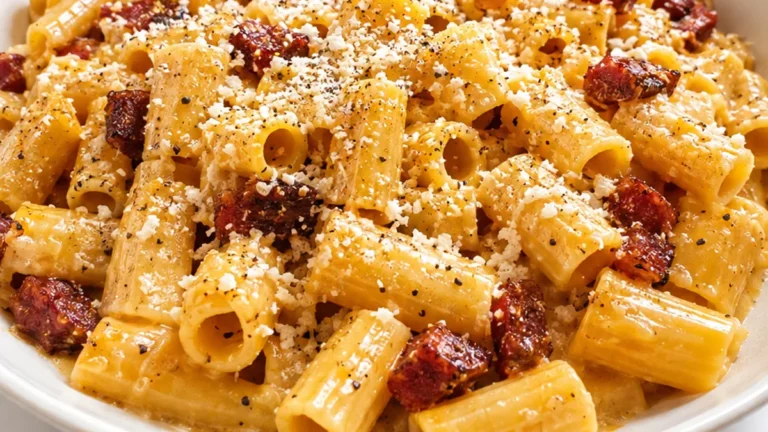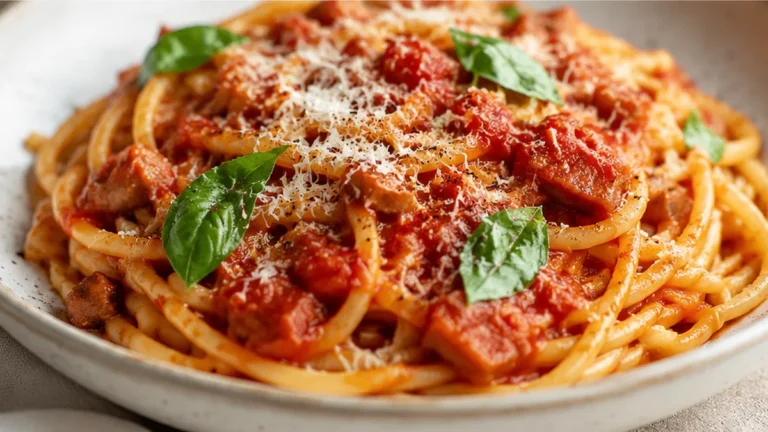
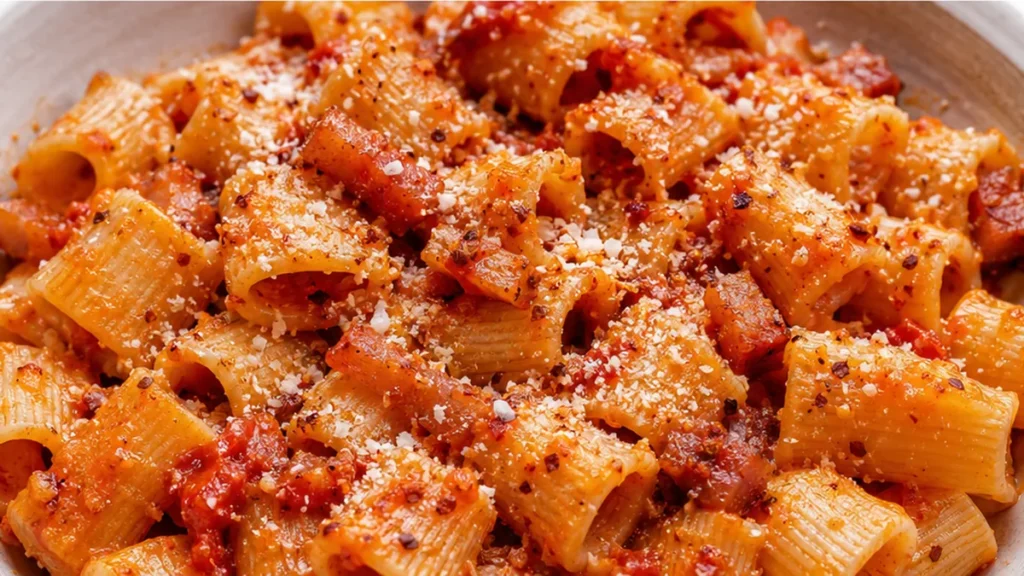
Pasta amatriciana relies on the rendered fat of cured pork cheek to flavor a simple tomato base. You will cook the guanciale until crisp, then use the residual fat to simmer the tomatoes.

Time: 20 min
👥 Servings: 4
📊 Level: Medium
🥗 8 ingredients

Key takeaways

  • Render 4 1/2 ounces guanciale from a cold pan over medium heat for 5 to 6 minutes so the fat escapes slowly and the pork stays tender.
  • Drain the San Marzano tomatoes and simmer only 10 to 15 minutes to keep the sauce bright against the fatty pork.
  • Stir the 3 1/2 ounces of finely grated Pecorino Romano in off the heat with starchy pasta water to prevent clumping above roughly 160 degrees Fahrenheit.
  • Reduce the white wine to almost nothing and reserve a quarter of the crisped guanciale to finish on top.
The ONLY Pasta Amatriciana You'll Ever Need! Master authentic Pasta all'Amatriciana with this easy recipe. Features crispy guanciale, San Marzano tomatoes, and

The ONLY Pasta Amatriciana You’ll Ever Need!

Master authentic Pasta all’Amatriciana with this easy recipe. Features crispy guanciale, San Marzano tomatoes, and Pecorino Romano for an unforgettable Italian classic.
Cook Time 20 minutes
Total Time 20 minutes
Cuisine American
Servings 4
Calories 550 kcal

Ingredients
  

  • 1 pound (~500 grams) uncooked pasta (mezzi rigatoni recommended)
  • 4 1/2 ounces (125 grams) guanciale, cut into ¼-inch-thick slices, then roughly ½ x 1-inch pieces
  • 1/4 cup (50 mL) dry white wine
  • 1 (28-ounce or 794 grams) can San Marzano whole tomatoes, drained
  • 1/4 teaspoon crushed red pepper flakes
  • 3 1/2 ounces (100 grams) Pecorino Romano cheese, finely grated
  • fine sea salt
  • freshly-ground black pepper

Instructions
 

  • Boil the pasta water. Fill a large stockpot about half full of water (roughly 3 quarts), add 2 tablespoons fine sea salt, and bring the water to a rapid boil.
  • Cut the guanciale. Slice the guanciale into ¼-inch-thick slices. Then cut each slice into roughly ½ x 1-inch pieces. (Tip: Freeze guanciale for 10 mins to make cutting easier).
  • Cook the guanciale. Heat a large sauté pan over medium-low heat. Add guanciale and cook, stirring, until golden brown and crispy, about 10 mins. Transfer guanciale to a plate. Save ¼ cup of the rendered fat; discard the rest.
  • Start the sauce. Add white wine to the saucepan, scraping up browned bits. Roughly crush drained tomatoes, add to pan with red pepper flakes, cooked guanciale, and reserved fat. Simmer gently while pasta cooks, adding pasta water if dry.
  • Cook the pasta. Add pasta to boiling water. Cook until about 2 minutes shy of al dente (still has a slight crunch).
  • Emulsify. Transfer pasta directly to the sauce using a spider strainer or tongs. Save remaining pasta water. Toss pasta continuously in sauce for 2-3 mins, adding pasta water as needed to create a glossy, emulsified sauce.
  • Finish & serve. Turn off heat. Gradually add grated Pecorino Romano, tossing until melted and sauce is glossy. Add more pasta water if needed to reach desired consistency. Serve immediately, garnished with extra cheese and black pepper.

Video

Notes

– Freezing the guanciale briefly makes it much easier to slice evenly.
– Cook the guanciale over medium-low heat to render the fat slowly and achieve maximum crispiness without burning.
– Don’t discard all the guanciale fat! A portion is essential for the sauce’s richness and flavor.
– Use San Marzano tomatoes for their superior sweetness and lower acidity.
– Reserve plenty of starchy pasta water; it’s crucial for emulsifying the sauce and achieving a silky texture.
Nutrition information is an estimate, calculated automatically. Values vary with brands, substitutions and portion sizes.
Keyword pasta amatriciana
Guanciale is the whole point, and why pancetta is a downgrade here Pasta amatriciana lives or dies on guanciale, the cured jowl of the pig, because that single cut carries almost all of the dish’s fat and its warm, peppery cure. Guanciale runs far fattier than pancetta (cured belly) or bacon, and that fat is not incidental: rendered slowly, the roughly 4 1/2 ounces (125 grams) called for here yields several tablespoons of liquid gold that becomes the base of the sauce. Daniel Gritzer of Serious Eats notes that in a tomato sauce the leaner muscle in pancetta firms up and turns chewy when cut into chunks, while fatty guanciale stays tender. Swap in pancetta and you lose body and the cure’s spice; swap in smoked bacon and you introduce a smoke note that is not traditional but is preferable to thin industrial pancetta. Cut the slab into 1/4-inch slices, trim the tough outer rind, then cut into the specified 1/2 by 1-inch pieces. Larger pieces stay juicy inside while crisping at the edges, and they give you something to bite through against the soft pasta. Cold pan, slow render: the fat base that never gets a hot skillet Start the guanciale in a cold, wide, unoiled pan and bring the heat up gradually, because a preheated skillet fries the exterior before the interior fat can escape. Over medium heat the 4 1/2 ounces (125 grams) of pork will render in roughly five to six minutes, releasing enough fat that no olive oil is needed. This method, favored by Coley Cooks and the Reluctant Gourmet, keeps the meat tender and maximizes the rendered fat that carries flavor into the tomato. Watch for lightly golden edges, not deep brown. One refinement borrowed from CJ Eats: once the guanciale is crisp, strain out the pieces onto paper towel, then decant the clean fat and wipe any dark scorched residue from the pan before returning the fat. That charred sediment turns bitter in a short-cooked sauce. Deglaze with the 1/4 cup (50 mL) of dry white wine, scraping the fond, and cook it down until nearly evaporated (about three minutes) so only its acidity and aroma remain, not raw alcohol. Why you drain the San Marzano tomatoes and simmer only 10 to 15 minutes Draining the 28-ounce (794 gram) can of San Marzano whole tomatoes removes watery packing liquid so the sauce reaches a clinging consistency in ten to fifteen minutes rather than thirty-plus. Amatriciana is a quick pan sauce, not a long-simmered ragu. The town of Amatrice’s own reference recipe and cooking authority Katie Parla both frame it as fast; Marcella Hazan and the Silver Spoon push the simmer to twenty or forty minutes, but Gritzer’s side-by-side testing found that longer cooking flattens the bright, sweet-tart fruit that is meant to contrast the fatty pork. Crush the drained tomatoes by hand, feeling for and discarding the tough pale stem ends that never soften. Add the crushed tomatoes to the rendered fat with the 1/4 teaspoon crushed red pepper flakes, season, and keep it at a lazy simmer while the pasta boils. The chile does the heavy lifting on heat here; a smaller hit of black pepper is an overtone, not the main event. Grating Pecorino Romano off the heat so it melts instead of seizing Add the 3 1/2 ounces (100 grams) of finely grated Pecorino Romano off the heat, because sheep’s-milk Pecorino is a hard, low-moisture, acid-set cheese whose proteins clench and turn grainy above roughly 160 to 175 degrees Fahrenheit (71 to 79 degrees Celsius). This is the same physics that wrecks cacio e pepe: CJ Eats keeps pasta water at about 150 degrees Fahrenheit (70 degrees Celsius) before it touches cheese precisely to dodge clumping. Pull the pan from direct flame, let it drop a few seconds, then stir the Pecorino in with a splash of reserved pasta water. Grate it yourself on a microplane. Pre-grated Pecorino is dusted with anti-caking starch that blocks a smooth emulsion. The starchy pasta water is the second half of the trick: its dissolved starch binds the rendered fat and tomato so the sauce turns glossy and coats each tube instead of splitting into an oily puddle. Mezzi rigatoni versus bucatini, plus the fixes for the usual failures Mezzi rigatoni is a smart choice for pasta amatriciana because its ridged tubes trap chunks of guanciale and hold sauce inside and out, and unlike bucatini it will not whip sauce across your shirt. Bucatini, the hollow spaghetti most associated with the Roman version, is traditional but famously unruly; regular spaghetti, penne, or full rigatoni all work. Whatever shape you use, boil it in well-salted water (about 1 tablespoon kosher salt per 5 quarts) and pull it a full minute shy of the package’s al dente time, then finish it in the sauce with a ladle of pasta water so it drinks in flavor as it cooks the last stretch. Common failures have specific causes and quick fixes: Grainy, clumped cheese: the pan was too hot when the Pecorino went in. Fix it by pulling off the heat first and loosening with a splash of warm (not boiling) pasta water while stirring hard. Oily sauce that won’t cling: not enough starch or too much rendered fat. Add starchy pasta water a little at a time and toss vigorously; if truly greasy, spoon off a bit of the excess guanciale fat before adding tomatoes. Flat, dull sauce: over-simmered tomatoes lost their brightness, or the wine wasn’t reduced. Keep the tomato stage to fifteen minutes and cook the wine down to almost nothing. Tough, jerky-like pork: the pan was preheated or the render ran too long and hot. Cold-pan start, medium heat, pull at golden. Sensible swaps and their trade-offs: pancetta for guanciale gives a leaner, cleaner pork note with less silky body; Parmigiano-Reggiano at 1:1 for Pecorino reads milder and sweeter, so add salt to compensate; a splash of the tomato liquid you drained can replace the wine if you avoid alcohol, at the cost of a little brightness. Reserve about a quarter of the crisped guanciale to scatter on top at the table, a texture contrast almost no other tomato pasta offers. Why amatriciana turns claggy the next day, and the pasta-water trick that revives it Pasta amatriciana suffers overnight because the emulsion of rendered guanciale fat, tomato, and Pecorino Romano breaks once it chills below roughly 4 degrees C (40 degrees F). The pork fat resolidifies, the cheese proteins tighten, and the mezzi rigatoni keep drinking sauce, so leftovers arrive dry and pasty. Store the plated dish in an airtight container for 3 to 4 days, then rescue it: add two or three splashes of water and reheat gently in a nonstick skillet over medium-low heat rather than blasting it in the microwave, which overcooks the tubes. The starch is the real lever here. If you saved even a quarter cup of the salted, cloudy cooking water from the original batch, it re-emulsifies the fat and Pecorino the way the finished pasta once behaved in the pan. Food writer Daniel Gritzer of Serious Eats notes that this starch binds and emulsifies the sauce; the same principle applies to reheating. Better still, freeze only the sauce, without pasta, for up to two months, then boil fresh mezzi rigatoni when you want it. Amatriciana, unlike a slow ragu, is built on the bright contrast between sweet-tart San Marzano tomato and fatty pork, and that contrast dulls with each reheat. Season lightly on day one, because the guanciale and cheese concentrate as moisture evaporates, and an already-salted dish turns aggressive overnight. Reheat once only. The habit that keeps leftovers usable Reserve extra pasta water in a jar the moment you drain, before you sauce anything. That reserved liquid is your single best reheating tool and costs nothing. Serving a Roman crowd: scaling guanciale, cheese, and pan width without greasing the plate Scaling pasta amatriciana past four people is where home cooks flood the plate with orange grease, because guanciale fat does not scale linearly with a wider pan. The recipe ratio, about 125 grams (4.5 ounces) guanciale and 100 grams (3.5 ounces) Pecorino Romano to 500 grams (1 pound) mezzi rigatoni, is calibrated for a single skillet. Double it and the rendered fat pools faster than a standard 30 centimeter (12 inch) pan can toss, so the emulsion slips instead of clinging. The fix is surface area: spread the guanciale across the widest pan or a low Dutch oven you own, and render at medium-low for 8 to 12 minutes so the fat leaves the meat gradually. Keep the proportions honest as you multiply. Chef Evan Funke of Felix Trattoria argues for a roughly 50/50 balance of fat to tomato sauce, and that balance is what makes the coating almost creamy rather than soupy. Rome-based food writer Katie Parla frames these dishes as studies in a few ingredients doing a lot, so resist adding onion or garlic to stretch a bigger batch; the people of Amatrice famously ridiculed a celebrity chef for admitting garlic. For eight or more diners, cook in two pans rather than one crowded vessel, or finish the pasta in batches and combine off heat. Add the Pecorino Romano only after pulling the pan from the burner, tossing hard with a ladle of reserved water, so the cheese melts into the sauce instead of seizing into rubbery clumps against direct heat. Pouring the right wine alongside A medium-bodied Montepulciano d’Abruzzo cuts the guanciale fat and tempers the tomato sweetness, a regional match since Amatrice was Abruzzese until 1927. Cesanese del Piglio, an old Lazio red, is the local alternative.

Pro tips

  • Freezing the guanciale briefly makes it much easier to slice evenly.
  • Cook the guanciale over medium-low heat to render the fat slowly and achieve maximum crispiness without burning.
  • Don’t discard all the guanciale fat! A portion is essential for the sauce’s richness and flavor.
  • Use San Marzano tomatoes for their superior sweetness and lower acidity.
  • Reserve plenty of starchy pasta water; it’s crucial for emulsifying the sauce and achieving a silky texture.

Experience the true taste of Rome with this authentic Pasta all’Amatriciana. Serve it hot and enjoy!