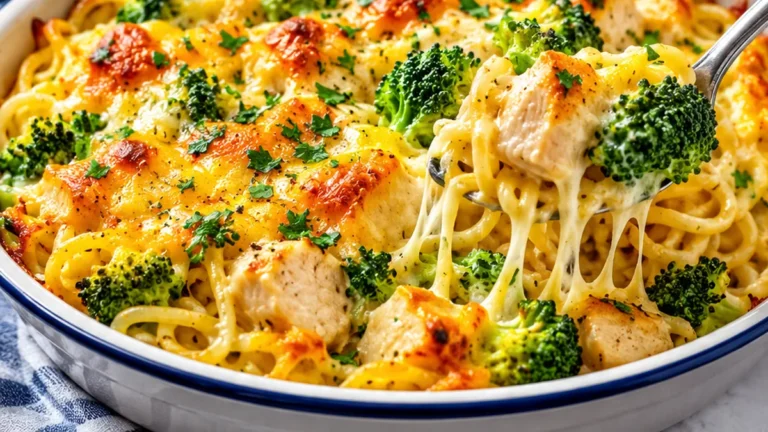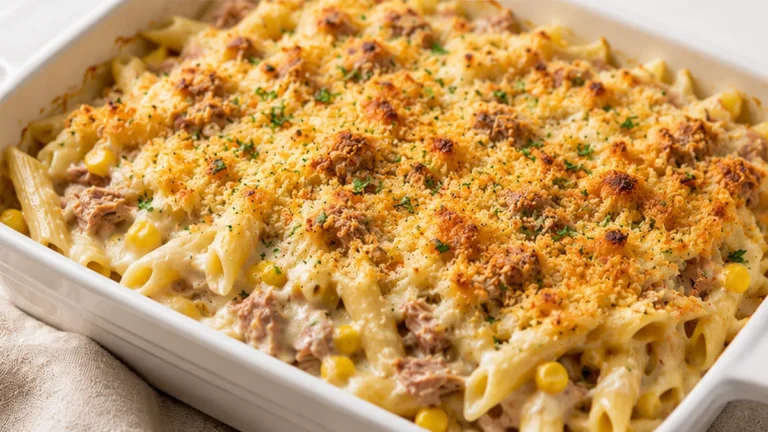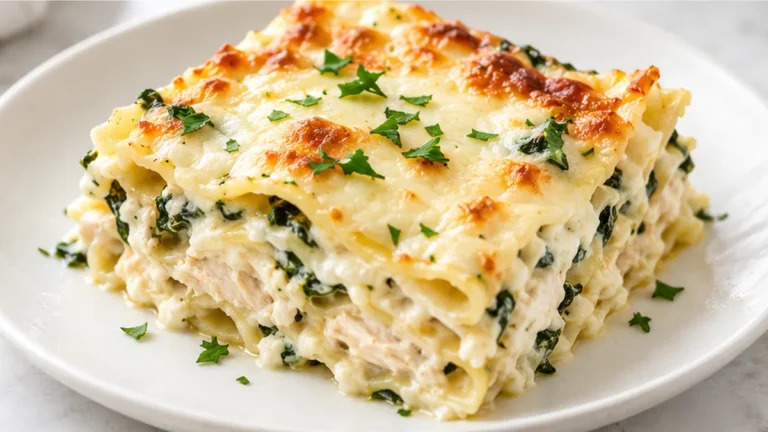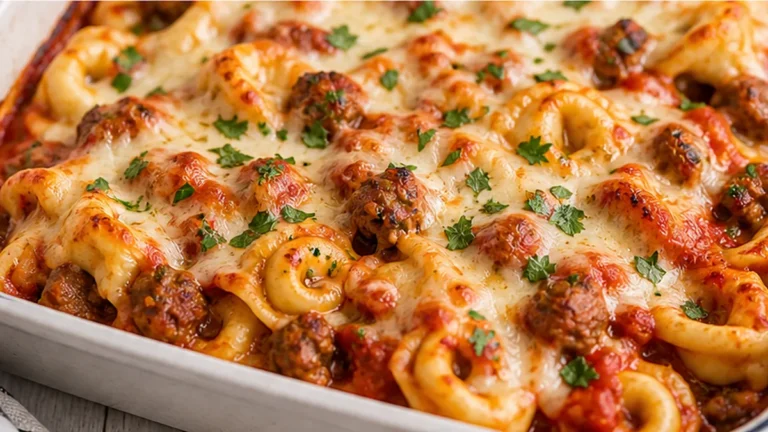
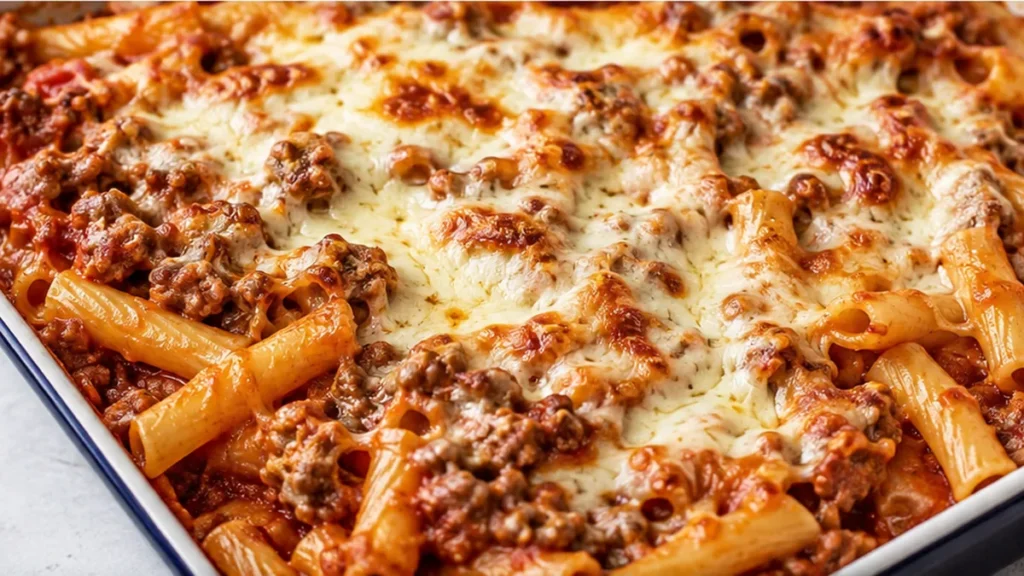
This 5-ingredient baked ziti is the ultimate weeknight dinner solution. It uses minimal ingredients and delivers maximum flavor, proving that delicious can also be incredibly simple. Perfect for busy families or anyone craving a cheesy, saucy, comforting meal without the fuss. Forget complicated recipes; this baked ziti focuses on quality ingredients that shine. It’s a testament to how a few key components can come together to create a truly satisfying dish that feels like a hug in a bowl.
Key takeaways
- Drain the pasta 2 to 3 minutes before package doneness so it finishes al dente in the oven instead of turning to mush
- Brown the sausage and beef in large clumps over medium-high heat, undisturbed, so the meat develops real Maillard flavor rather than steaming gray
- Split the mozzarella: most inside for gooey pockets, a thin layer on top over a spoonful of sauce so it browns without seizing into rubber
- Keep a little rendered fat and a splash of pasta water in the mix so the no-added-sugar Primal Kitchen marinara stays glossy and clings to every tube
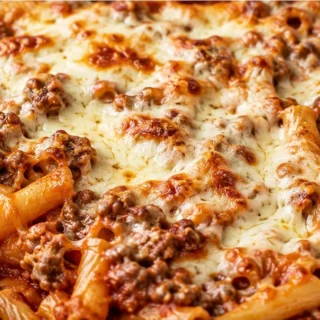
5-Ingredient Baked Ziti: MELTS IN YOUR MOUTH!
Ingredients
- 12 ounces pasta of choice (use gluten-free, if needed)
- ½ lb bulk mild Italian sausage + ½ lb. lean ground beef (or, may use 1 lb. ground meat of choice)
- 1 24-ounce jar Primal Kitchen marinara sauce
- 1 ½ cups shredded mozzarella cheese, divided
- 1 teaspoon dried Italian seasoning
- Optional for serving: Fresh basil and Parmesan cheese
- Optional for serving: Fresh basil and Parmesan cheese
Instructions
- Preheat oven to 350°F (175°C). Lightly grease a 9×13 inch baking dish.
- In a large skillet over medium-high heat, cook Italian sausage and ground beef until browned. Break up the meat with a spoon. Drain off excess grease.
- While meat cooks, boil salted water in a large pot. Add pasta and cook until al dente (slightly firm). Drain well.
- Add cooked meat, marinara sauce, 1 cup mozzarella, and Italian seasoning to the pasta. Stir gently to combine.
- Pour the mixture into the prepared baking dish. Sprinkle the remaining 1/2 cup mozzarella cheese evenly over the top.
- Cover with foil and bake for 15 minutes. Remove foil and bake for another 5-10 minutes, until bubbly and cheese is melted and golden.
Video
Notes
Why undercooking your pasta by 2 minutes is the difference between ziti and mush
Baked ziti fails most often at the pot, not the oven. Dried pasta absorbs roughly 80 percent of its own weight in water to reach al dente, and once it goes into a 375F (190C) oven surrounded by marinara, it keeps drinking. If you boil the 12 ounces of pasta to full package doneness first, the noodles finish soft in the pot and turn slabby and blown-out after baking. The fix is to drain 2 to 3 minutes early, while there is still a firm chalky core. As J. Kenji Lopez-Alt documents in The Food Lab, that residual starch structure survives a second cooking, so the ziti emerges tender but with a defined bite instead of dissolving into the sauce.
There is a second reason this matters. Pasta that is short on hydration will pull moisture straight out of the 24-ounce jar of Primal Kitchen marinara, and a dry casserole is the most common complaint home cooks report. Salt the boiling water hard, around 1 tablespoon per 4 quarts, because this is the only stage where the noodle itself gets seasoned from the inside.
How much water the noodles keep stealing in the oven
Reserve half a cup of starchy pasta water before you drain. If your sauce looks tight when you fold everything together, that liquid loosens it and the suspended starch helps the marinara cling to each tube rather than pooling at the bottom of the dish.
The mozzarella mistake that leaves a rubbery, oil-slicked cap on top
Low-moisture shredded mozzarella is the right cheese for this baked ziti, but it turns against you above roughly 220F (104C) at the surface. Mozzarella melts smoothly because it is young, high in moisture, and low in protein cross-linking, according to the Wisconsin Milk Marketing Board’s breakdown of melting science. Push it too hot for too long and the casein proteins tighten, squeezing out fat as visible orange grease and leaving a chewy skin. That is why the recipe divides the 1 1/2 cups of shredded mozzarella: most goes inside for gooey pockets, and a thinner layer crowns the top so it browns before it can seize.
To protect the cap, spoon a thin layer of marinara over the pasta before the final cheese goes on. The sauce acts as a thermal buffer, insulating the mozzarella from the direct radiant heat of the upper element. Bake covered first, then uncover only for the last stretch so the cheese sets and takes on color without overshooting into rubber.
Broiler browning without scorching
If you want the leopard-spotted top of a pizzeria bake, run the broiler for 60 to 90 seconds at the very end and do not walk away. The gap between golden and burnt at broiler distance is under 30 seconds.
Browning the sausage and beef properly instead of gray-steaming it
The half pound of bulk mild Italian sausage plus half pound of lean ground beef is where most of this dish’s savory depth is built, and it only develops if the meat actually browns. The Maillard reaction, the chemistry behind roasted, meaty flavor, begins in earnest above 300F (150C) at the meat’s surface, as Serious Eats and Modernist Cuisine both note. Crowd a pound of cold meat into a cool pan and it releases water, drops the surface temperature below the boiling point of that liquid, and simply steams to a dull gray.
Work in a wide skillet over medium-high heat, break the meat into large clumps rather than fine crumbles, and let each side sit undisturbed for 3 to 4 minutes before stirring. The mild Italian sausage brings fennel, garlic, and enough fat that you rarely need extra oil; the lean beef adds structure so the mixture is not greasy. Stir the 1 teaspoon of dried Italian seasoning into the hot fat for the last 30 seconds so the oil-soluble aromatics bloom instead of tasting dusty.
Draining, or not
Because you are using lean beef alongside sausage, you usually get a light slick of rendered fat, not a puddle. Leave a tablespoon or two in; it carries flavor into the marinara and keeps the finished ziti from tasting austere against a no-added-sugar sauce.
Five swaps that change the dish, and the trade-off each one brings
This recipe is deliberately short, so every ingredient carries weight and every substitution shifts the result in a predictable direction. Before you swap, know what you are gaining and giving up.
- Gluten-free pasta instead of wheat: works well, but corn and rice blends shed far more starch and go from firm to mushy fast. Drain 3 minutes early and do not rinse, because the surface starch is what grabs the sauce.
- One pound of a single ground meat: all beef is leaner and cleaner but flatter; all sausage is richer and more seasoned but can dominate. The half-and-half split is the balance point.
- A standard jarred marinara for the Primal Kitchen jar: most supermarket sauces contain added sugar, so the dish reads sweeter and less bright. Taste and add a pinch of salt or a splash of vinegar to compensate.
- Whole-milk mozzarella for part-skim: whole-milk melts creamier and stretchier; part-skim browns a touch faster and can turn leathery, so pull it sooner.
- Adding ricotta or an egg-enriched layer: pushes this toward a richer, lasagna-style bake, at the cost of the clean, meat-forward simplicity that makes the five-ingredient version fast.
Fresh basil and Parmesan cheese at the table are the two finishes worth keeping no matter what you swap. The detailed pasta hydration testing at Serious Eats is worth reading if you want to skip parboiling entirely with a soak method.
What makes this five-ingredient version different from a classic ricotta ziti
The thing that sets this baked ziti apart from nearly every restaurant version is the absence of ricotta and egg. Traditional Italian-American ziti binds the noodles into sliceable squares with a ricotta-egg custard; this one stays loose, saucy, and scoopable, which means it reheats without turning to paste. That single choice, combined with a no-added-sugar marinara, gives you a leaner, brighter, faster bake that leans on browned meat and stretchy mozzarella rather than a dairy custard for body.
For a comparison of tube shapes, the pasta-shape guide comparing ziti, penne, and rigatoni explains why ridged penne rigate grips this meaty sauce even better than smooth ziti. If you are cooking around a wheat allergy, our guide to cooking gluten-free pasta without it turning to mush covers the timing traps in detail, and you can pair this with our crusty homemade garlic bread that soaks up marinara for the full plate.
Assembling this ziti tonight to bake Friday: how it holds and reheats
Assemble this five-ingredient ziti up to two days ahead, cover it tightly, and refrigerate at 40F (4C) or below until you bake it. A cold casserole straight from the fridge needs an extra 10 to 15 minutes of oven time, so either add that or let the dish sit on the counter for 20 to 30 minutes to take the chill off first. Because there is no ricotta binding the layers, the sauce keeps the pasta moist rather than drying it into a paste, which is exactly why make-ahead works so well here.
Cooked pasta and meat are safe in the refrigerator for 3 to 4 days, per the USDA Food Safety and Inspection Service, and frozen leftovers stay safe for 3 to 4 months. Freeze it before baking for the best texture, since baked-then-frozen pasta softens as the starch re-firms and releases water on thawing. Reheat leftovers to an internal temperature of 165F (74C), checked with a thermometer, and cover the dish so the top does not scorch before the center is hot. A splash of marinara stirred in before reheating fixes any dryness that develops overnight.
Trade-offs worth knowing: reheated portions taste saltier and more concentrated as moisture cooks off, and the mozzarella cap firms up rather than staying stretchy. Reheat covered at 350F (175C) for 20 to 25 minutes from cold, or microwave single servings with the marinara refresh.
Doubling for a crowd, halving for two, and the pan that decides both
Scaling this ziti is direct because the ratios are simple: 12 ounces of pasta, 1 pound of meat, one 24-ounce jar of marinara, and 1.5 cups of mozzarella feed roughly six as written in a standard 2- to 3-quart baker. Double every ingredient for a 9×13-inch (23×33 cm) dish that serves 10 to 12, and expect 10 to 15 extra minutes of bake time because the deeper bed heats slower. Halve it cleanly for two to three people in an 8-inch square or a small oval gratin; the shallower depth means the cheese browns faster, so watch the last five minutes.
Equipment changes the result more than most cooks expect. Ceramic and stoneware hold heat and give you an evenly bubbling, gently browned top, while a thin metal pan runs hotter at the edges and can crisp the perimeter pasta before the center melts. A deep dish traps steam and keeps the interior saucy; a wide, shallow one drives off moisture and concentrates flavor. Match the pan to what you want.
For serving, this dish leans on the meat and marinara for backbone, so pair it with something acidic and green. A medium-bodied Italian red such as Chianti or a southern Sangiovese cuts the richness, and a lemony arugula salad plus garlic bread rounds the plate. Finish each portion with fresh basil and grated Parmesan cheese for brightness and salt the baked layers cannot provide on their own.
Pro tips
- Use gluten-free pasta to make this recipe gluten-free.
- For a slightly different flavor, try a spicy marinara sauce.
- If freezing one pan, let it cool completely before wrapping tightly and freezing.
- Bake frozen ziti for an additional 10-15 minutes, covered, before uncovering.
Enjoy this simple yet incredibly satisfying baked ziti. It’s a true weeknight dinner that delivers on flavor and ease. Serve with a smile!
Frequently asked questions
Do I have to boil the pasta first, or can I bake it raw?
You can bake it raw only if you soak it first in hot water for about 30 minutes, or it will pull all the moisture from the marinara and bake up dry. The simplest route for this recipe is boiling the 12 ounces of pasta 2 to 3 minutes short of package doneness, then draining and combining while still firm.
Why did my mozzarella turn rubbery and greasy on top?
Low-moisture mozzarella tightens and weeps fat when its surface climbs past roughly 220F (104C) for too long. Spread a thin layer of marinara under the top cheese as a heat buffer, bake covered first, and uncover only at the end. Pull it as soon as the cheese is golden rather than deeply browned.
Can I use only ground beef instead of the sausage and beef mix?
Yes, one pound of any ground meat works. All beef is leaner and milder, so the dish tastes flatter without the fennel and garlic from the Italian sausage. Compensate by browning the meat hard for flavor and stirring the full teaspoon of Italian seasoning into the hot fat so the aromatics bloom.
How do I keep this baked ziti from drying out as leftovers?
Because there is no ricotta or egg binding it, this version reheats better than most, but pasta keeps absorbing sauce in the fridge. Stir in a splash of water or extra marinara before reheating, cover with foil, and warm at 350F (175C) until hot through. A fresh sprinkle of mozzarella on top restores the melty texture.
More from Baked Pasta Recipes →