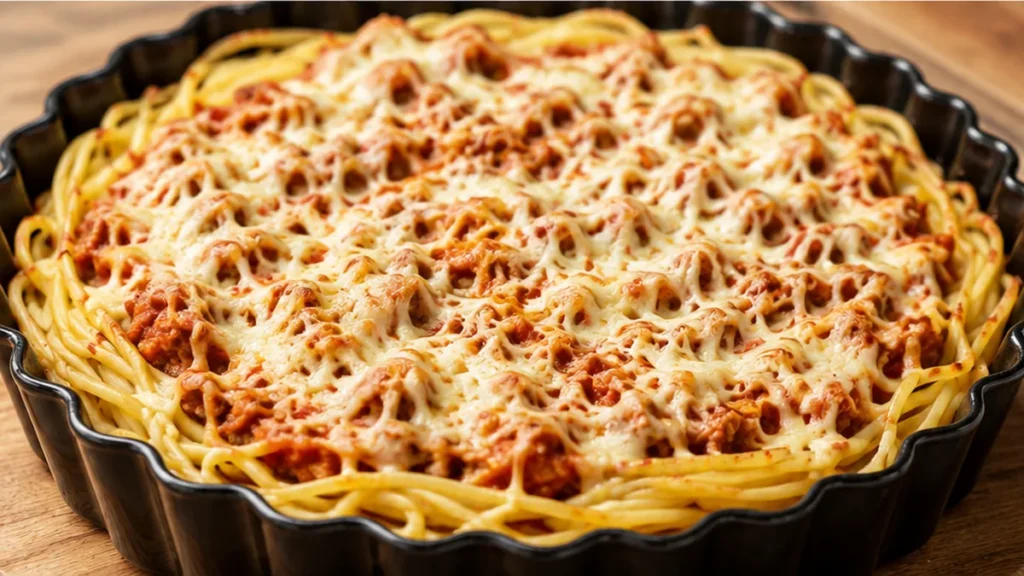
Spaghetti pie is the ultimate comfort food casserole, combining pasta, cheese, and a rich meat sauce into one delicious, crowd-pleasing dish. This recipe takes classic spaghetti and transforms it into a hearty pie that’s perfect for family dinners or potlucks. Its satisfying layers and savory flavors make it a guaranteed hit. This spaghetti pie is designed for ease and maximum flavor. The spaghetti forms a unique crust, holding together a creamy ricotta layer and a robust meat sauce, all topped with melted cheese. It’s a dish that proves pasta can be anything you want it to be.
Key takeaways
- Toss the beaten eggs and Parmesan into spaghetti that is warm but not scalding, then bake to a center temperature near 70 to 71 C so the egg fully coagulates and the crust holds as slices.
- Rest the finished pie 10 to 15 minutes before cutting; carryover heat keeps the custard soft, so slicing early makes it collapse.
- Control moisture at both sources: drain the browned meat and, if using cottage cheese, drain it in a sieve first so the base does not weep.
- Boil the spaghetti to firm al dente and grate cheese from a block, since overcooked noodles turn gummy and cellulose-coated bagged cheese melts poorly.
Ultimate Spaghetti Pie: Comfort Food Dream!
Ingredients
- 2 large eggs (lightly beaten)
- 4 teaspoons olive oil (mixed use)
- ½ cup Parmesan cheese (grated)
- 3 ½ cups cooked spaghetti (more or less)
- 1 ½ cups pasta sauce, marinara or meat sauce
- 1 medium onion (finely chopped)
- 2 cloves garlic (finely chopped)
- ½ pound ground beef, turkey or Italian sausage (without casing)
- 2 medium carrots (grated)
- 1 cup ricotta or cottage cheese
Instructions
- Preheat oven to 350℉ (175℃). Lightly grease a 9 or 10 inch pie plate.
- In a large bowl, combine beaten eggs, 2 teaspoons olive oil, Parmesan cheese, cooked spaghetti, and ½ cup of pasta sauce.
- Press this mixture into the prepared pie plate, forming a crust that goes up the sides.
- In a large skillet, heat the remaining 2 teaspoons olive oil over medium heat. Add chopped onion and cook until translucent (about 5 minutes). Add garlic and cook for 30 seconds until fragrant. Add ground beef, breaking it up. Cook until no longer pink.
- Stir in grated carrots and the remaining 1 cup of pasta sauce. Cook for a few more minutes, scraping the bottom of the pan.
- Spread the ricotta cheese evenly over the spaghetti crust. Pour the meat sauce mixture on top. Sprinkle with half of the mozzarella cheese.
- Cover with foil and bake for 20 minutes. Remove foil, add remaining mozzarella cheese, and bake uncovered until cheese is melted and bubbly, about 5 more minutes.
- Let the pie rest for about 10 minutes before slicing and serving.
Video
Notes
Spaghetti pie works because two eggs and a half cup of grated Parmesan turn loose noodles into a sliceable custard-bound crust, and getting that set right is the whole game. The eggs are not garnish here. They are the structural skeleton that holds 3.5 cups of cooked spaghetti in a wedge shape once the dish cools. Miss the temperature window where egg protein firms up and you get a tangle that collapses on the plate; hit it and you get clean, lasagna-like slices. Everything below is specific to this build: beaten eggs, olive oil, Parmesan, spaghetti, pasta sauce, aromatics, a half pound of ground meat, grated carrot, and a cup of ricotta or cottage cheese.
Quick answer: Toss the 3.5 cups of cooked spaghetti with the 2 beaten eggs and half cup of Parmesan while the pasta is warm but not scalding, press it firmly into an oiled pie dish, add the ricotta and meat-carrot sauce, and bake at 350 F (175 C) for about 30 minutes. The center should reach roughly 71 C (160 F) so the egg coagulates fully. Rest 10 to 15 minutes before cutting. That rest is what gives you wedges instead of a heap.
Why the egg-Parmesan crust sets into slices instead of a soggy tangle
The spaghetti crust holds together because whole egg coagulates and locks the noodles in place as it bakes. According to the American Egg Board, whole-egg proteins begin setting around 60 C (144 F) and firm up near 70 to 71 C (158 to 160 F), and the Institute of Food Science and Technology puts full coagulation at about 70 C. That is your target for the center of this pie. The half cup of grated Parmesan adds a second binder: as it melts it releases fat and casein that fill gaps between strands, so the crust behaves like a savory custard net rather than plain pasta.
Two moves protect that set. Toss the eggs into spaghetti that is warm, not steaming, since strands above roughly 71 C can scramble the egg on contact and leave you with curds instead of a smooth bind. And press the noodle layer down hard into the oiled dish so it bakes as one slab. Serious Eats and other test kitchens describe the same egg-set principle for frittata-style pasta cakes.
Draining the meat and choosing ricotta versus cottage cheese to control moisture
Excess water is the number-one reason a spaghetti pie weeps and slumps, and both the meat layer and the cheese layer are the usual sources. After browning the half pound of ground beef, turkey, or casing-free Italian sausage with the onion and garlic, drain the rendered fat and liquid before the 1.5 cups of pasta sauce go in. Turkey renders least, sausage most, and unabsorbed grease pools at the base of the crust and softens it.
The cheese choice matters just as much. Food and Wine notes ricotta is drier and pillowy while cottage cheese carries far more free whey. If you use the cup of cottage cheese, drain it in a fine sieve for 10 to 15 minutes first; skip that and its liquid seeps into the crust as the pie bakes. Ricotta needs no draining and gives a firmer layer. The grated carrot adds sweetness that tempers sauce acidity, but grate it fine so it softens fully in the 30-minute bake.
Four failures that wreck a spaghetti pie and the exact fix for each
Most spaghetti pie problems trace to one of four causes, each with a direct correction.
- Slices collapse into a pile: the pie was cut hot. Carryover heat keeps the egg custard soft for several minutes out of the oven. Rest a full 10 to 15 minutes so the proteins finish firming, exactly as Gonna Want Seconds and Tara’s Multicultural Table advise.
- Scrambled bits in the crust: the eggs met pasta that was too hot. Let drained spaghetti cool 2 to 3 minutes below scald before tossing in the beaten eggs and Parmesan.
- Watery, weeping base: undrained meat or wet cottage cheese. Pour off the grease after browning and drain cottage cheese in a sieve first.
- Gummy, mushy texture: overcooked noodles. Iowa PBS notes overcooked pasta absorbs too much water and its starch turns gelatinous, so boil the spaghetti to firm al dente since it keeps cooking during the bake.
Swapping the meat, the cheese, and the sauce without breaking the bind
Each substitution in this recipe changes moisture, fat, or flavor in a predictable way, so plan for the trade-off.
- Ground turkey for beef: leaner and lighter, but it renders little fat and can taste dry. Keep the 4 teaspoons of olive oil in play and lean on the full 1.5 cups of sauce for moisture.
- Italian sausage for beef: the biggest flavor upgrade thanks to built-in fennel and garlic seasoning, but it is fattier, so drain thoroughly or the crust softens.
- Cottage cheese for ricotta: lighter and higher in protein with a tangier note, but wetter; drain it and expect a looser layer. Reddit’s r/Cooking community and Food and Wine both flag cottage cheese as the higher-moisture curd.
- Jarred marinara for meat sauce: quicker, but thinner. Simmer it a few extra minutes to reduce, since a watery sauce undermines the set.
The one thing about spaghetti pie almost no other pasta bake shares
Spaghetti pie is one of the only baked pasta dishes where the noodles themselves are the crust, held by egg rather than a wheat pastry or a bottom layer of sheet pasta. In lasagna the flat sheets stack and the sauce binds; in baked ziti the tubes trap sauce internally. Here the long strands are woven into a slab by coagulated egg and melted Parmesan, so the pie stands as free-form wedges with no pan-shaped edge crust. That is why grating cheese from a block matters: pre-shredded bags are coated in cellulose anti-caking agents that, as The Cozy Cook and r/Cooking both point out, interfere with smooth melting and weaken the very bond doing the structural work. Freshly grated Parmesan and mozzarella melt cleanly and knit the crust tighter.
How a spaghetti pie behaves in the fridge and why day two slices cleaner than day one
Refrigerate a spaghetti pie and the egg-and-Parmesan bind keeps firming for the first 12 to 24 hours as the proteins fully finish setting and the pasta reabsorbs surface moisture from the ricotta and sauce. Cold slices hold their wedge shape better than a warm-from-the-oven pie, which is why cutting is easier the next day. Cool it fully in the pan first, roughly 45 to 60 minutes, then cover; slicing a hot pie tears the still-molten center. Store up to 4 days at or below 4C (40F). Reheat covered at 165C (325F) for 15 to 20 minutes rather than microwaving on high, which drives water out of the cottage or ricotta cheese and leaves a rubbery patch. For freezing, wrap individual slices; the 3.5 cups of cooked spaghetti survive a freeze far better inside this custard matrix than loose noodles do, because the set egg shields them from freezer-burn and ice-crystal mushiness. Thaw overnight before reheating for the most even result. One caution specific to this recipe: the grated carrot releases a little moisture as it sits, so a make-ahead pie can read slightly wetter at the rim than a fresh one. Blot the top with a paper towel before reheating and finish uncovered for the last 5 minutes to re-crisp the edge. Undercook the pie by 3 to 5 minutes if you know it is destined for reheating, since the second heating finishes the set without overcooking the eggs into a grainy scramble.
Scaling from a pie plate to a sheet pan without a soupy middle
Double this spaghetti pie into a 9×13 pan and the trap is depth: piling twice the volume into a deeper vessel means the center hits egg-setting temperature (roughly 71C/160F) long after the edges overcook. Spread a doubled batch across a rimmed sheet pan or two pie plates instead so the layer stays about 4 to 5 cm (1.5 to 2 inches) deep, and the 4 large eggs still knit everything in one even pass. Keep the ratios locked: for every 3.5 cups cooked spaghetti you want 2 eggs, half a cup Parmesan, and 1 cup ricotta or cottage cheese, because that is the bind-to-starch balance that lets it slice. Add 8 to 12 minutes to the bake for a doubled sheet-pan version and check the center with a knife tip; it should come out clean, not wet. The half pound of ground beef, turkey, or sausage should also scale by weight, not by eye, since underseasoned meat gets diluted fast at volume. King Arthur Baking and America’s Test Kitchen both stress even layer depth over vessel size for custard-set casseroles, and Serious Eats notes that egg-bound bakes set on a curve tied to thickness, not just oven time. For a crowd, two shallow pies beat one tall one every time. If you love a firm rim, brush the exposed pasta with the reserved olive oil before baking so the edge crisps while the interior stays tender.
Pro tips
- Use cooked spaghetti that isn’t too mushy; slightly al dente is best for the crust.
- Don’t skip resting the pie; it helps it set so it slices cleanly.
- For a meatless version, omit the ground meat and add extra vegetables like mushrooms or zucchini to the sauce.
- Ensure your ricotta is well-drained if it seems watery; this prevents a soggy crust.
This spaghetti pie is a testament to how simple ingredients can create an incredibly satisfying meal. Enjoy this comforting classic!
Frequently asked questions
Can I make spaghetti pie ahead and bake it later?
Yes. Assemble the whole pie, cover it, and refrigerate up to 24 hours or freeze up to 3 months. Thaw fully, then let it sit at room temperature about 30 minutes before baking so the egg-bound crust heats evenly. Add a few minutes to the bake time and confirm the center is hot throughout before resting and slicing.
Why did my spaghetti pie fall apart when I sliced it?
Almost always it was cut too soon. The egg custard binding the noodles stays soft straight out of the oven and keeps firming through carryover heat. Rest the pie a full 10 to 15 minutes so the proteins finish setting. Undrained meat grease or wet cottage cheese can also weaken the base, so drain both first.
Do I have to use ricotta, or will cottage cheese work?
Cottage cheese works and adds protein with a tangier flavor, but it holds much more liquid than ricotta. Drain the cup of cottage cheese in a fine sieve for 10 to 15 minutes before layering it in, or the extra whey will seep into the crust as it bakes. Ricotta is drier and gives a firmer, cleaner-slicing layer.
What kind of pasta sauce is best for this pie?
Either marinara or a meat sauce works, but thickness matters more than type. A thin, watery sauce undermines the egg set and makes the pie weep, so simmer jarred sauce a few extra minutes to reduce it before using the 1.5 cups called for. A robust meat sauce with the browned ground meat and grated carrot gives the richest, best-holding result.
More from Baked Pasta Recipes →