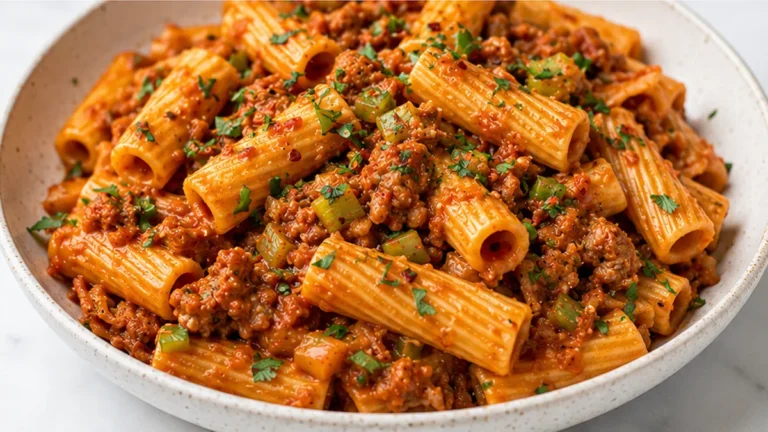
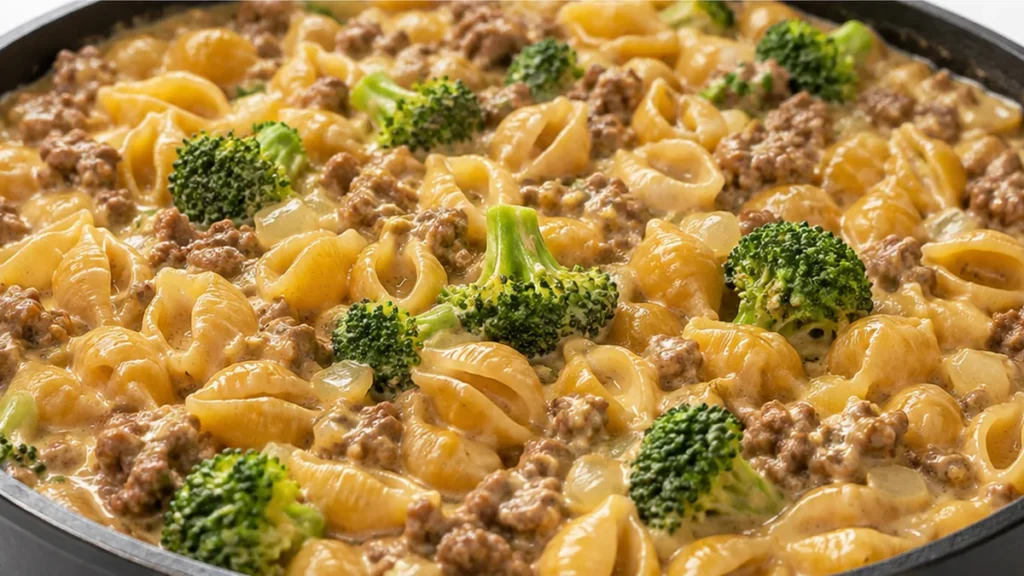
Making hamburger helper at home allows you to control the exact ingredients used. This specific formula produces a stable cheese sauce from scratch.
Key takeaways
- Boil chickpea shells for the full package time; unlike wheat pasta, undercooking leaves them stiff and grainy
- Brown the beef undisturbed until a crust forms and cook the tomato paste until it darkens, so Maillard and glutamate flavor build before any milk goes in
- Stir flour into the fat for 60 to 90 seconds, then add milk in stages and simmer near 90 C so the roux thickens fully without lumps or breaking
- Add broccoli only in the final 3 to 5 minutes for crisp-tender bite, and cook the ground beef to 160 F for safety
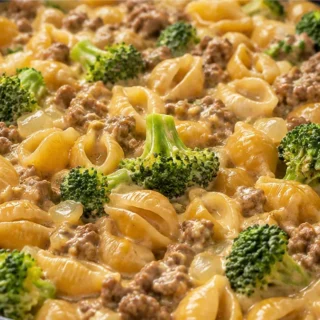
The BEST Homemade Hamburger Helper EVER!
Ingredients
- 1 lb lean ground beef
- 6 ounces dry chickpea shell or elbow pasta*
- 1 tablespoon olive or avocado oil
- 1 medium head broccoli florets, cut into small pieces (~ 2 ½ cups)
- 1 small yellow onion, finely diced (~ ⅔ cup)
- 3 garlic cloves, minced (~ 2 teaspoons)
- 2 tablespoons all-purpose flour
- 2 cups milk (whole milk or 2%)
- ⅓ cup half and half
- 1 tablespoon tomato paste
Instructions
- Cook the ground beef in a large skillet over medium-high heat for 7-8 minutes, breaking it into small pieces. Drain excess fat and set beef aside.
- Meanwhile, cook pasta in boiling water according to package directions. Drain and set aside.
- Wipe out the skillet, add oil, and cook broccoli, onion, and garlic over medium-high heat for 4-5 minutes until onions are translucent.
- Sprinkle flour over the vegetables and stir to coat evenly.
- Gradually whisk in milk, one cup at a time, until thickened (about 8 minutes). Stir in half-and-half, tomato paste, shredded cheese, and seasonings. Remove from heat.
- Fold the cooked pasta and ground beef into the cheese sauce mixture until well combined. Serve warm.
- Store leftovers in an airtight container in the fridge for up to 3 days.
Video
Notes
Why chickpea shells demand a full-length boil while wheat elbows beg for al dente
Chickpea pasta wants the full cooking time printed on its box, not a minute less, which is the opposite of how you treat wheat elbows. Undercooked chickpea shells stay stiff and grainy in the bite, a texture The Daily Meal describes as “extra stiffness” that never softens the way durum wheat does. Cook 6 ounces of chickpea shells to the top of the package range, usually 8 to 9 minutes, then let them finish in the sauce. Wheat elbows are the reverse: pull them at 6 to 7 minutes, one minute shy of tender, because they keep absorbing milk and swelling as the sauce simmers. Chickpea shells also hold their shape against a heavy cream-and-beef sauce better than rice noodles, which fall apart under the same weight.
The trade-off is starch. Legume flour sheds more surface starch into the water, so if you boil the shells directly in the sauce you get a gummy, gluey coat. Boil them separately in salted water, drain, and stir them in during the last two minutes. That keeps the sauce silky rather than pasty. Save a splash of that starchy water; a tablespoon or two loosens the sauce if it tightens on the plate.
The 2:1 flour-to-milk roux math that decides whether your sauce coats or breaks
The sauce lives or dies on a roux ratio of 2 tablespoons flour cooked into 2 cups milk plus a third-cup of half and half, which lands right on the classic pouring-sauce line. Serious Eats pegs a proper coating bechamel at roughly 1.5 to 2 tablespoons of flour per cup of liquid; this recipe sits at the pourable end so the sauce naps the pasta without turning to paste. Sprinkle the flour over the cooked onion, garlic, and beef fat and stir it for a full 60 to 90 seconds before any milk goes in. That cooks off the raw-flour taste and lets the starch granules coat in fat so they hydrate evenly instead of clumping.
Add the milk in stages, not all at once, whisking hard between pours. Cold milk hitting hot flour in one dump is the classic path to lumps. Bring it to a bare simmer around 88 to 94 degrees C (190 to 200 degrees F) and hold it there for 3 to 5 minutes; the starch in all-purpose flour swells and thickens fully only near the boil. The half and half goes in near the end. Adding it too early and boiling hard risks the dairy proteins tightening into a grainy break.
The failure-and-fix list that saves the pan
- Sauce turns gluey and thick as it sits: the flour was over-reduced or the pasta kept drinking liquid. Loosen with a splash of reserved pasta water or warm milk, one tablespoon at a time, off direct heat.
- Lumps in the white sauce: milk went in too fast or too cold. Whisk vigorously, and if lumps persist, push the sauce through a fine strainer before adding pasta.
- Sauce looks curdled or grainy: the dairy boiled too hard. Pull it off the heat, whisk in a splash of cold half and half, and keep it at a gentle simmer from then on.
- Beef sitting in a gray puddle, no browning: the pan was crowded or too cool. Cook in a single layer over medium-high and leave it undisturbed 2 to 3 minutes per side.
Browning 1 lb of lean beef past 150 C: where the flavor actually comes from
The savory backbone of this dish is Maillard browning on the beef, which only fires above roughly 140 to 150 degrees C (285 to 300 degrees F), well past the 100 degrees C where water boils. That number matters because lean ground beef throws off moisture, and as long as the pan is full of that liquid the surface can’t climb past boiling and you get steamed gray meat instead of brown crust. Serious Eats and Modernist Cuisine both point to this threshold: the amino acids and sugars only rearrange into deep meaty flavor once the surface dries and gets hot. Spread the pound thin in a wide pan, cook over medium-high, and resist stirring so a crust can form.
Those stuck brown flecks on the pan bottom are fond, and they are pure concentrated flavor. When you add the tomato paste and then the milk, scrape them up; the acid in the tomato and the liquid dissolve the fond back into the sauce. Because the beef is lean, you may not need to drain much fat, and that rendered fat is exactly what coats the flour for the roux, so keep a tablespoon or so in the pan.
Browning the tomato paste before the milk goes in, and other swaps with a catch
Cook the 1 tablespoon of tomato paste in the hot fat for 60 to 90 seconds until it darkens two shades, a trick Christopher Kimball’s Milk Street calls out for unlocking glutamate, the compound behind tomato’s umami. Raw paste stirred straight into milk tastes flat and slightly tinny; browned paste tastes roasted and deep. Do this after the onion and garlic soften and before you build the roux.
- Whole milk swapped for 2%: the recipe already allows both. 2% gives a lighter sauce; whole milk gives more body and a rounder mouthfeel. Going to skim risks a thin, watery sauce that struggles to coat.
- Half and half swapped for heavy cream: richer and more stable against heat, but noticeably heavier; cut it to a quarter cup if you use cream.
- Broccoli swapped for cauliflower or peas: works, but peas need only the last 2 minutes while cauliflower wants the same 3 to 5 minutes as broccoli, so time it to the vegetable.
- Ground turkey for the beef: leaner and milder, but it browns less and gives less fond; add a teaspoon of extra oil and lean harder on the browned tomato paste for depth.
Broccoli in the last 5 minutes and beef at 71 C: the two timing rules that carry this meal
Two temperatures run this dish: broccoli florets need only 3 to 5 minutes to hit crisp-tender, and the ground beef must reach 71 degrees C (160 degrees F) to be safe per the USDA Food Safety and Inspection Service. Add the small broccoli pieces to the simmering sauce for the final few minutes so they turn vivid green and just tender rather than olive-drab and mushy; broccoli overcooks fast and starts throwing off sulfur odors past the 5-minute mark. The beef, unlike a steak, must be fully cooked because grinding spreads any surface bacteria throughout, so 160 degrees F is non-negotiable, and color is not a reliable gauge.
What sets this homemade version apart from the boxed original is the live white sauce: a real roux thickened with fresh milk and half and half, carrying browned beef fond and caramelized tomato paste, rather than a powdered cheese packet rehydrated on the stove. That combination of fresh emulsion plus one-pan fond is something almost no shelf-stable dinner kit can reproduce.
Packing the skillet for tomorrow: why the sauce tightens overnight and the fix that revives it
Refrigerated hamburger helper thickens into a near-solid slab within a few hours, and that is starch physics, not a mistake in your cooking. As the dish cools below 40F (4C), the gelatinized starch from the pasta and the 2 tablespoons of flour retrogrades, pulling free water out of the sauce and locking it around the dairy proteins. The concentrated proteins then read as grainy or dry when you reheat. Cool the skillet in a shallow container within 2 hours per USDA Food Safety and Inspection Service guidance, and it keeps 3 to 4 days. To bring it back, warm it low and slow on the stovetop with a 2 to 3 tablespoon splash of milk per portion, stirring constantly so the retrograded starch relaxes and re-absorbs the added liquid. A rolling boil is only needed to hit the leftover-safe 165F (74C); reach it briefly rather than holding it there, since sustained high heat is what splits a half-and-half sauce that already has tomato paste acidity working against it. Chickpea shells suffer more than wheat here: their higher protein and lower gluten mean they keep drinking moisture in the fridge and can turn pasty, so slightly under-boiling before storage and adding extra milk on the reheat both help. Microwaving works if you cover the bowl, add liquid, and stir at the halfway mark, but the stovetop protects the emulsion far better.
Cooking for two versus a crowd: how doubling changes the browning window and the roux ratio
Doubling this recipe is not a matter of multiplying every number by two, because the two steps that decide its texture do not scale linearly. When you brown 2 pounds of lean ground beef instead of 1, a standard 12-inch skillet crowds, steam builds, and the meat gray-braises instead of hitting the 300F-plus surface heat that drives the Maillard browning behind the savory depth. Brown in two batches, or move to a wider pot, so each piece keeps contact with hot metal. The roux behaves differently too: the 2 tablespoons flour to 2 cups milk plus a third cup of half-and-half is roughly a medium-body ratio, and if you scale the liquid but skimp on flour, the doubled batch reads thin. Hold the ratio, whisk the flour into the fat until it smells nutty, then add warm dairy gradually to prevent lumps. Volume also stretches your cook times: 12 ounces of chickpea shells need the full package boil to soften their protein, and a bigger broccoli load, closer to 5 cups, steams unevenly, so add it in the last few minutes and give it room. Salt last and taste, because seasoning does not double cleanly against the sweetness of the extra milk. A larger batch actually stores well; portion it shallow to cool fast and reheat only what you will eat, since repeated reheating punishes the dairy.
Pro tips
- Use a good quality shredded cheese for the best melt and flavor.
- Don’t rinse the pasta after cooking; the starch helps thicken the sauce.
- For a richer sauce, use whole milk and a splash of heavy cream instead of half-and-half.
- If you have leftovers, store them in an airtight container in the refrigerator for up to 3 days.
Enjoy this incredibly satisfying homemade Hamburger Helper – it’s a quick, flavorful, and budget-friendly meal that proves homemade is always better!
Frequently asked questions
Can I make this hamburger helper in one pot to save on dishes?
You can build the beef, sauce, and broccoli in one wide pan, but boil the pasta separately, especially chickpea shells. Their extra surface starch turns a one-pot sauce gluey. Cook the pasta in salted water, drain, reserve a splash of the water, then fold the pasta into the sauce during the last two minutes.
Why did my white sauce turn grainy or curdled?
The dairy boiled too hard. Milk and half and half proteins tighten and separate above a gentle simmer. Keep the sauce around 90 degrees C, never a rolling boil, and add the half and half near the end. If it breaks, pull the pan off the heat and whisk in a splash of cold half and half to smooth it back out.
How do I stop the sauce from thickening into paste after it sits?
The flour keeps working and the pasta keeps drinking liquid, so the sauce naturally tightens off heat. Loosen it with a tablespoon of reserved starchy pasta water or warm milk at a time, stirring gently until it naps a spoon again. Serve it promptly, since a milk-based roux firms up fast as it cools on the plate.
Is it safe to serve the beef if it still looks a little pink?
Color is not reliable for ground beef. The USDA requires an internal temperature of 160 degrees F (71 degrees C) because grinding distributes surface bacteria throughout the meat. Use an instant-read thermometer in the thickest clump rather than judging by pink or brown, since browned meat can still be undercooked and gray meat can be safe.
More from Baked Pasta Recipes →