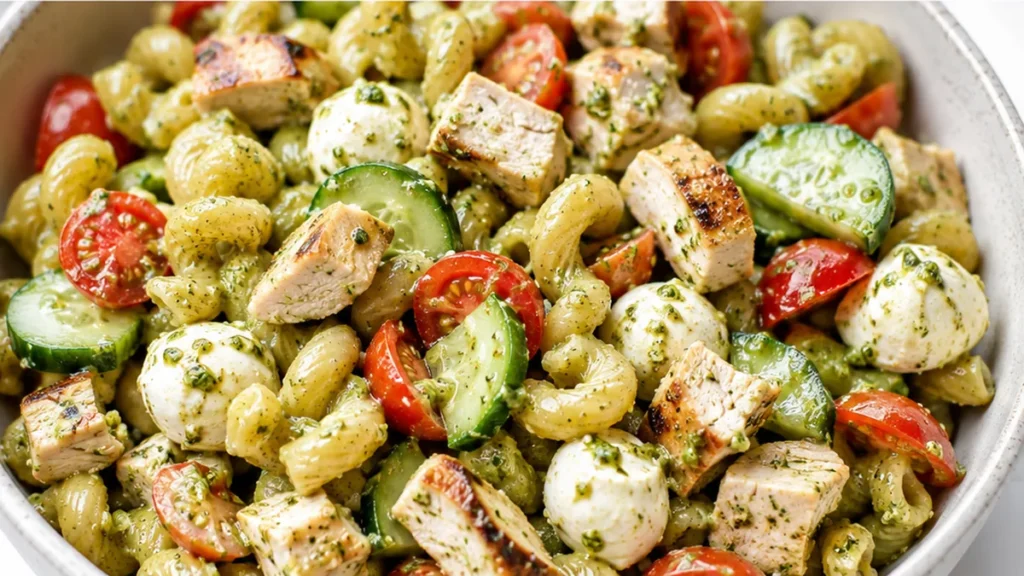
Chicken pesto pasta salad is the ultimate weeknight savior, combining tender chicken, satisfying pasta, and a punchy pesto dressing into one easy dish. Forget bland, boring salads; this recipe is bursting with fresh flavors and bright colors, making it a guaranteed hit for lunches, picnics, or busy weeknights. You’ll love how simple it is to assemble, and the leftovers are even better the next day.
Key takeaways
- Boil the cavatappi 1 to 2 minutes past al dente, then rinse it cold, because pasta firms up and tastes blander once chilled
- Drain the mozzarella and blot the cucumbers and tomatoes dry so their water does not thin the pesto or pool at the bottom
- Toss the pasta with cold pesto first to oil-coat every noodle, and keep everything below room temperature to stop the basil from browning
- Let the salad rest 15 to 30 minutes before serving so the chilled olive oil clears, and add basil only at the very end
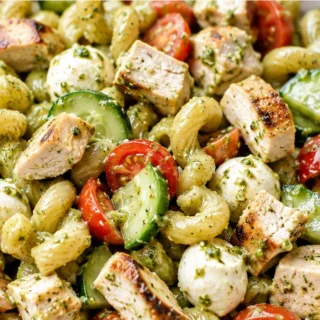
Chicken Pesto Pasta Salad: Easy & Delicious!
Ingredients
- 2 ½ cups diced cooked chicken (12 ounces)
- 6 ounces cavatappi pasta, cooked and cooled
- 8 ounces fresh mozzarella pearls
- 2 cups sliced Persian cucumbers
- 6 ounces grape tomatoes, halved
- ⅓ cup finely diced red onion
- ½ cup prepared pesto
- ¼ cup shredded Parmesan cheese
- Fresh basil leaves, for garnish
Instructions
- Combine cooked and cooled pasta and chicken in a large mixing bowl.
- Add mozzarella pearls, cucumbers, tomatoes, onion, pesto, and Parmesan cheese.
- Mix gently to combine all ingredients.
- Garnish with fresh basil leaves and additional Parmesan, if desired.
- Serve immediately or chill for later.
Video
Notes
Chicken pesto pasta salad lives or dies on one number most cooks ignore: the temperature of the pasta when it meets the pesto. A basil-based sauce is a suspension of oil, water, cheese, and crushed leaf tissue, and it behaves very differently at 60 degrees Celsius than it does at 4. Get the sequence and the moisture right and the ⅓ cup of prepared pesto in this recipe coats all six ingredients evenly, staying glossy and green from the first bite to the last container of leftovers.
Quick answer: Chicken pesto pasta salad works best when the 6 ounces of cavatappi is boiled 1 to 2 minutes past al dente (roughly 9 to 11 minutes for dry pasta), rinsed cold to stop the starch, and drained hard before it ever touches the ½ cup of pesto. Keep the fresh mozzarella pearls, Persian cucumbers, and grape tomatoes patted dry so they do not water down the sauce, and stir the diced cooked chicken in cold. Dress, rest 20 to 30 minutes, then garnish with basil.
Why cavatappi at 9 to 11 minutes beats spaghetti for holding pesto
Cavatappi is the single ingredient that makes this salad forgiving, and the reason is geometry. The corkscrew ridges and hollow center create surface area and pockets that trap the ½ cup of prepared pesto instead of letting it pool at the bottom of the bowl. Dry cavatappi cooks in about 9 to 11 minutes, and for a cold salad you want it cooked 1 to 2 minutes past the package’s al dente mark. Here is the counterintuitive part: pasta firms up as it chills, so a noodle that feels perfect hot will read hard and chalky at fridge temperature. Boil the 6 ounces in water salted to roughly 1 percent, about 10 grams of salt per liter, because a cold noodle tastes flatter than a hot one and cannot be seasoned from the outside later.
A long strand like spaghetti simply cannot do this job. It sheds sauce, tangles, and turns gummy once cold. Short, ridged, hollow shapes such as fusilli, rotini, or radiatori are the only real substitutes here. The America’s Test Kitchen team makes the same point about twisty short shapes grabbing dressing in their pasta salad work, and it holds for pesto specifically because pesto is thick and clingy rather than thin and pourable.
The rinse-and-dry step that stops a watery, sliding sauce
Rinsing cooked pasta is normally a culinary sin because it strips the surface starch that helps hot sauce cling. For a cold pesto salad, that rule flips completely. You want the 6 ounces of cavatappi rinsed under cold running water until it is fully chilled, then drained hard, for two reasons: the cold water halts carryover cooking so the noodle does not overshoot into mush, and washing off loose starch stops the pieces from gluing into one solid clump in the fridge. Bon Appetit and Vincenzo’s Plate both flag rinsing as correct only for cold applications, which is exactly this one.
Moisture is the other enemy. Fresh mozzarella pearls sit in brine or water, and Persian cucumbers and grape tomatoes are roughly 95 percent water. If you dump them in wet, that liquid pools at the bottom, thins the pesto, and leaves the top of the salad looking dry while the base turns soupy. Drain the 8 ounces of mozzarella and blot the halved 6 ounces of tomatoes and 2 cups of sliced cucumbers on a towel before they go in.
- Pasta too warm when dressed: residual heat above 40 degrees Celsius reactivates the enzymes that brown basil, dulling the pesto within minutes. Fix by chilling the cavatappi fully before it meets the sauce.
- Salad tastes flat and gray: under-salted pasta water plus warm dressing. Salt at 1 percent and dress cold.
- Puddle at the bottom of the bowl: wet mozzarella and un-blotted vegetables. Drain and pat everything dry first.
- Clumped, gluey noodles: skipped the cold rinse. Rinse to remove surface starch for cold salads only.
Keeping the ½ cup of pesto bright green instead of army-brown
Pesto turns from emerald to muddy brown because of enzymatic browning, the same reaction that darkens a cut apple. When basil cells are crushed, polyphenol oxidase enzymes meet phenolic compounds and oxygen, and the reaction accelerates sharply with heat, roughly doubling with every 10-degree-Celsius rise between 15 and 50 degrees. Serious Eats and food scientist Harold McGee both note that enzyme activity drops off steeply below 4 degrees Celsius. That single fact dictates handling here: keep the ½ cup of prepared pesto cold, and never stir it into warm pasta or warm chicken.
The oil in pesto is also your color insurance. Fat physically coats the basil particles and blocks oxygen, which is why a thin slick of olive oil over stored pesto keeps the surface green. In this salad, toss the pasta with the pesto first so every noodle is oil-coated before the wet vegetables arrive. One quirk unique to an oil-based dressing like this: extra-virgin olive oil begins to cloud and thicken near 5 to 7 degrees Celsius, so a salad pulled straight from a cold fridge will look stiff and dull. Let it sit out 15 to 20 minutes and the oil clears and re-loosens on its own. That is physics, not spoilage.
Four smart swaps and exactly what each one costs you
Every substitution in this salad has a trade-off worth knowing before you commit. The recipe is built around fresh, mild, creamy notes, so the swaps that work best preserve that balance rather than fighting it. Below are the changes most home cooks reach for, with the real result of each so you can decide with open eyes rather than guessing at the counter.
Mozzarella, chicken, cucumber, and onion alternatives
- Bocconcini or halved ciliegine for the 8 ounces of mozzarella pearls: same milky flavor, but the larger pieces mean fewer cheese bites per forkful and a slightly less even distribution.
- Rotisserie chicken for the 2 ½ cups diced cooked chicken: faster and adds seasoned, roasted depth, but it is saltier, so ease back before adding any extra salt to the pesto.
- English cucumber for the 2 cups of Persian: works, but English cucumbers are wetter and softer, so seed them and salt-drain 10 minutes or the salad turns watery.
- Shallot or soaked red onion for the ⅓ cup red onion: soaking the diced onion in cold water 5 to 10 minutes strips the harsh sulfur bite while keeping crunch, useful if raw onion overpowers the delicate pesto.
Food safety: the 74-degree chicken and the 3-to-4-day window
Because this salad uses 2 ½ cups of already-cooked chicken and sits at room temperature to let flavors meld, two USDA numbers matter. Cooked chicken must reach an internal temperature of 74 degrees Celsius, or 165 degrees Fahrenheit, at some point during cooking to be safe, so verify that whatever chicken you dice, whether poached breast or rotisserie, hit that mark. Chill it fully before it joins the salad, both for safety and to protect the pesto’s color.
Once assembled, cooked chicken and the finished salad keep 3 to 4 days refrigerated in an airtight container, per USDA Food Safety and Inspection Service guidance. Do not let the assembled bowl sit out longer than 2 hours total, or 1 hour if the room is above 32 degrees Celsius, since a protein-and-dairy salad is prime territory for bacterial growth. Add the fresh basil garnish only at serving time; whole leaves bruise and blacken within a day, and stirring them in early wastes their aroma. Refresh leftovers with a small extra spoon of pesto, as the pasta keeps absorbing sauce as it sits.
Making it Sunday for a Thursday lunch: how the salad drinks its own pesto
Cooled cavatappi keeps absorbing pesto for the entire time it sits in the fridge, so a salad that looked glossy on day one can read dry and dull by day three. Cooked pasta starch continues to soak up the oil and moisture around it, which is why nearly every pesto pasta salad lands in the same 2-to-4-day window before it turns pasty. Reserve roughly a quarter of your half cup of prepared pesto, refrigerate it separately, and fold it back in cold, straight before serving. Patty Catalano at The Kitchn builds this exact reserve step into her make-ahead notes, holding back part of the sauce and stirring it through at the last minute. The 8 ounces of fresh mozzarella pearls behave differently: packed in whey, they weep liquid overnight, thinning the dressing and pooling water at the bottom of the bowl. Drain them well and, if you are building more than a day ahead, add the pearls and the halved grape tomatoes only on serving day. A splash of the reserved pesto, or a teaspoon of olive oil, revives coverage without turning the dish greasy. Store everything in a genuinely airtight container: exposed surface area is what dulls the green and stales the pasta fastest. Bring the bowl out of the fridge 20 to 30 minutes before eating so the diced chicken and the oil in the pesto lose their fridge chill.
The trade-off with any make-ahead batch is texture versus convenience. Same-day salad has the springiest cavatappi and the brightest basil; a two-day-old batch trades some of that bounce for deeper, more married flavor, which many cooks actually prefer for packed lunches.
Room temperature over ice cold: the serving move that wakes the basil back up
Serve this salad cool but not fridge-cold, because chilling flattens exactly the flavors the pesto depends on. Research from the University of Leuven found that human taste perception drops noticeably below roughly room temperature, and Serious Eats notes that cold specifically muffles volatile aroma compounds, which is where basil, garlic, and Parmesan live. Pull the bowl out 20 to 30 minutes ahead so the salad climbs into the 68 to 72 F (20 to 22 C) range where those notes read loudest. Serving temperature also protects the sauce itself: pesto is a loose emulsion of oil, and Serious Eats recommends keeping pesto pasta only very warm rather than piping hot precisely so that emulsion does not break; the same logic keeps a fridge-cold version from tasting like oily, muted pasta. For the 12 ounces of diced cooked chicken, letting the chill come off also softens the meat texture so it does not read rubbery against the soft mozzarella pearls.
Quality of raw ingredients decides the ceiling here more than technique. Grape tomatoes carry this dish, and Serious Eats stresses using best-quality, room-temperature tomatoes for any caprese-style plate; a pale winter grape tomato will taste watery no matter how good the pesto is. Peak-summer Persian cucumbers and just-torn basil for garnish push the whole bowl brighter. Two practical pairings: a crisp dry white or a sparkling water with lemon cuts the richness, and a simple green salad or grilled bread rounds it into a full plate. Keep the finishing shower of shredded Parmesan and fresh basil leaves for the moment you serve, not before storage, so they stay sharp and green.
Pro tips
- Use refrigerated pesto for the brightest green color and freshest flavor.
- For best results, ensure pasta and chicken are cooled to room temperature before mixing to prevent the cheese from melting too much.
- Feel free to add other vegetables like bell peppers or Kalamata olives.
- Leftovers can be stored in an airtight container in the refrigerator for up to 4 days.
Enjoy this incredibly simple yet flavorful Chicken Pesto Pasta Salad – it’s a delicious way to bring a taste of sunshine to your table!
Frequently asked questions
Can I make chicken pesto pasta salad the night before?
Yes, and the flavor actually improves as the pasta absorbs the pesto. Assemble everything except the fresh basil, cover tightly, and refrigerate up to 3 days. Let it sit out 15 to 20 minutes before serving so the olive oil re-loosens, then stir in a small extra spoon of pesto and the basil leaves just before the table.
Why does my pesto turn brown and dull in the salad?
Heat drives it. Enzymes in basil react with oxygen and brown fast above room temperature, roughly doubling their speed every 10 degrees Celsius. Stirring the half cup of pesto into warm pasta or warm chicken triggers this within minutes. Chill the cavatappi and chicken fully first, keep the pesto cold, and the oil coating will hold the green color for days.
Should I rinse the cavatappi for this pasta salad?
Yes, for a cold salad only. Rinsing under cold water halts carryover cooking so the noodles do not overshoot into mush, and it washes off surface starch that would otherwise glue the pieces into one clump in the fridge. Drain hard afterward. For hot pasta dishes you would skip rinsing, since that same starch helps sauce cling.
My salad turned watery at the bottom. What went wrong?
Wet ingredients released liquid. Fresh mozzarella pearls sit in brine, and Persian cucumbers and grape tomatoes are about 95 percent water. Drain the mozzarella and pat the halved tomatoes and sliced cucumbers dry on a towel before they go in. Toss the pasta with pesto first so it is oil-coated, which also helps repel the small amount of moisture that remains.
More from Chicken Pasta Recipes →