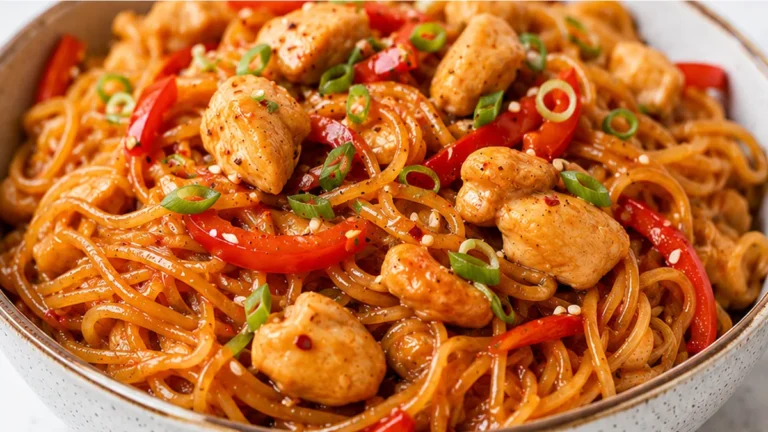
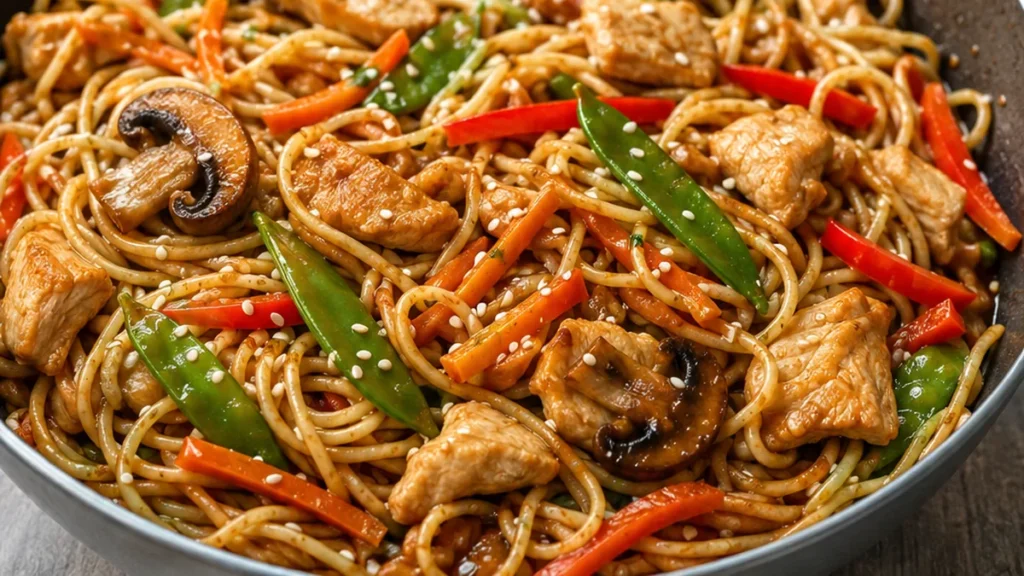
Stir fry noodles are the ultimate weeknight savior, and this chicken stir fry noodle recipe is proof! Forget takeout menus; you can create a dish that’s packed with flavor, loaded with tender chicken and crisp vegetables, and coated in a perfectly balanced savory sauce, all in under 30 minutes. This recipe breaks down exactly how to achieve that perfect balance of textures and tastes, ensuring your homemade stir fry noodles are a guaranteed hit. We’ll guide you through preparing a bright medley of vegetables and succulent chicken breast, all brought together with chewy noodles and a simple yet addictive sauce. This isn’t just another stir fry; it’s a streamlined approach to a classic favorite, designed for speed and maximum deliciousness.
Key takeaways
- Slice the chicken breast against the grain at about 1/4 inch, ideally when semi-frozen, and cook it in two batches so it browns instead of steaming.
- Add the sauce only near the end and around the edge of the pan, because coconut aminos plus brown sugar scorch fast above 160C (320F).
- Sequence the vegetables by hardness: carrots first, then mushrooms and bell pepper, snow peas last, and keep everything dry before it hits the pan.
- Have every ingredient prepped and the sauce pre-mixed before the burner is on, since the whole cook runs six to eight minutes with no pause to chop.
Chicken Stir Fry Noodles in 30 Mins!
Ingredients
- Cooking spray
- ⅓ cup coconut aminos
- 3 tablespoons rice vinegar
- 1 tablespoon toasted sesame oil, divided
- 1 ½ teaspoons brown sugar
- 3 garlic cloves, grated or finely minced
- ¾ teaspoon fresh ginger, grated or finely minced
- 4 cups thinly sliced or julienned vegetables (such as 1 cup carrots, 1 cup mushrooms, 1 cup snow peas, 1 cup red bell pepper)
- 4 green onions, thinly sliced, white and green parts separated
- 1 ¼ lbs. boneless skinless chicken breast, very thinly sliced
Instructions
- Bring a large pot of salted water to a boil. Cook noodles according to package directions, then drain and set aside.
- Whisk together coconut aminos, rice vinegar, 1 teaspoon sesame oil, brown sugar, garlic, and ginger for the sauce. Set aside.
- Heat 1 teaspoon sesame oil in a large skillet over medium-high heat. Add thinly sliced chicken and cook for 3-4 minutes until done. Remove chicken to a plate.
- Add remaining 1 teaspoon sesame oil to the skillet. Stir fry carrots, mushrooms, snow peas, bell pepper, and the white parts of green onions for 3-4 minutes until tender-crisp.
- Return chicken to the pan with the cooked noodles. Pour in the sauce and toss to coat everything. Cook for 2-3 minutes until heated through.
- Serve immediately, garnished with the green parts of the green onions and sesame seeds.
Video
Notes
Coconut aminos brown almost instantly at wok heat, so timing the sauce is everything
Coconut aminos carry roughly 5 to 6 grams of sugar per tablespoon, several times what light soy sauce contains, which changes how this sauce behaves in the pan. The added 1.5 teaspoons of brown sugar pushes it further into scorch territory. Caramelization of table sugar begins near 160C (320F), and a bare wok bottom over a home burner regularly exceeds 200C (400F), so a puddle of the coconut-aminos mixture poured into the center of a screaming-hot pan can go bitter in under 30 seconds. Add the liquid only after the chicken and vegetables are nearly done, drizzle it around the perimeter rather than the middle, and keep everything moving. Grace Young, author of Stir-Frying to the Sky’s Edge, describes this edge-searing as part of how wok aroma develops without burning the sugars.
Why a splash of water rescues a sauce that reduced too far
Because coconut aminos are thinner and sweeter than soy sauce, the third of a cup here reduces fast and can turn gluey and over-sweet. If the pan looks dry and the sauce is clinging in dark streaks, pull it off the heat and stir in a tablespoon of water at a time. Serious Eats notes that experienced cooks keep a small cup of water at the stove precisely for this on-the-fly correction.
Slicing the chicken breast thin and against the grain decides whether it turns out tender or rubbery
Chicken breast in a fast stir fry lives or dies on the cut. Muscle fibers in the breast run in visible lines, and slicing across them at roughly 1/4 inch (about 6mm) shortens each fiber so it reads as tender rather than chewy. Slice with the grain and the same cooked meat feels stringy no matter how briefly it cooks. A partially frozen breast, firmed for 15 to 20 minutes in the freezer, holds its shape under the knife and lets you get slices thin enough that they cook through in 90 seconds to two minutes. Aim for even thickness across the batch; a mix of thick and paper-thin pieces guarantees some dry and some undercooked. The United States Department of Agriculture sets 74C (165F) as the safe internal temperature for poultry, and thin slices reach that almost the instant they lose their pink center.
Cook the chicken in two batches, not one crowded pile
A pound and a quarter of chicken dropped into a home wok at once drops the surface temperature hard and the meat steams gray instead of browning. Young’s rule of thumb is that most home ranges cannot brown much more than a pound of protein at a time. Split this batch, let each layer sit undisturbed for about a minute to take color, then remove it and return everything at the end.
Add the four cups of vegetables in hardness order or half of them end up wrong
Carrots, mushrooms, snow peas, and red bell pepper do not cook at the same rate, and dumping all four cups in together leaves the carrots raw while the snow peas collapse. Sequence by density: carrots first for about two minutes since they are fibrous and slow, then mushrooms and bell pepper for another one to two minutes, and snow peas last for under a minute so they stay bright green and snap. The white parts of the green onions go in early with the garlic and ginger as aromatics; the green parts are a raw garnish at the very end. Dry vegetables are non-negotiable here. Water clinging to washed produce flashes to steam on contact and pulls the wok out of searing range, which is why America’s Test Kitchen measures wok-bottom temperatures dropping sharply the moment wet food lands.
Grate the garlic and ginger instead of mincing for even flavor
Three grated garlic cloves and 3/4 teaspoon grated ginger disperse through the sauce far more evenly than chopped pieces, and they are far less likely to leave a scorched shard in one bite. Grated aromatics also release their compounds faster, which matters when they only spend 20 to 30 seconds in hot oil before the next ingredient joins them.
Four swaps that keep this stir fry working, and what each one costs you
This recipe is forgiving on substitutions as long as you understand the trade-off each one brings. The sauce and protein are the levers most worth adjusting for what is in your kitchen.
- Low-sodium soy sauce for the coconut aminos: coconut aminos run about 90 to 200mg sodium per tablespoon against roughly 878mg for regular soy sauce, per the ThermoWorks and WebMD figures. Swapping in soy sauce deepens the umami and color but roughly triples the salt, so cut the quantity by about a third and skip the brown sugar since soy is not sweet.
- Apple cider or white wine vinegar for rice vinegar: both bring similar gentle acidity to brighten the sauce, though cider vinegar leaves a faint fruity note and white wine vinegar is sharper. Start with two tablespoons rather than three and taste up.
- Boneless thigh for breast: thigh carries more fat and connective tissue, so it stays juicy even if you overshoot 74C (165F) by a minute, but it needs slicing just as thin and browns darker.
- A cornstarch slurry for a glossier finish: the recipe sauce stays loose; whisk one teaspoon cornstarch into one tablespoon cold water and stir it in at the end for a clingy, take-out-style coat. The cost is a slightly heavier mouthfeel and a sauce that thickens further as it cools.
The one habit that separates this dish from a slow braise: everything is prepped before the burner is lit
Unlike most 30-minute dinners, this one gives you no time to chop mid-cook, and that single constraint is what makes or breaks it. From the moment the chicken hits the oil, the whole dish is done in roughly six to eight minutes, faster than the sauce takes to over-reduce if you turn away. Mix the coconut aminos, rice vinegar, sesame oil, brown sugar, garlic, and ginger in a bowl ahead of time. Have the sliced chicken, the sequenced vegetables, and the separated green onions in reach. Lucas Sin of Junzi Kitchen makes the same point in Serious Eats: build the sauce in a bowl before cooking so you never stop to think at the stove. Reserve the toasted sesame oil that is called for divided; a portion belongs in the sauce, but a final few drops off the heat keep its low-smoke-point aroma from cooking away entirely, since sesame oil starts breaking down around 175C (350F).
Why the noodles clump and go gummy when you reheat this stir fry the next day
Cooked noodles keep firming up in the fridge because their starch retrogrades, the same recrystallizing that stales bread, and by hour twelve they lock into a solid brick. Stored right, this dish holds three to four days at or below 4C (40F). The fix is oil and separation: toss leftovers with the reserved half tablespoon of toasted sesame oil before they cool, and store the chicken-and-vegetable mixture in a shallow container so it drops below 4C fast rather than sweating in a deep tub. Reheat in a hot pan, not a microwave, adding one to two tablespoons of water so the coconut aminos glaze loosens back into sauce instead of scorching. Snow peas and red bell pepper lose their snap after a day, going olive-drab and limp, so if you know you want leftovers, undercook the vegetables by roughly a minute on the first pass. The chicken breast, sliced very thin, actually reheats better than a thick cut because it warms through in under a minute before it can dry out. Freezing works for the chicken-and-sauce portion up to two months, but skip freezing the snow peas and mushrooms, whose cell walls rupture and turn watery on thaw. One quirk specific to a coconut aminos sauce: it is lower in sodium than soy sauce, so leftovers taste flatter cold than they did hot, and a splash of rice vinegar on the reheat brightens them right back up.
Cooking this for four versus doubling it for a crowd changes what your pan can do
The recipe as written feeds about four, and it works because 1.25 lbs of thin chicken and four cups of vegetables still fit in a single layer across a large skillet or wok. Double it and that single layer is gone: crowding drops the pan temperature, moisture pools, and the chicken steams to a pale gray instead of taking on any browning. Above roughly 375F (190C) you get the searing this dish depends on, and a doubled batch dumped in at once can crash a home burner below that in seconds. The real fix is not a bigger pan but batches: cook the chicken in two loads, set each aside, then stir fry the vegetables and combine everything with the sauce at the end. Scaling the sauce is not perfectly linear either, because the coconut aminos, rice vinegar, and brown sugar reduce faster in a wider pan with more surface area, so a doubled sauce can over-thicken before the vegetables are done; hold back about a quarter of it and add it only if the pan looks dry. Grated garlic and fresh ginger scale one to one, but three cloves doubled to six can turn bitter if they hit bare metal, so keep them moving and add them with the white parts of the green onion rather than to an empty pan. For a true crowd, cook two separate rounds rather than one giant one, because past a certain volume even a professional wok burner cannot recover heat fast enough to keep it a stir fry.
Pro tips
- For extra flavor, marinate the thinly sliced chicken in a bit of the sauce for 10 minutes before cooking.
- Don’t overcrowd the pan when stir-frying vegetables; cook in batches if necessary to ensure they get crisp-tender, not steamed.
- For perfectly cooked noodles, follow package directions precisely and drain them immediately. Do not rinse, as the starch helps the sauce adhere.
- Adjust the heat of the sauce by adding a pinch of red pepper flakes with the garlic and ginger.
Enjoy these quick and flavorful chicken stir fry noodles any night of the week! Experiment with different vegetables to make it your own.
Frequently asked questions
Can I make these stir fry noodles ahead of time?
You can prep every component up to a day ahead: mix the sauce, slice the chicken, and cut the vegetables, storing each separately in the fridge. The actual cooking should happen just before serving, though. Reheated snow peas go limp and the chicken dries out, so hold everything raw and assemble at the last minute.
Why did my chicken come out chewy instead of tender?
Almost always the culprit is slicing with the grain rather than across it, which leaves the muscle fibers long and stringy. Slicing at 1/4 inch against the grain fixes it. The second cause is crowding the pan, which steams the meat gray. Cook a pound and a quarter in two batches for proper browning.
What noodles work best with this sauce?
Any noodle that holds a light coating works, since the coconut-aminos sauce is thinner than bottled stir fry sauce. Lo mein, rice noodles, ramen, or even spaghetti all do the job. Cook them just short of done, drain well, and toss them in at the very end so they absorb sauce without turning mushy or diluting it with cooking water.
Is this dish spicy, and how do I add heat?
As written it is savory and mildly sweet, not spicy, since the ingredients contain no chili. To add heat, stir a teaspoon of chili crisp or a pinch of red pepper flakes into the sauce, or add a thinly sliced fresh chili with the garlic and ginger. Adjust to taste, as the sweetness of the coconut aminos balances a fair amount of spice.
More from Chicken Pasta Recipes →