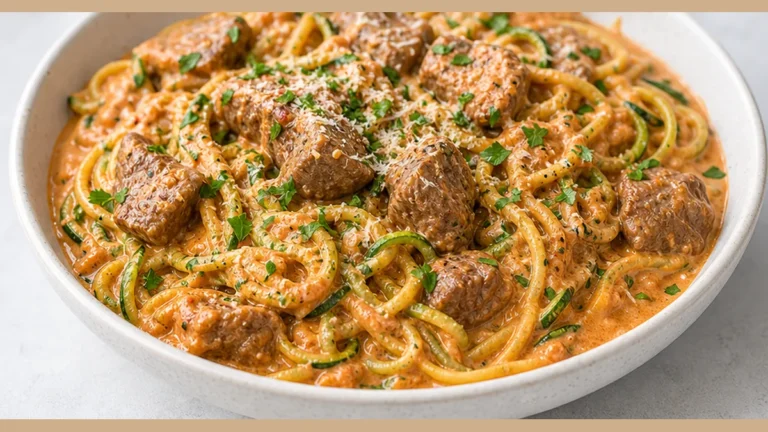
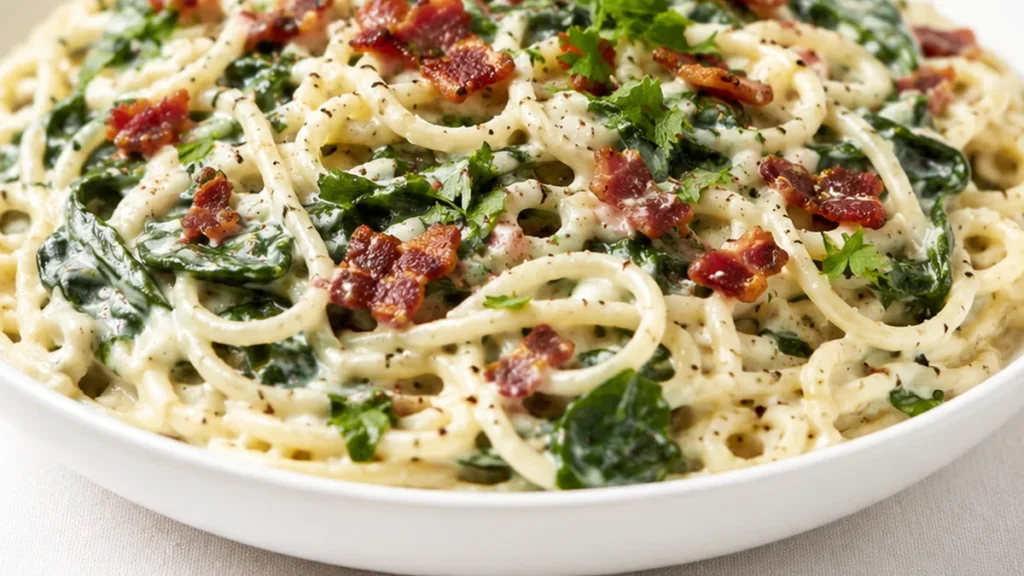
Preparing florentine pasta with bacon requires a single skillet and thirty minutes. The rendered bacon fat acts as the base for cooking the spinach. This method yields a unified flavor profile with minimal dishwashing.
Key takeaways
- Cook the flour into the fat for 60 to 90 seconds and add the broth and milk in stages, whisking hard, so the sauce sets smooth instead of lumpy or thin.
- Pull the pan off the heat before the parmesan goes in; cheese added to liquid hotter than about 82 C or 180 F turns grainy and breaks.
- Render the full pound of bacon low and slow, keep the drippings in the pan, and use them to cook the onion and garlic for built-in smoky depth.
- Reserve a cup of pasta water and pull thin spaghetti 1 to 2 minutes early, then finish it in the sauce so it clings and stays glossy.
Bacon Florentine Pasta
Ingredients
- 8 oz thin spaghetti
- 1 tablespoon olive oil
- 1/2 cup onions (diced)
- 1 tablespoon garlic (minced)
- 2 tablespoons butter
- 3 tablespoons all-purpose flour
- 1 ½ cups chicken broth
- 1 ½ cups whole milk
- 1/2 cup parmesan cheese (shredded)
- 1 lb bacon (crumbled)
Instructions
- Cook spaghetti according to package directions until al dente. Drain and set aside.
- In a large deep skillet, heat the olive oil over medium heat.
- Add the diced onions and sauté until tender and translucent, about 5 minutes.
- Stir in the minced garlic and sauté until fragrant, about 1 minute.
- Add the butter and stir until melted.
- Sprinkle in the all-purpose flour and cook, stirring constantly, until lightly golden, about 2-3 minutes.
- Slowly pour in the chicken broth and whole milk, whisking constantly to prevent lumps.
- Stir in the shredded parmesan cheese until melted and smooth.
Video
Notes
Florentine pasta earns its name from a 1533 French kitchen, not an Italian one, which is the first thing worth understanding before you cook this bacon version. When Catherine de Medici of Florence married Henry II of France, the term “a la Florentine” attached itself to dishes finished with spinach and a Mornay sauce, and Auguste Escoffier codified it in his 1903 Le Guide Culinaire with a recipe for sole Florentine. This recipe borrows the sauce architecture, a roux-thickened white sauce enriched with cheese, and swaps the classic spinach-and-fish for crumbled bacon over thin spaghetti. What you are really building is a Mornay-style sauce, and getting the roux, the milk, and the parmesan to behave is where the whole dish lives or dies.
Quick answer: Florentine pasta here is thin spaghetti bound in a bacon-Mornay sauce, a butter-and-flour roux loosened with chicken broth and whole milk, then finished with parmesan and crumbled bacon. The three make-or-break moves are cooking the roux 1 to 2 minutes so it loses its raw-flour taste, adding warm liquid gradually while whisking to prevent lumps, and pulling the pan off direct heat before the parmesan goes in so the cheese proteins do not seize into a grainy mess. Reserve pasta water to adjust thickness.
Why this Florentine skips the spinach that defines the classic
This dish carries the Florentine name while breaking its single defining rule: no spinach. In classical French cooking, per Larousse Gastronomique and Escoffier, “a la Florentine” means spinach plus Mornay sauce over fish, eggs, or white meat, which is why eggs Florentine replaces the bacon of eggs Benedict with a bed of greens. This recipe keeps the Mornay logic, a bechamel finished with parmesan, but rebuilds the flavor around bacon fat and chicken broth instead. That is the one thing true of this plate and almost no other Florentine you will find: it is a spinach dish with the spinach removed and pork put in its place. If you want to honor the original while keeping this recipe intact, wilt a large handful of fresh spinach into the finished sauce off the heat; it will not change the quantities on the card and it pulls the dish back toward its 16th-century root.
Getting the roux and 3-cup liquid ratio to set instead of run
The sauce succeeds or fails on the roux, and the ratio here runs slightly lean on fat. The card uses 2 tablespoons butter and 3 tablespoons flour to thicken 3 cups of liquid, the 1.5 cups chicken broth plus 1.5 cups whole milk. A classic pourable bechamel runs about 1.5 tablespoons each of butter and flour per cup of milk, so this version has extra flour for structure and leans on rendered bacon fat left in the pan to make up the butter. Cook the flour into the fat for a full 60 to 90 seconds over medium heat until it smells nutty rather than pasty; that step gelatinizes the starch and burns off raw-flour flavor. Add the broth and milk in stages, whisking hard after each pour, because dumping all 3 cups at once is the number one cause of lumps. Bring it to a bare simmer, near 100 C or 212 F, and hold it there 3 to 5 minutes until it coats the back of a spoon.
Failure to fix pairs for the sauce
Grainy, broken sauce: the parmesan went into liquid that was too hot, above roughly 82 C or 180 F, and the cheese proteins tightened and squeezed out fat. Fix it by pulling the pan off the burner, letting it cool a minute, then whisking the cheese in a small handful at a time.
Lumpy white sauce: cold liquid hit the roux all at once. Whisk in a splash of hot broth to smooth it, or push the whole thing through a fine strainer as a rescue.
Sauce too thin and watery: it never reached a real simmer, so the starch never fully swelled. Return it to gentle heat and let it bubble 2 to 3 more minutes; it thickens as it approaches the boil.
Sauce too thick and gluey: the 3 tablespoons flour firmed up on standing. Loosen with reserved pasta water 2 tablespoons at a time; the starchy water blends in better than plain milk.
Rendering the 1 lb of bacon so the fat works twice
Bacon fat renders liquid at about 60 C or 140 F and burns near 165 C or 325 F, and that narrow window is why slow-cooked bacon out-crisps rushed bacon every time. The lean meat crisps through the Maillard reaction at roughly 165 C or 325 F while the fat needs time below that to melt out; push the pan too hot too fast and you get stringy, half-rendered fat around scorched edges. Cook the 1 pound over medium heat, or spread it on a rimmed sheet in a 200 C or 400 F oven, until deeply crisp, then crumble. Do not wash out that skillet. The pan drippings are your best cooking fat for softening the 1/2 cup onions and 1 tablespoon garlic, and they carry smoky, salty depth straight into the roux. Because the bacon already loads the dish with salt, hold back on seasoning the sauce until after the parmesan and a taste at the end.
Cooking thin spaghetti to the right stage for a bound sauce
Thin spaghetti cooks fast, and pulling it early is what lets it finish inside the sauce instead of drowning in it. Where standard spaghetti runs 8 to 10 minutes, thin spaghetti hits al dente in roughly 6 to 8 minutes, so start checking at 5. Drain it 1 to 2 minutes before the package time and reserve at least a cup of the cooking water before you pour it off. That water is loaded with dissolved starch, and it is the single best tool for marrying a flour-thickened sauce to pasta: a splash emulsifies the fat and loosens the sauce to a glossy, clinging consistency without watering down flavor. Toss the drained noodles directly into the finished bacon Mornay off the heat, add the crumbled bacon, and stir for 30 to 60 seconds so the strands drink up sauce. If it stiffens on the way to the table, another spoon of reserved water brings it right back.
Four swaps that hold the recipe together, with their trade-offs
Half-and-half or heavy cream for the whole milk: richer, more velvety, and more forgiving of heat because higher fat resists curdling; the trade-off is a heavier plate and more calories, and cream can mute the bacon’s smoke.
Gruyere or aged white cheddar for the parmesan: this pushes it toward a true melting Mornay with more stretch and body; the trade-off is a milder, less savory finish since parmesan brings sharper glutamate punch per ounce.
Vegetable or bone broth for the chicken broth: vegetable keeps it lighter and works for a pescatarian table, bone broth adds collagen and a fuller mouthfeel; either shifts the background flavor away from the poultry note the recipe assumes.
Gluten-free spaghetti and a cornstarch slurry for the flour roux: makes the dish celiac-friendly; the trade-off is a slightly slicker, less stable sauce, so add the slurry at the end and expect to serve it promptly before it thins.
For readers building out a weeknight rotation, this sauce is the same base that carries a good step-by-step guide to saucing pasta properly and a rescue plan when it splits. Anyone who wants the deeper chemistry of why cheese seizes can compare notes with a trusted classic bechamel and white sauce reference before scaling the recipe up.
Pro tips
- Use good quality bacon for the best flavor.
- Don’t skip cooking the flour for a couple of minutes to avoid a raw flour taste.
- For an extra touch of freshness, stir in some fresh spinach at the end until wilted, just like traditional Florentine dishes.
- Taste and adjust seasoning (salt and pepper) before serving, as bacon and cheese can be salty.
Enjoy this rich and comforting Bacon Florentine Pasta. It’s a simple yet elegant dish that’s sure to become a family favorite!
More from Creamy Pasta Recipes →