
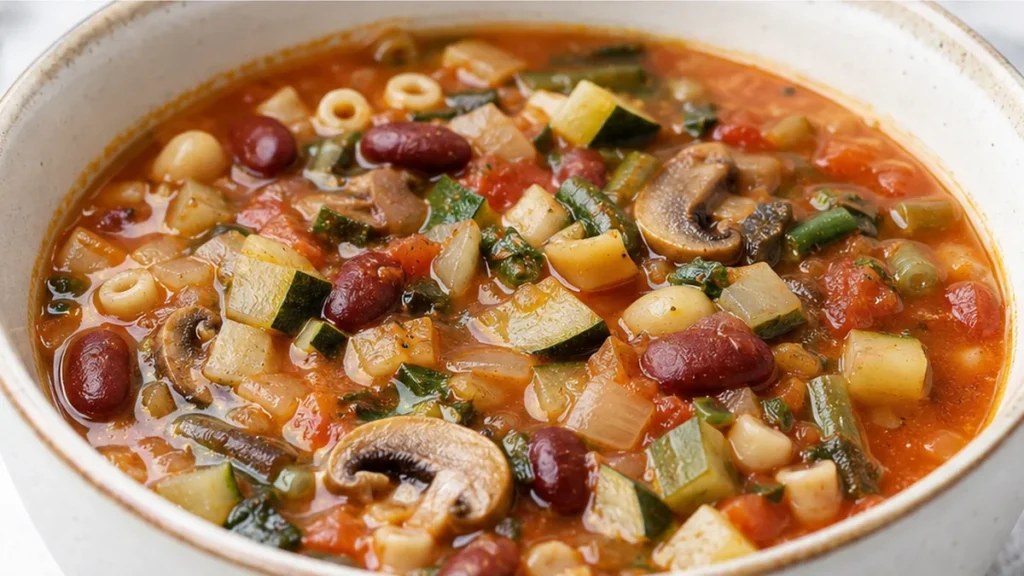
Minestrone soup is a classic Italian dish, celebrated for its hearty blend of vegetables and beans. This recipe rounds out it by making it entirely vegan and naturally gluten-free, proving that comfort food can be both wholesome and incredibly flavorful. We’ve streamlined the process so you can enjoy a deeply satisfying bowl, brimming with fresh ingredients, in about an hour. This minestrone soup recipe is perfect for a nutritious weeknight dinner or a warming lunch. This hearty vegan minestrone soup is a celebration of simple, fresh ingredients coming together to create something truly special. It’s designed to be flexible, allowing you to adapt it to the vegetables you have on hand. The key is building layers of flavor from the aromatics to the simmered broth, ensuring every spoonful is rich and comforting.
Key takeaways
- Cook the soffritto of onion, carrot, and celery slowly for 7 to 10 minutes before anything else, then add garlic last so it does not scorch.
- Add the canned kidney beans drained, rinsed, and only in the final 10 to 15 minutes so they warm through without turning mealy.
- Hold the zucchini back until the last 8 to 10 minutes to keep it tender instead of dissolving into the broth.
- Let the crushed tomatoes cook down until the pan crackles before adding the vegetable broth, and round out any sharpness with miso or nutritional yeast stirred in off the heat.

Vegan Minestrone Soup Recipe
Ingredients
- 2 tablespoons olive oil or avocado oil
- ½ large white or yellow onion, diced
- 7 cloves garlic, peeled and minced
- 2 celery ribs, diced
- 2 medium carrots, peeled and diced
- 1 cup (4 oz) mushrooms, sliced
- 1 medium zucchini, diced
- 1 (28-ounce) can crushed tomatoes
- 4 cups vegetable broth
- 1 (14-ounce) can red kidney beans, drained and rinsed
Instructions
- Heat the olive oil in a large pot over medium heat.
- Add the onion, garlic, celery, and carrots. Cook for 8-10 minutes until softened.
- Stir in the mushrooms and zucchini, cooking for another 5 minutes until tender.
- Pour in the crushed tomatoes and vegetable broth, stirring to combine.
- Add the kidney beans and bring to a simmer. Cook for at least 20 minutes.
- Season with salt and pepper to taste before serving.
Video
Notes
Why tomatoes and beans fight each other in the same pot
Minestrone soup pits two ingredients against each other chemically: the acid in a 28-ounce can of crushed tomatoes and the pectin holding your kidney beans together. Acid keeps the pectin in bean cell walls from dissolving, so beans simmered in a tomato-heavy liquid stay firm far longer than beans cooked in plain water. Cook’s Illustrated measured plain-water beans turning tender in about 60 minutes, while beans in acidic water needed roughly 1 hour and 45 minutes. Because this recipe uses canned red kidney beans that are already fully cooked, that acid problem works in your favor: the beans hold their shape in the acidic broth instead of collapsing into mush. Add them drained and rinsed for only the final stretch of simmering, long enough to warm through and pick up flavor, and they stay intact.
The lesson flips if you ever swap in dried beans. Then the tomato acidity becomes an enemy, and food writer J. Kenji Lopez-Alt and Harold McGee both note you should cook dried beans nearly soft in salted water before the tomatoes ever meet them. With the canned beans this recipe calls for, no such staging is needed.
Rinsing the beans is not optional
That cloudy liquid in the can is starch and sodium. Rinsing red kidney beans cuts surface sodium meaningfully and removes the raffinose-heavy slick that muddies the broth. Rinse until the water runs clear, then let them drain so you are not adding extra liquid that thins your carefully built base.
Building the soffritto so the broth tastes like more than tomato water
The soffritto is the flavor engine of this vegan minestrone, and rushing it is the single most common reason a pot tastes flat. Heat your 2 tablespoons of olive oil over medium, add the diced half onion, two celery ribs, and two carrots first, and let them sweat 7 to 10 minutes until the onion turns translucent and the carrot edges soften. This is where the Maillard reaction and slow sugar release happen; skip it and vegetable broth plus canned tomato gives you thin, sharp liquid. The Italian tradition calls this base a soffritto (a battuto before it hits the pan), the vegetable analog of French mirepoix.
Garlic goes in later for a reason. Your 7 cloves of minced garlic burn and turn acrid in about 30 to 60 seconds on a hot pan, so add them only after the harder vegetables have softened, stirring for under a minute until fragrant. Mushrooms come next: their 4 ounces release water, and cooking them until that water evaporates and the pan crackles rather than sputters concentrates their glutamates, the natural umami compounds that stand in for the meat or Parmesan a traditional minestrone would lean on.
Stopping the zucchini from turning to slush
One medium zucchini is the most fragile thing in this pot, and it is what separates a bright minestrone from a gray one. Zucchini is roughly 95 percent water with delicate cell walls, and Serious Eats puts its ideal simmer time at about 10 minutes for half-inch chunks. Add it at the start with the carrots and it will disintegrate into stringy mush well before the soup is ready to serve. The fix is timing, not technique: hold the diced zucchini back and stir it in only for the last 8 to 10 minutes of simmering, so it turns tender but still holds a defined edge on the spoon.
If you are reheating leftovers, expect the zucchini to soften further each time. For batch cooking, some cooks simmer the base with tomatoes, broth, and beans, then add fresh zucchini to each portion as they reheat it, keeping the vegetable crisp-tender rather than cooking it three times over.
Four failures and the exact cause behind each
Most minestrone problems trace to one specific misstep, not bad luck. Here are the ones that matter for this ingredient list:
Broth tastes thin and watery. Cause: the soffritto was cooked too fast, and the tomatoes never reduced. Fix: after adding the crushed tomatoes to the softened vegetables, cook the mixture until it crackles and fries rather than simmers, roughly 5 minutes, before pouring in the 4 cups of vegetable broth.
Beans are mealy or split apart. Cause: canned kidney beans added too early and boiled hard. Fix: keep the pot at a gentle simmer, not a rolling boil, and add the drained beans in the final 10 to 15 minutes.
Soup is sharp and sour. Cause: undercooked canned tomatoes still tasting tinny. Fix: let the tomato-vegetable mixture cook down properly, and finish with a pinch of sugar or a splash of the bean liquid to round the acid.
Everything tastes like the same flat vegetable. Cause: garlic added with the onion and scorched, or no salt during the sweat. Fix: salt the vegetables as they sweat to draw moisture, and add garlic last.
Swaps that change the pot, and what each one costs you
This recipe is forgiving, but every substitution has a trade-off worth knowing before you make it:
Avocado oil for olive oil. Higher smoke point and cleaner flavor, but you lose the peppery, savory backbone extra-virgin olive oil lends the soffritto. Result: a slightly more neutral base.
White miso paste to replace a Parmesan rind. A traditional minestrone drops a rind in for umami; vegan cooks at Umami Girl and The First Mess use miso instead. Stir 1 to 2 teaspoons in at the very end off the heat, because boiling above 100 degrees C degrades its flavor and turns it bitter. Result: deeper, cheese-like savoriness without dairy.
Nutritional yeast for extra depth. Its glutamic acid mimics aged cheese. A tablespoon stirred in near the end adds body and umami. Result: nuttier, slightly thicker broth, with a faint yellow tint.
Cannellini or great northern beans for kidney beans. Creamier and milder. Result: a softer texture that breaks down more readily, so watch your simmer time.
Why day-two minestrone tastes better and how to store it without ruining the vegetables
Minestrone improves overnight because the starch that leaches from the kidney beans and the pectin from the crushed tomatoes keep dissolving into the broth, thickening it and rounding the acidity. Cool the pot to room temperature within two hours, then refrigerate in a sealed container for up to four days. The soup will thicken noticeably as it sits, so loosen it with 60 to 120 ml of vegetable broth or water when reheating over medium heat. The catch is texture: the zucchini keeps softening in the fridge and turns mushy by day three.
If you know you are storing leftovers, pull the zucchini out slightly firmer than you want, or cook a batch without it and add fresh zucchini when you reheat. Freezing works for the tomato-and-bean base, which holds up to three months at minus 18 degrees C, but zucchini and any small pasta go grainy and bloated after thawing. Freeze the broth-bean base flat in bags, then stir in freshly cooked zucchini and greens the day you serve. Reheat frozen soup gently rather than by microwave blast, which curdles the crushed tomatoes at the edges and leaves the center cold. The America’s Test Kitchen guidance on soup storage recommends this base-and-fresh-element split for exactly this reason.
Doubling the pot for a crowd without watery broth or crunchy carrots
Scaling this minestrone past four servings is not a clean multiplication, because a bigger pot changes evaporation and browning. When you double the batch, do not double the vegetable broth on the first pass. Use about 1.75 times the liquid, then adjust at the end, because a wider surface loses less water per portion and the extra crushed tomatoes release their own juice. A doubled pot also crowds the soffritto: 14 minced garlic cloves and a full diced onion will steam instead of soften if the pan bottom is packed, so sweat the aromatics in two stages or use a wider, heavier pot like a 7-quart Dutch oven that spreads the heat evenly.
Carrots are the scaling trap. In a taller, fuller pot the liquid takes longer to reach a simmer, and the 2 medium carrots per single batch will still be firm when the zucchini is already soft. Cut them smaller, closer to 1 cm dice, when doubling, and give them a five-minute head start before the tomatoes go in. Taste for salt only after the volume is settled, since a bigger pot dilutes seasoning unpredictably and the kidney beans absorb salt as they warm. The J. Kenji Lopez-Alt principle of building flavor in layers matters more, not less, at scale: a large pot forgives nothing you skipped early.
Pro tips
- Use a good quality vegetable broth for the best flavor foundation.
- Don’t skip the sautéing time for the aromatics (onion, garlic, celery, carrots) – this is crucial for developing depth.
- For a thicker soup, you can mash some of the kidney beans against the side of the pot before simmering, or add a small amount of gluten-free pasta in the last 10 minutes of cooking.
- This soup stores beautifully in the refrigerator for up to 4 days and can be frozen for up to 3 months.
Enjoy this fresh and nourishing minestrone soup! It’s a testament to how simple, plant-based ingredients can create a deeply satisfying and delicious meal.
More from Baked Pasta Recipes →