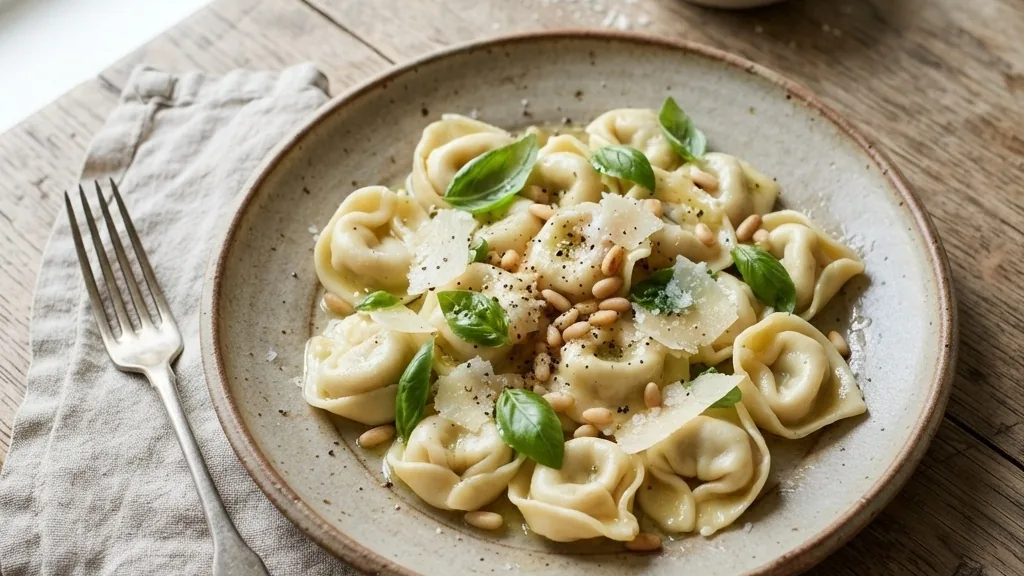
Gluten free tortellini pasta finally exists in enough forms to be worth taking seriously, but the category hides two traps that most pages skip: filled shapes cook in a fraction of the time wheat tortellini needs, and boiling them in the wrong water can push a celiac reader past a daily limit that Catassi and colleagues set at roughly 10 mg. This guide covers the three things you actually came for, which are what to buy, how to make it, and how to cook it without contaminating it, with the numbers behind each decision kept in plain sight.
Standard tortellini starts from durum semolina or soft “00” wheat, and many fillings carry a wheat-crumb binder, so both the shell and the stuffing are gluten vectors. The dish also carries an authenticity spine: the Confraternita del Tortellino and the Accademia Italiana della Cucina deposited an official Bolognese filling recipe at the Bologna Chamber of Commerce on 7 December 1974. Getting a gluten free version right means respecting both that tradition and the celiac safety math at once.
Quick answer: Yes, gluten free tortellini pasta is real and safe when you choose the right label and cook it correctly. In the United States a “gluten-free” claim requires under 20 ppm gluten, while GFCO certification tightens that to 10 ppm or lower. Fresh and frozen options cook in 2 to 6 minutes at a simmer, not the 10 to 11 minutes wheat tortellini needs. If your kitchen also boils wheat pasta, use a separate pot or rinse the cooked pieces under running water, because shared boiling water is the single biggest home risk.
What Gluten Free Tortellini Pasta Actually Is
Gluten free tortellini pasta is a filled, ring-shaped stuffed dumpling made without wheat, rye, or barley, using a dough built from starches and a binding gum instead of the gluten network that holds wheat pasta together. Tortellini are small, folded around a savory filling and traditionally served in broth. Tortelloni are simply larger, which is why most retail “four cheese” products carry that name. Both differ from ravioli, which are flat sealed squares, and from cappelletti and agnolotti, which fold differently.
The shape has a legal identity in Italy. Beyond the 1974 filling deed, a further act on 15 April 2008 registered the shape and process. That authentic filling lists 100 g pork loin, 100 g Parma prosciutto, 100 g mortadella, 150 g Parmigiano Reggiano, one egg, and nutmeg.
- Tortellini: small rings, classically meat-filled, served in capon broth at squares of max 3 by 3 cm.
- Tortelloni: larger rings, usually cheese-filled, the common gluten free retail format.
- Ravioli: flat sealed pockets, which is the shape Cappello’s makes without offering tortellini.
What changes in a gluten free build is the dough chemistry. Rice flour and starches do not form gluten, so a gum such as xanthan takes over the structural job. That single swap drives every downstream difference in cook time, tearing, and sauce behavior described later on this page.
What “Gluten-Free” Legally Means: FDA, EU, and GFCO Numbers
A “gluten-free” label is a numeric promise, not a vibe, and the number depends on who is regulating it. The U.S. Food and Drug Administration requires a food carrying that claim to contain less than 20 ppm gluten under 21 CFR 101.91, a rule published on 5 August 2013 in the Federal Register at 78 FR 47154, effective 4 September 2013, with mandatory compliance from 5 August 2014. The FDA treats “free of gluten,” “without gluten,” and “no gluten” as equivalent claims, and cites 20 ppm as the lowest level reliably detectable across food matrices with validated ELISA methods.
The threshold repeats across borders with small twists. The European Commission, through Commission Implementing Regulation (EU) No 828/2014 applying from 20 July 2016, sets “gluten-free” at 20 mg/kg or less and “very low gluten” at 100 mg/kg or less, and it covers non-prepacked food including restaurants. Both rest on the international reference, Codex Standard 118-1979 from the Codex Alimentarius Commission. National bodies such as the Food Safety Authority of Ireland enforce the EU text locally.
Certification is a stricter, voluntary tier. The Gluten-Free Certification Organization, a program of the Gluten Intolerance Group founded in 2005, holds finished products and every ingredient to 10 ppm or lower against an 80-point standard, prohibits barley-derived ingredients, and runs annual on-site plant audits.
Read the three tiers as a ladder, from weakest to strongest guarantee:
- “Gluten-free” on the label: legally under 20 ppm, self-affirmed by the maker.
- “Certified gluten-free” (GFCO): under 10 ppm, third-party audited every year.
- “Made in a dedicated facility”: no wheat on site at all, removing cross-contact at the source.
The Shared-Pot Rule: The Numbers That Decide Everything
Boiling gluten free tortellini in water that just cooked wheat pasta is the highest-evidence contamination risk in a mixed kitchen, and it is measurable. Weisbrod and colleagues, publishing in Gastroenterology in 2019, found gluten in every gluten free pasta sample cooked in previously-used wheat water, ranging from 33.9 to 115.7 ppm. That is well over the 20 ppm line. The fix is almost embarrassingly simple: rinsing the cooked gluten free pasta under running tap water dropped the readings to 5.1 and 17.5 ppm, both under the limit.
The pot itself is forgiving. In the same study, rinsing the pot with plain water before reuse worked as well as scrubbing with soap, and gluten transfer from a rinsed pot was undetectable. The assay was an R5 sandwich ELISA with a 5 ppm limit of detection, run by Bia Diagnostics.
Batch size flips the answer in larger settings. Work from the Food Allergy Research and Resource Program at the University of Nebraska-Lincoln, by Korth, Clarke, Taylor, and Downs, showed that with 52 g gluten free penne portions, both water and pasta stayed under 20 ppm across five consecutive batches. With 140 g restaurant-size portions, the water exceeded 50 ppm after the fourth batch and 80 ppm after the fifth.
Here is the protocol at a weeknight scale:
- Best: cook in a separate, dedicated pot. Zero decisions, zero risk.
- Good: use shared water, then rinse the cooked tortellini under running tap water before saucing.
- Pot reuse: a plain-water rinse of the pot is enough; you do not need soap.
- Foodservice: never share water, because large portions push readings past the limit fast.
Best Gluten Free Tortellini Brands Compared
The retail category is thin, so the real buying decision comes down to four SKUs measured on safety-relevant axes rather than taste alone. Fresh gluten free tortellini barely exists as a shelf category, and Cappello’s, a well-known gluten free ravioli and gnocchi maker, does not make tortellini at all. Tasting Table ranked Taste Republic number one of 12 gluten free pasta brands in May 2025, which tracks with its certification and dedicated-facility status. The table below compares the four most findable options on format, weight, cook time, and their gluten claims.
| Brand | Format / Weight | Cook Time | Gluten Claim |
|---|---|---|---|
| Taste Republic Four Cheese Tortelloni | Refrigerated, 9 oz | 2-3 min fresh, 4 min frozen | GFCO certified, dedicated facility |
| Conte’s Four Cheese Tortellini | Frozen, 10 oz | 5-6 min at a simmer | Dedicated facility, GF breadcrumb binder |
| Wildgrain Cheese Tortellini | Frozen, 12 oz | 2-4 min from frozen | Every batch tested below 5 ppm |
| Roma Four Cheese Tortelloni | Frozen IQF, foodservice | As few as 2 min, pre-cooked | Dedicated facility, foodservice |
Taste Republic is the benchmark for the celiac shopper. The 9 oz refrigerated pack is GFCO certified, made in a dedicated gluten free facility in Madison, Wisconsin by a Certified B Corp, and delivers 12 g protein per serving. Its dough runs on brown rice flour, potato starch, tapioca starch, whole egg, egg white, flax seed, and xanthan gum; the label calls for 3 quarts of water per 9 oz pack.
Conte’s takes the frozen slot and shows the hidden filling trick: it uses gluten free breadcrumbs precisely because standard tortellini fillings lean on wheat crumb. Its dough is rice flour and corn starch based rather than brown rice, and per an Instacart listing it carries 400 calories, 56 g carbohydrate, 14 g fat, and 1 g sugar, listed around $9.99 for 10 oz on delivery platforms. Wildgrain’s per-batch testing below 5 ppm is the tightest self-reported ceiling here, four times stricter than the FDA line. Every one of these contains milk and egg, so none is allergen-free beyond gluten. If you want dairy-free direction, the plant-based approach behind these [vegan pasta recipes](https://veganstove.com/vegan-pasta-recipes/) points at swaps that a cheese-filled ring cannot offer.
Cooking Technique Specific to Gluten Free Filled Pasta
Gluten free filled pasta cooks fast and splits easily, so the technique that saves wheat tortellini will wreck it. Fresh gluten free tortelloni finish in 2 to 3 minutes, and even frozen formats land between 2 and 6 minutes depending on the brand. Compare that to Barilla Collezione wheat cheese and spinach tortellini at 10 to 11 minutes: anyone reusing a wheat recipe’s timing overcooks a gluten free version into paste. There is no al dente window here, so the doneness cue is simple, which is float plus fork-tender, then out.
Heat management matters as much as timing. A violent rolling boil tears the seams on filled gluten free shapes, so several makers, Conte’s among them, direct you to add the pieces and bring the pot only to a simmer for 5 to 6 minutes. Salt to the maker’s ratio, which for Conte’s is 1.5 tsp salt to 2 quarts of water.
- Simmer, do not boil hard, for filled shapes to keep seams intact.
- Watch the float-and-fork cue; there is no forgiving al dente stage.
- Adjust your sauce, because gluten free starch leaches out and the pasta water emulsifies weakly.
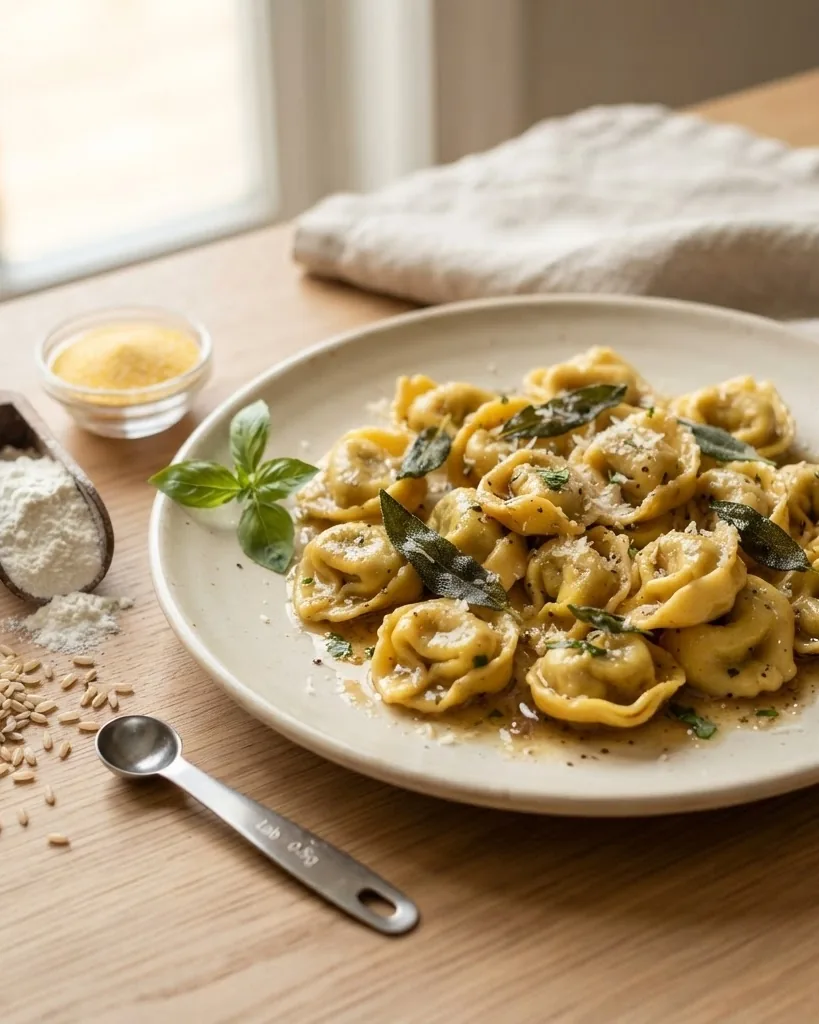
That weak, starchy water is the reason creamy and emulsified sauces flatter gluten free pasta while thin oil sauces expose it. A butter-and-sage or brodo service leans on the pasta’s own character, while a tomato cream or a vodka sauce forgives texture. For a broader sense of how sauce weight pairs with shape, our [specs-first field guide to pasta shapes](https://pastapeak.com/pasta-shapes-and-names/) explains why ridged and hollow forms hold sauce that smooth ones shed.
How to Make Gluten Free Tortellini From Scratch
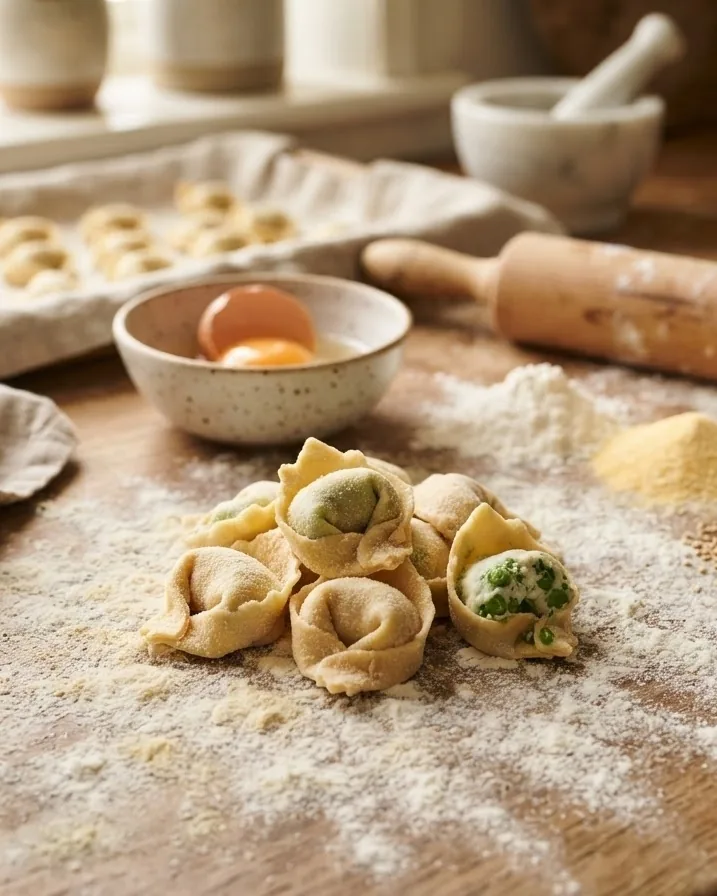
Homemade gluten free tortellini is achievable without a pasta machine, and the whole thing rides on hydration and a rested dough because there is no gluten to stretch. A tested working baseline uses 2 cups (280 g) of an all-purpose gluten free flour blend plus 1 tsp xanthan gum and tapioca starch, bound with whole eggs, extra yolks, olive oil, and 1/3 cup warm water, with more water added by the 1/4 teaspoon until the dough just comes together. The gum replaces the structure gluten would provide, and the rest lets the starches fully hydrate so the sheet stops tearing.
A critical note on equipment: a pasta roller previously used for wheat retains flour in its mechanism, which is a real cross-contact source. Use a dedicated roller or roll by hand.
The filling determines whether your rings survive the pot. Drain the ricotta hard, because a wet filling is the number one cause of blowouts. Keep the cheese blend firm, cut squares no larger than the traditional 3 by 3 cm, fold, and press the seams. If you want the classic meat register instead, follow the 1974 Bologna proportions.
- Rest the dough so starches hydrate and the sheet stops cracking.
- Drain ricotta thoroughly; wet filling causes seams to burst on contact with heat.
- Freeze shaped tortellini in a single layer on a tray, then bag, and cook from frozen with no thaw.
Freeze-ahead is the payoff of making your own. Once the tray-frozen pieces are bagged, they cook straight from frozen, which mirrors how the retail frozen SKUs behave. If you enjoy the from-scratch route, the same patience shows up in these Fluffy Gluten-Free Vanilla Cupcakes! So Easy!, where structure again comes from a gum rather than wheat. For a savory make-ahead in the same spirit, our One Pot Wonder: Sausage & Sun Dried Tomato Pasta! shows how a single vessel keeps a weeknight simple.
Nutrition, Substitution Math, and Who This Is For
Gluten free tortellini serves several different eaters with very different risk tolerances, and matching the product to the reason for avoidance matters more than any single spec. Pooled global figures from Singh and colleagues in Clinical Gastroenterology and Hepatology in 2018 put celiac seroprevalence at 1.4 percent and biopsy-confirmed disease at 0.7 percent, with Europe and Oceania highest at 0.8 percent, children at 0.9 percent versus adults at 0.5 percent. A celiac reader should default to GFCO-certified or dedicated-facility products; someone with elective avoidance has more latitude.
On nutrition, the numbers already on the shelf are the honest ones. Taste Republic reports 12 g protein per serving, and Conte’s lists 400 calories with 56 g carbohydrate per its delivery-platform listing. All of the major products carry milk and egg. If protein density is your goal, pairing gluten free pasta with legume-based sides in the style of these [high-protein recipes](https://brokeandbuff.com/high-protein-recipes/) closes the gap that a starch-heavy ring leaves open.
Substitution is the trap that ruins converted recipes. Convert by weight, not volume, because gluten free shapes vary in density from wheat ones. Cut the cook time hard, and add tortellini to soups and bakes later than a wheat recipe says, because gluten free pasta absorbs liquid and disintegrates faster.
- Match by weight when swapping into any wheat-tortellini recipe.
- Shorten cook time to the maker’s 2 to 6 minute window.
- Add to soup or a bake near the end to avoid mush.
For lighter meals, our ranking of Pasta With Least Calories: A Sourced Ranking, Real Numbers, and Recipes Under 400 gives sourced numbers you can plan around, and for a creamy dairy-free sauce that flatters starchy gluten free water, this Creamy White Bean Alfredo Pasta is a strong template. Shoppers hunting the broader gluten free landscape can also browse this [gluten free pasta and pizza](https://glutenora.com/gluten-free-pasta-pizza/) resource for adjacent products.
Storage and Restaurant Ordering
Storage rules for gluten free tortellini are short and worth following exactly, because these doughs stale and dry faster than wheat. Fresh refrigerated packs, such as Taste Republic, hold up to 5 days in the fridge and up to 1 year in the freezer from the produced-on date. Frozen products cook straight from frozen with no thaw, which preserves the seams. When eating out, the menu tells you almost nothing about the real risk.
The ordering script that protects a celiac diner is about the water, not the ingredient list. Ask whether the kitchen cooks gluten free pasta in a dedicated, separate pot, because a shared pot at restaurant portion sizes crosses the limit quickly per the Nebraska batch data.
- Fresh: use within about 5 days refrigerated.
- Frozen: keep up to 1 year and cook from frozen.
- Restaurant: confirm a dedicated pot, not just a gluten free menu line.
Frequently Asked Questions
Is tortellini gluten free by default?
No. Standard tortellini uses durum semolina or soft wheat dough, and many fillings add a wheat-crumb binder, so both parts contain gluten. Only products specifically labeled gluten-free, meaning under 20 ppm in the United States, qualify. For celiac safety, look for GFCO certification at 10 ppm or a dedicated-facility statement rather than a plain label claim.
Can I cook gluten free and regular tortellini in the same pot of water?
Not without a fix. Weisbrod and colleagues in 2019 found gluten free pasta cooked in used wheat water measured 33.9 to 115.7 ppm, far over the limit. Rinsing the cooked gluten free pieces under running tap water dropped it to 5.1 and 17.5 ppm, both safe. A separate pot is safest, and a plain-water pot rinse before reuse leaves transfer undetectable.
Why did my homemade tortellini burst?
The usual culprit is a wet filling and too violent a boil. Drain ricotta thoroughly before mixing, because excess moisture forces seams open under heat. Then cook at a gentle simmer rather than a rolling boil, since filled gluten free pasta splits when agitated. Press seams firmly, keep squares small, and pull the pieces the moment they float.
Is Taste Republic celiac-safe?
By its stated credentials, yes. The Four Cheese Tortelloni is GFCO certified, which requires 10 ppm or lower with annual audits, and it is made in a dedicated gluten free facility in Madison, Wisconsin. Those two facts together, tighter than the FDA 20 ppm floor and free of shared-line risk, are exactly what a celiac shopper should look for on any product.
What is the difference between tortellini and tortelloni?
Size and filling convention. Tortellini are the smaller rings, traditionally meat-filled and served in broth, sized to squares of about 3 by 3 cm. Tortelloni are larger and usually cheese-filled, which is why most gluten free retail four-cheese products, including Taste Republic and Roma, carry the tortelloni name. The dough and gluten free build are otherwise the same.