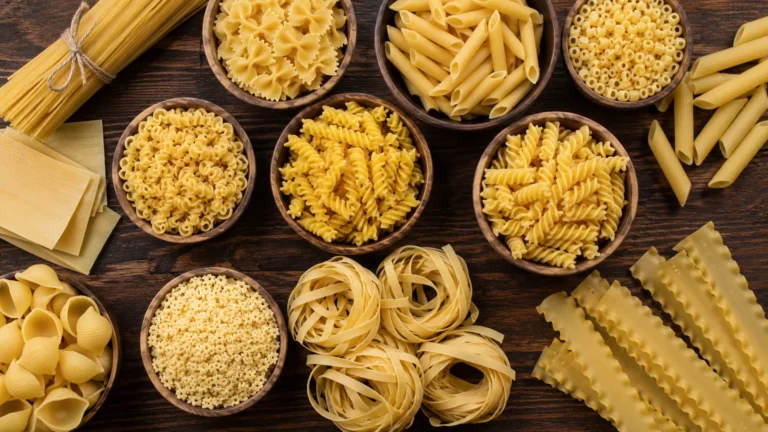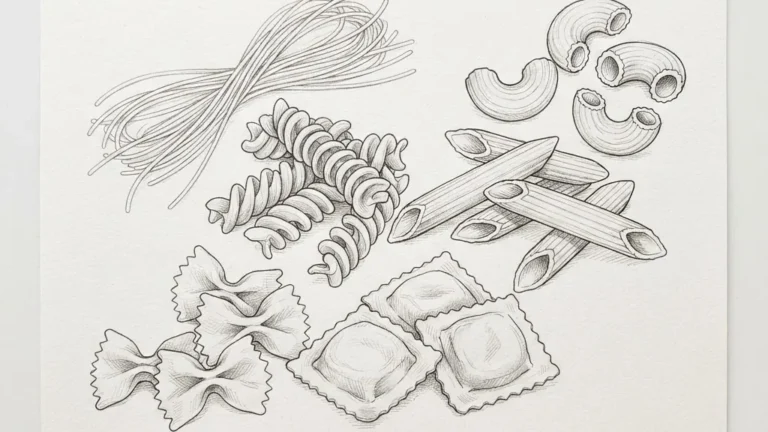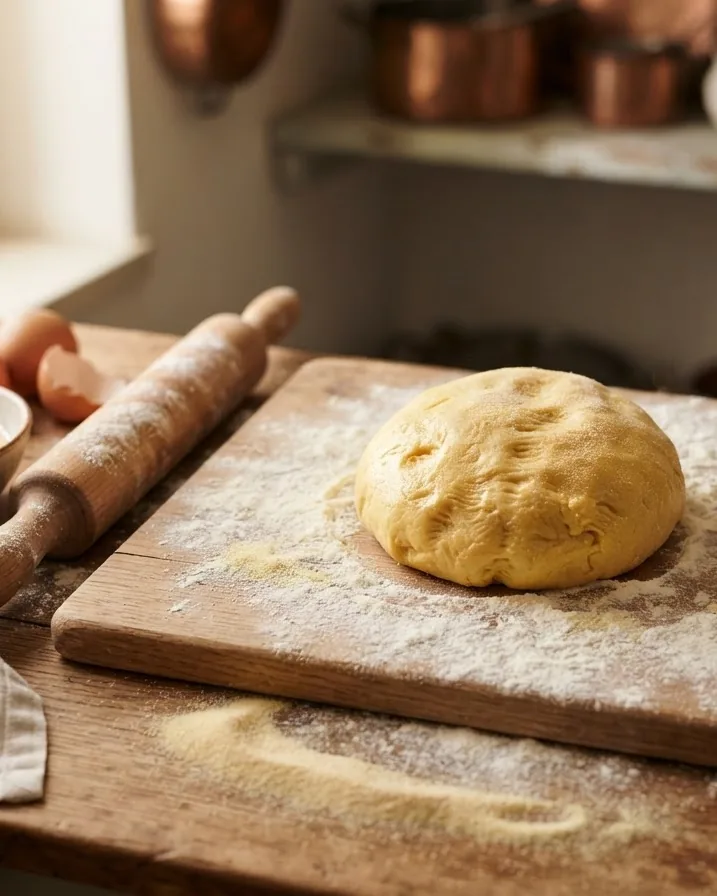
Homemade pasta without machine help comes down to three numbers: how much liquid per 100 g of flour, how thin the sheet has to be, and how long the noodle needs in the pot. Miss those and you get grey, snapping dough. Most hand-rolling guides stop at the instruction to roll it thin and never print a millimetre figure. Bologna does. Italian law does. The U.S. Food and Drug Administration has something to say about the flour itself. What follows is the weighed version, from cupboard flour to drained noodle, plus a short detour into reading pasta shapes and names if you are still deciding what to cut.
Quick answer: homemade pasta without machine equipment works with two doughs. Egg dough runs 100 g flour to 1 whole egg and rolls into sheets for ribbons. Semolina dough runs 100 g semola to 50 g water, a hydration of 50 percent, and is hand-shaped instead of rolled. Knead 8 to 10 minutes, rest at least 30 minutes wrapped, then roll from the centre outward with a straight non-tapered pin to a sheet of 0.6 to 0.8 mm. Cook in salted boiling water for 30 seconds to 5 minutes depending on thickness.
Homemade Pasta Without Machine Gear: Egg Dough or Semola Dough
Two doughs cover every no-machine build. Egg dough belongs to the soft-wheat kitchens of northern and central Italy: roughly 100 g of flour per whole egg, rich enough to roll into a sheet for tagliatelle, pappardelle or lasagne. Semolina dough belongs to the south: durum semola and water, no egg at all.
The choice sets your workload. An egg sheet has to be rolled thin by arm, so it rewards a softer, fattier dough. A semola dough at 100 g flour to 50 g water skips rolling entirely: you pinch, drag and thumb it into pici, orecchiette, cavatelli or trofie. Durum wheat, Triticum durum, is only about 5 percent of global wheat production, which is why most home cupboards default to the egg route by accident rather than by decision. Pick the dough first, then pick the shape it can carry.
America’s Test Kitchen attacked the same problem from the formula side. Dan Souza’s tested hand-rolled pasta formula, published on 6 January 2013, uses 283 g (2 cups, 10 ounces) of all-purpose flour, 2 whole eggs plus 6 large yolks, 2 tablespoons of olive oil and 1 tablespoon of salt. Total time is 1.5 hours plus 1 hour of resting; yield is 1 pound, 454 g, serving 4 to 6.
The extra fat is the mechanism. Yolks and oil coat the flour proteins and limit gluten development, so the sheet stops fighting the pin. That same headnote tells you to go to 7 yolks with a high-protein all-purpose flour such as King Arthur Baking Company’s, and warns that dusting too heavily during rolling causes excessive snapback.
Which shapes actually need a rolled sheet? Only the flat cuts and sheet formats.
- Needs a sheet: tagliatelle, fettuccine, pappardelle, maltagliati, farfalle, lasagne sheets.
- Needs no sheet at all: pici, orecchiette, cavatelli, trofie, strozzapreti, gnocchi.
- Needs a board or comb: garganelli, rolled from a cut square over a ridged surface.
Sheet formats forgive more than strands do. If your first sheet comes out uneven, cut it into squares and build a layered homemade lasagna bake instead of ribbons, because thickness variation vanishes under sauce and cheese.
Flour and Liquid by Weight: The Hydration Numbers
Hydration is the number that decides whether your dough behaves. For semola and water, extruded shapes sit at 35 to 38 percent, hand-shaped orecchiette and cavatelli at 38 to 42 percent, and 50 percent is the forgiving beginner default: 100 g of semola to 50 g of water.
Egg dough hides the same variable inside the shell. Egg size swings it: a 45 g egg and a 65 g egg on the same 100 g of flour differ by roughly 20 points of hydration, which separates a dough that shears from one that smears. Weigh the egg. If it lands short of 50 g, top up with water to hit your target; if it runs heavy, hold back a little white or add flour by the teaspoon. That one habit removes most first-batch failures. A kitchen scale settles the argument.
Reading the bag
The 00 on a bag is an ash number. Italian grading measures the mineral residue left after incineration: tipo 00 caps at 0.55 percent ash, tipo 0 runs 0.55 to 0.65 percent, tipo 1 runs 0.65 to 0.80 percent, tipo 2 runs 0.80 to 0.95 percent, and integrale keeps the lot. Minimum protein under the same rules is 9 percent for tipo 00 and 11 percent for tipo 0, while commercial 00 flours run from about 9 percent up to roughly 14 percent for Manitoba grades.
So a bag of 00 can be weaker than your supermarket plain flour, or considerably stronger. Read the protein figure on the panel before you decide how many yolks to carry.
- All-purpose or plain: the workhorse behind the 283 g test-kitchen formula, and the easiest to hand-roll once yolks and oil are in.
- Bread flour: more protein, more spring, more resting time before the sheet stops contracting.
- Tipo 00: fine and low in ash, strength unknown until you read the panel.
- Semola and semola rimacinata: durum, golden, thirsty, and the base for water doughs at 100 g to 50 g.
- Wholemeal or integrale: bran cuts the gluten network, so expect a shorter, more tearable sheet.
Gluten-free flour is the one case where hand-rolling stops working, since no gluten means no elastic sheet without a binder. Buying is often the saner route, and the trade-offs are laid out in this guide to gluten free tortellini. Cooks who bake and boil across the whole category tend to keep a gluten-free pasta reference within reach.
Per-serving nutrition depends entirely on your final weights, so run your own ingredient list against USDA FoodData Central rather than copying a number off another recipe. Egg-yolk-heavy dough shifts fat upward, which matters if you are tracking macros the way high-protein recipes usually do.
Knead, Rest, and Roll to 0.6 mm
Knead 8 to 10 minutes by hand: heel push, fold, rotate 90 degrees, repeat. The dough is ready when it is smooth and springs back slowly under a finger, and when a cut cross-section shows few air bubbles. Then wrap it and leave it alone for at least 30 minutes.
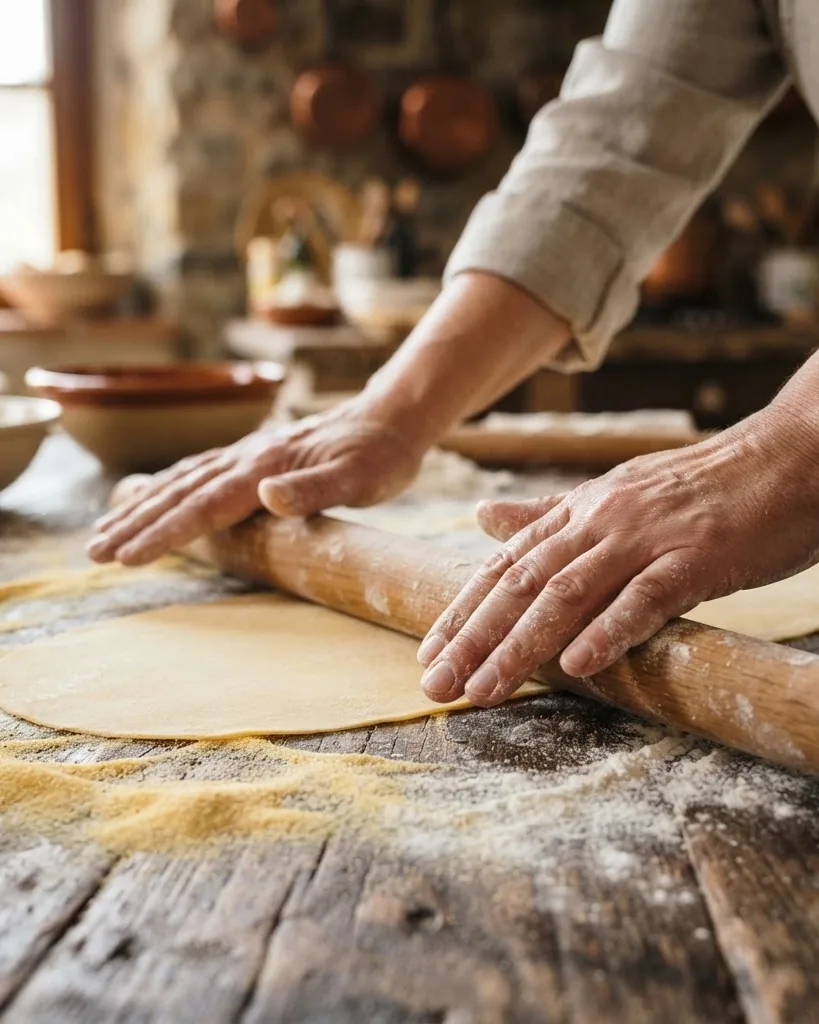
Rest is gluten relaxation, and it is what stops the sheet contracting the moment you lift the pin. Thirty minutes at room temperature is the floor; refrigerated, the dough will hold up to 24 hours. A food processor reaches comparable hydration and early gluten development in around 60 seconds, and the America’s Test Kitchen method runs flour, eggs, yolks and oil to a rough ball in about 30 seconds before finishing by hand. Rolling starts at the centre of the square and moves away from you, one quarter of the dough at a time, the rest kept covered.
Use a long, straight, non-tapered pin. A French pin keeps pressure even across the width of the sheet, while a tapered pin thins the middle faster than the edges, and you discover that at the last quarter when the sheet tears. No pin in the drawer? A wine bottle or a straight-sided glass tumbler does the same job.
Target 0.6 to 0.8 mm, the traditional sfoglia range. Since almost nobody owns a micrometer, use the sheet itself: lay it over your hand or a page of newsprint and you should see the shape underneath. Let the far end hang over the table edge so gravity pulls while you roll, which spares your arms real work.
The Bologna measurements
Bologna wrote its dimensions down. On 16 April 1972, Francesco Majani and Alcino Cesari deposited the tagliatella recipe and its measurements at the Camera di Commercio di Bologna on behalf of the Accademia Italiana della Cucina: 8 mm wide cooked, 6.5 to 7 mm when cut raw, from a sfoglia of 0.6 to 0.8 mm. A gold reference strip sits in a casket at Palazzo della Mercanzia. The notarised wording holds that any other dimension costs the tagliatella its character, and that 8 mm equals 1/12,270 of the height of the Torre degli Asinelli.
Snapback, tearing, sticking
- Dough springs back under the pin: cover it, wait 5 to 10 minutes, resume.
- Snapback on every batch: raise the durum fraction next time for more extensibility.
- Snapback that appears halfway through rolling: you are dusting too heavily.
- Sheet tears at the edges: it dried out, so work one quarter at a time and wrap the rest.
- Sheet sticks to the counter: dust with semolina rather than more flour.
- Dough crumbles: hydration is short, so add water a teaspoon at a time.
No Rolling Pin? Shapes That Skip the Sheet
Four formats need no sheet, no pin and no machine, only your thumbs and a bench. Hydration in the 38 to 42 percent band holds a shape best, which is why hand-formed durum doughs feel stiff compared with an egg dough. Roll a rope, cut it, then work each piece.
- Pici: hand-rolled fat strands, the most forgiving starting point.
- Orecchiette: drag a cut cube with a knife, flip it over your thumb.
- Cavatelli: press and roll each piece to a curl with two fingers.
- Trofie: a thin twist rolled off the palm.
- Strozzapreti: a flattened strip rubbed between both hands.
After the Cut: Nesting, Drying, Freezing, Cooking
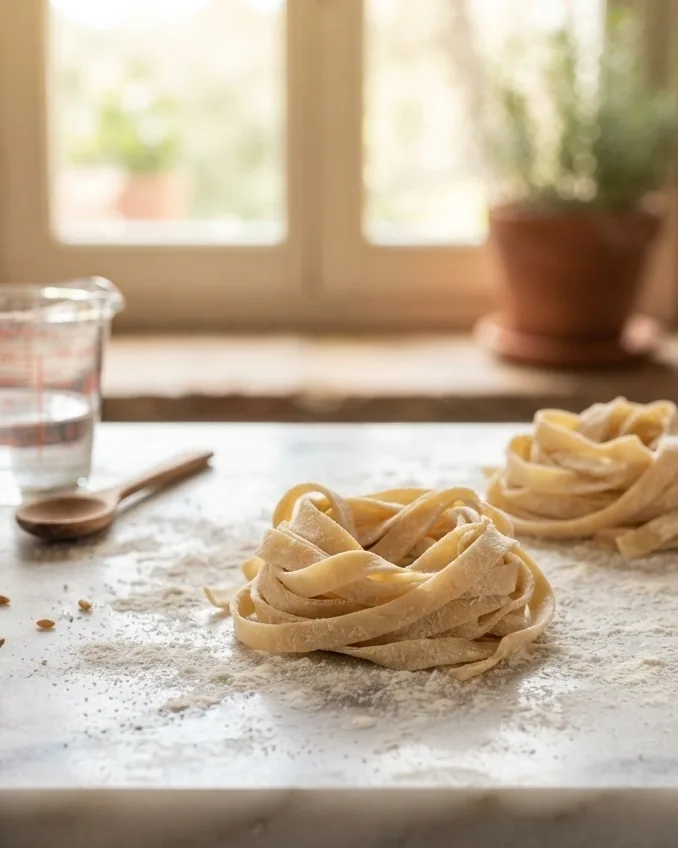
Dust the cut ribbons with semolina, not flour, before you nest them. Flour absorbs surface moisture and glues the coils together, while semolina behaves like tiny ball bearings and keeps the nest loose. Then decide within the hour: cook fresh, dry, or freeze.
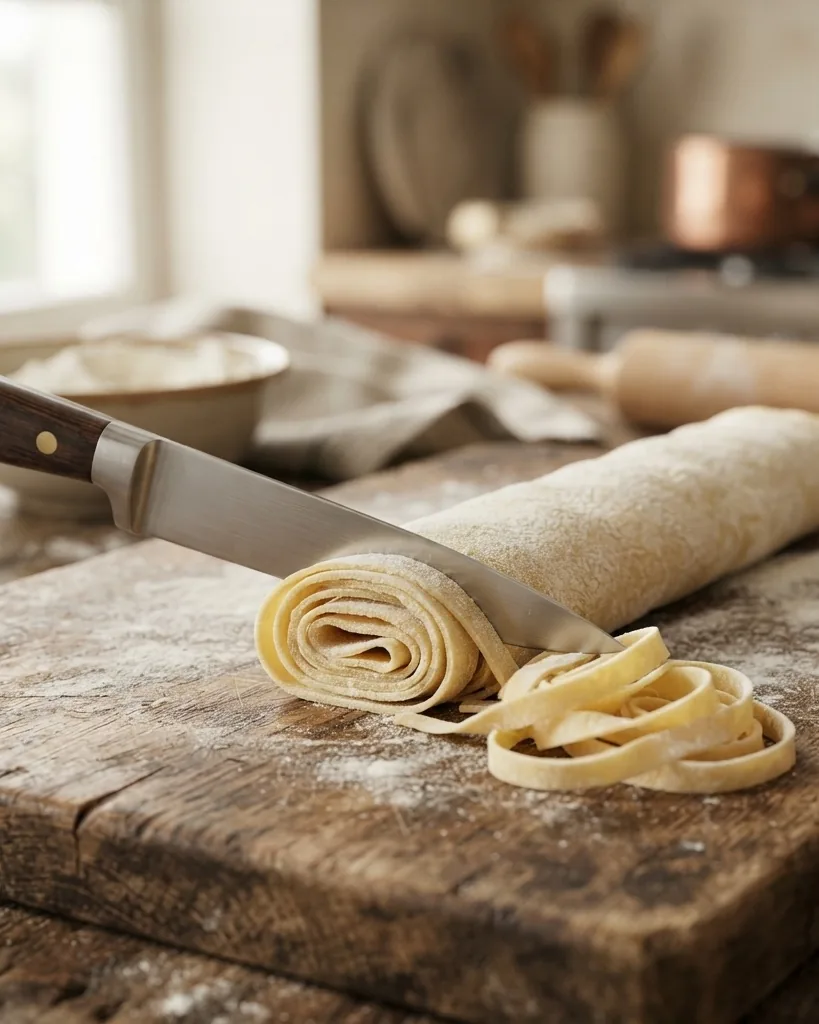
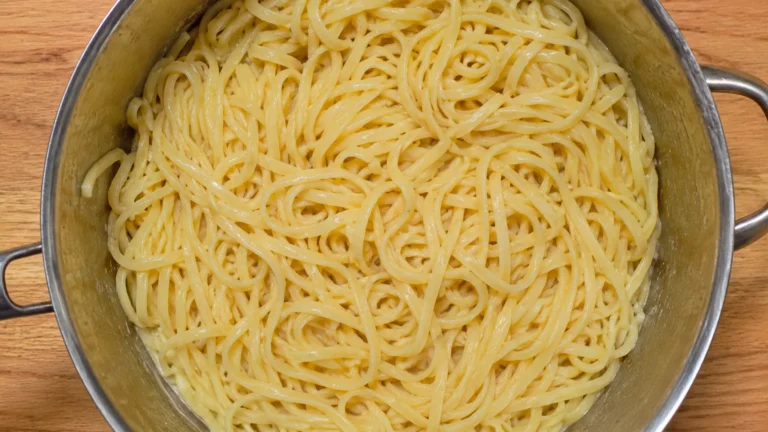
Fresh is the shortest path: salted boiling water, 30 seconds for a very thin sheet, 4 to 5 minutes for thicker cuts, no rinsing afterwards. Drying happens on a rack, a hanger or a floured cloth until the nests are brittle. Dried or frozen homemade pasta needs longer than fresh, so taste rather than trust a timer. Uncooked egg pasta you are not cooking today goes to the refrigerator, since it carries raw egg. Reserve a mugful of starchy cooking water before draining, because that is the emulsifier that makes sauce cling instead of sliding off the strands.
Air-dry the nests briefly before freezing so they hold their shape, then bag them. They go into the pot straight from the freezer.
Pairing follows fat. Egg ribbons carry butter, cream and slow ragu because the dough already brings fat and softness. Durum water doughs have rougher surfaces that grip oil, vegetable and tomato sauces, which is the logic behind most vegan pasta recipes. A pot of creamy white bean alfredo behaves like a cream sauce with no dairy in it at all.
Cut the ribbons short and wide and they hold up in a wok, so a quick noodle stir fry dinner is a fair landing spot for an uneven first batch. Glaze-style sauces need reduction and balance, and a scratch homemade teriyaki sauce shows those mechanics better than a bottle does.
What the Law Says About Flour, Eggs, and Labels
Flour is a raw agricultural product. The U.S. Food and Drug Administration is blunt about it: milling and bleaching do not kill pathogens, so nobody should eat or taste raw flour, dough or batter. That includes the scrap you trim off a sheet.
The record backs the warning. Flour-linked outbreaks have been documented since 2009. In 2016, General Mills voluntarily recalled 10 million pounds of flour from its Kansas City, Missouri plant, sold as Gold Medal, Gold Medal Wondra and Signature Kitchens, after an E. coli outbreak across 20 states, with at least 10 hospitalisations and no deaths. In 2019, an E. coli O26 outbreak hit 21 people in 9 states, and investigators isolated the outbreak strain from an unopened 5 lb bag of Baker’s Corner All Purpose Flour, sold at ALDI, milled by ADM Milling, recalled on 23 May 2019.
The FDA’s guidance on handling flour safely covers the other raw ingredient on your counter too: wash hands and surfaces after contact, keep raw dough away from ready-to-eat food, and use pasteurised eggs when cooking for anyone vulnerable. The U.S. Centers for Disease Control and Prevention tracks the outbreak side of the same problem.
Italy legislates the recipe rather than the hygiene. Under D.P.R. 187/2001, administered by the Ministero dell’agricoltura, della sovranita alimentare e delle foreste, pasta all’uovo must contain at least four whole shell-free hen eggs, no less than 200 g of egg per 1 kg of semola, with moisture capped at 12.50 percent and protein at 12.50 or more per 100 parts dry matter.
D.P.R. 66/2013 later lowered the verification thresholds to 2.50 g ether extract and 0.130 g sterols, down from 2.80 g and 0.145 g. Do the arithmetic on 200 g per 1 kg and you get one 50 g egg per 250 g of flour, far leaner than the home ratio of one egg per 100 g. Your kitchen version outruns the legal minimum by a wide margin. In the European Union, Regulation (EU) No 1169/2011 governs how any of that reaches the shopper, including the Annex VIII rules for pasta that loses moisture while drying.
Frequently Asked Questions
Can I make pasta with no rolling pin at all?
Yes. A wine bottle or a straight-sided glass tumbler flattens a sheet well enough for ribbons. Better still, choose a format that never needs a sheet: pici, orecchiette, cavatelli, trofie or strozzapreti are all shaped by hand from a rope of semola dough at 38 to 42 percent hydration.
How thin should the sheet actually be?
The traditional sfoglia range is 0.6 to 0.8 mm. Lay the rolled sheet over your hand or over newsprint and you should make out the shape underneath. In the Bologna tradition, that sheet is then cut to 6.5 to 7 mm wide raw, which relaxes to 8 mm once cooked.
How long does fresh homemade pasta keep?
Uncooked egg pasta carries raw egg, so it belongs in the refrigerator rather than on the counter if you are not cooking it the same day. Dried nests need to be brittle right through before storage. Frozen nests go into boiling water straight from the freezer and take longer than fresh.
Why does my dough keep shrinking back?
Tight gluten. Cover the dough, wait 5 to 10 minutes and start again, and it will usually behave. If it happens every batch, raise the durum fraction for more extensibility, or add yolk and oil, since fat limits gluten development. Heavy dusting flour during rolling also triggers excessive snapback.
Do I need tipo 00 flour?
No. The 00 on the bag is an ash grade capped at 0.55 percent, and it says nothing about strength: commercial 00 flours range from about 9 percent protein to roughly 14 percent. All-purpose flour works, and America’s Test Kitchen built its hand-rolled dough on 283 g of it.
How long do I knead by hand?
Eight to ten minutes with a heel push, fold and 90-degree rotation. Stop when the surface is smooth and a poke springs back slowly, and when a cut cross-section shows few air bubbles. A food processor covers the same ground in roughly 60 seconds, though the finish still happens by hand.
Start With 100 Grams
Homemade pasta without machine equipment stops being a gamble the moment you weigh things. One hundred grams of flour, one weighed egg or 50 g of water, ten minutes of kneading, thirty minutes of rest, a sheet at 0.6 to 0.8 mm, then salted water for 30 seconds to 5 minutes. Scale up once that works. If the sheet defeats you, drop to a shaped format or a potato dough instead, the way this spring vegetable gnocchi recipe does, and keep the pin for next weekend.