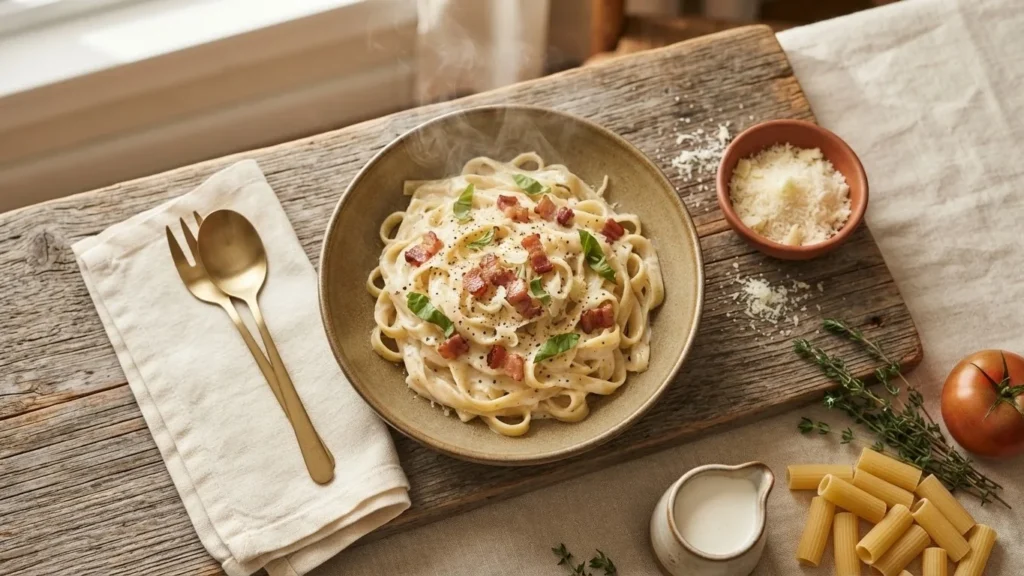
For a pourable, non-greasy cream sauce, use heavy cream with at least 36 percent milkfat and keep it below a boil. The one move to skip: dumping in pre-grated Parmesan off the shelf. The anti-caking starch and the lack of gentle heat are what turn it grainy. Across pasta and cream recipes, the fat percentage of the dairy and the temperature of the pan decide more than the brand on the carton. This guide pulls the quantities straight from published recipes by Vikalinka, Full Glass Events, Serious Eats and Real Simple, keeps every number in its original scope, and tells you where those sources diverge.
The short answer: heavy cream (also sold as heavy whipping cream) is the standard dairy for creamy pasta because its 36 to 40 percent milkfat resists curdling and thickens without flour. Half-and-half works but runs thinner, at 10.5 to 18 percent milkfat. Warm the cream over low heat, never a rolling boil, whisk in freshly grated cheese off the heat, and loosen with reserved starchy pasta water. One base of 1 cup heavy whipping cream, 2 Tbsp butter, and 2/3 cup Parmesan coats 1 lb of pasta. Add acid late, if at all, to avoid breaking the emulsion.
What Goes Into a Working Cream Sauce

A minimal sauce needs three things: the dairy, a hard grating cheese, and salt. Vikalinka’s three-ingredient base uses double/heavy cream with a fat content of at least 36%, freshly grated Parmesan, and salt, enough for 1 lb (500g) of pasta. Full Glass Events builds a richer butter-and-cream version with 1 cup heavy whipping cream divided, 2 Tbsp butter and 2/3 cup Parmesan for the same 1 lb. Keep a mug of pasta water aside before draining; you will need up to 1/3 cup of it to adjust the finish.
Tips for a Cream Sauce That Does Not Break

These sauces fail for reasons you can control. The protein in dairy and cheese denatures and clumps when the sauce gets too hot, when the fat content is too low to hold the emulsion, or when acid hits it at the wrong moment. Food52’s kitchen-rescue work frames curdling as proteins separating out; the fix is prevention first, repair second.
Keep the heat low. Vikalinka’s method warms the cream over low heat and explicitly stops it short of a boil, then takes the pan off the burner before the Parmesan goes in. That off-heat whisking is the make-or-break step: melting cheese into a still-simmering base is what seizes it into grains. Grate the cheese yourself from a block. Pre-grated Parmesan carries anti-caking starch that refuses to melt cleanly, which is a second common route to a gritty sauce.
Fat buys you a margin for error. Real Simple notes that regarding milkfat, “Federal regulations stipulate the percentage of fat in half-and-half”, between 10.5 and 18 percent. At 36 to 40 percent milkfat, it also thickens on its own, so you can skip a flour roux entirely. Half-and-half, at 10.5 to 18 percent, is thinner and more prone to splitting, so watch other liquids in the pan.
Add acid last. Lemon or tomato stirred into the hot base can tip it over; fold it in near the end, off heat. Salt is not optional for flavor here, and reserved pasta water does double duty: the dissolved starch helps the fat and water hold together into a glossy coat rather than pooling. Loosen with that water up to 1/3 cup at a time until the sauce clings to the noodle.
If it breaks anyway, pull the pan off the heat immediately and stop cooking the proteins further; cooling the base is the first repair move before you try to whisk it back together. See also our Creamy Sausage Pasta for the same low-heat approach with a meat base.
Heavy Cream vs Half-and-Half, by the Numbers

The one measurement that predicts how a cream sauce behaves is milkfat percentage. These figures come from Real Simple’s reporting of US federal dairy standards and USDA nutrition data; the per-cup calorie and fat values are for raw dairy, not a finished serving of pasta.
| Dairy | Milkfat | Calories (1 cup) | Fat (1 cup) | Needs flour to thicken? |
|---|---|---|---|---|
| Heavy cream | 36-40% | 809 calories | 86 grams | No |
| Half-and-half | 10.5-18% | 317 calories | 28 grams | Often yes |
Read it this way: if you want the sauce to thicken on heat alone and tolerate a little rough handling, reach for heavy cream. If you are deliberately lightening the dish and will manage the extra liquid, half-and-half gets you there with roughly a third of the calories per cup.
Cajun Chicken Pasta

Build this on the heavy-cream base so the Cajun spice has fat to carry it. Pour heavy cream into the pan and warm it over low heat without boiling, whisk in freshly grated Parmesan off the burner, and toss with long pasta. Loosen with up to 1/3 cup pasta water so the sauce coats rather than clumps around the spice.
Bow Tie Chicken Alfredo
This is the American restaurant-style cream Alfredo rather than the original Roman butter-and-cheese version. For 1 lb of farfalle, use the Full Glass Events ratio of 1 cup heavy whipping cream divided, 2 Tbsp butter and 2/3 cup Parmesan. Cook the pasta 7 to 8 minutes to al dente, melt butter and warm half the cream, add cheese off heat, then the rest of the cream to adjust thickness. Add cooked chicken and the farfalle, which holds pockets of sauce in its folds.
Pasta With Tomato Cream Sauce
The order of operations keeps this one from splitting. Cook a tomato base until it is no longer sharply acidic, then lower the heat and stream in heavy cream rather than adding cream to a boiling pan. The 36 to 40 percent milkfat is what lets the cream absorb the tomato’s acid without curdling. Finish with Parmesan off the heat and loosen with pasta water. Penne or rigatoni catch this clinging, slightly pink sauce well.
Marry Me Chicken Pasta
A sun-dried tomato skillet dish built on seared chicken. Brown seasoned chicken, remove it, then soften garlic and sun-dried tomatoes in the same pan. Lower the heat before adding heavy cream so the tomato acidity does not break the sauce. Whisk in Parmesan off the burner, return the chicken, and simmer gently until the sauce coats a spoon. Serve over short pasta with up to 1/3 cup reserved pasta water held back to adjust. Choose heavy cream here specifically for its curdle resistance against the acid.
Chicken Carbonara
Traditional carbonara uses none at all; the silk comes from eggs and cheese emulsified with hot pasta water, the same starchy-water principle Serious Eats relies on for Roman Alfredo. Temper the beaten egg and Parmesan with a ladle of pasta water, then toss off the heat so the egg thickens without scrambling. Add cooked chicken and crisp pork. Keep the pan off direct heat throughout.
Macaroni and Cheese
Stovetop mac leans on heavy cream to melt cheese into a sauce without a heavy flour roux, since the 36 to 40 percent milkfat thickens on its own. Warm it gently, add grated cheese in handfuls off high heat so the proteins stay smooth, and fold in cooked elbow macaroni. For a baked version with broccoli and chicken, see our Cheesy Chicken Broccoli Mac & Cheese.
Creamy Pasta Sauce With Milk
When you have no cream, a flour-based white sauce (béchamel) does the thickening that milkfat would otherwise handle. You cook flour and butter into a roux, then whisk in milk and simmer until it thickens, then melt in cheese off the heat. This route is also the freezer-friendly one: a flour-based white sauce can be stored in an airtight container in the freezer for up to three months, per Goldilocks Kitchen, whose Emily Sego has been developing recipes for the last 10 years. A pure cream-and-cheese sauce lacks that flour scaffold and separates more readily on freezing.
To approximate heavy cream from milk, the fat has to come from somewhere, usually melted butter whisked into whole milk. It will not whip, but it thickens a sauce acceptably. For the tossed, finished dish, freezing is the weak link: reheat gently with a splash of milk to bring a split sauce back together.
Making and freezing creamy pasta ahead
Freeze the sauce, not the plated dish. For a bake-ahead casserole, Goldilocks Kitchen’s formula is 16 oz pasta cooked very al dente plus 1/2 cup additional broth or sauce, with any crunchy topping frozen separately and sprinkled on only before the thawed casserole goes in the oven. The extra half cup of liquid compensates for what the pasta drinks as it sits.
Is Heavy Whipping Cream Used for Pasta
Yes. Heavy whipping cream and heavy cream are the same product, both at 36 to 40 percent milkfat, and it is the standard choice for creamy pasta. Real Simple reports that federal regulations stipulate between 10.5 and 18 percent milkfat for half-and-half, compared with 36 to 40 percent milkfat for heavy cream. The high milkfat is why it resists curdling and thickens without a roux, which is exactly what a pan sauce needs.
Vikalinka’s pourable sauce uses cream at a fat content of at least 36 percent for a sauce that is rich but still flows. Full Glass Events calls for 1 cup of heavy whipping cream, divided, for 1 lb of pasta. So when a recipe says heavy cream and your carton says heavy whipping cream, you have the right thing.
What Cooking Cream for Pasta Means
“Cooking cream” is a general label for a cream marketed as stable over heat, meant to resist splitting in a hot pan. In US terms the practical equivalents are heavy cream and half-and-half, and the one that matters for cream sauce is fat percentage.
Heavy cream at 36 to 40 percent milkfat is the more forgiving cooking cream because, as Real Simple puts it, it is less likely to curdle than half-and-half’s 10.5 to 18 percent. Half-and-half still works as a lighter cooking cream; you just manage the thinner body and watch for other liquids. Whichever carton you reach for, the cooking rules are identical: low heat, cheese off the burner, acid last.
What 2 Cups of Cream Actually Costs Your Dish, Heavy vs Half-and-Half
The per-cup label numbers are easy to skim past, but this guide’s base pour is 2 cups of cream for 1 lb of pasta, so the real decision happens at double scale. Run the article’s own figures against that base and the choice between dairies stops being abstract. These are raw-dairy totals for the cream alone, before it ever meets the noodle, not finished per-serving values.
- Heavy cream base: 809 calories x 2 cups = 1,618 calories and 86 g x 2 = 172 g fat going into one batch.
- Half-and-half base: 317 calories x 2 cups = 634 calories and 28 g x 2 = 56 g fat for the same pour.
That 984-calorie gap is the price of the margin for error you buy with milkfat: at 36-40 percent, heavy cream thickens on its own and shrugs off rough handling, while half-and-half at 10.5-18 percent hands most of those calories back in exchange for a thinner, more breakable sauce you’ll have to babysit. Spread across a 1 lb batch that typically feeds four, the swap is the difference between a self-thickening sauce and one where you watch every other liquid in the pan.