Pasta shapes and names confuse most shoppers because the same tube can carry five labels across five Italian regions, and no supermarket aisle tells you why. Standing there with a bag in your hand, you do not need poetry. You need to know what the thing is called, where it came from, how wide it is, how long it cooks, and which sauce it was built to hold. That is the whole job. This guide treats naming as the subject rather than an afterthought, and it anchors every claim to a named source so you can check the work.
Most guides give you two of the seven facts that matter per shape. The classification below leans on Oretta Zanini De Vita and her Encyclopedia of Pasta, published by the University of California Press in 2009, and on Italian law, specifically Presidential Decree D.P.R. 9 febbraio 2001, n. 187. Those anchors are what let a page make a promise and keep it.
Quick answer: Pasta shapes and names sort into six Italian macro-categories: pasta lunga (long), pasta corta (short), pasta ripiena (stuffed), pastina (tiny soup shapes), pasta a nastro or sfoglia (ribbons and sheets), and strascinati or pasta fatta a mano (dragged and hand-formed). Names decode through suffixes: -ini and -ine mean smaller, -oni means bigger, -etti and -elle mean smaller. Once you learn that spaghetto becomes spaghettini becomes spaghettoni, hundreds of names become derivable rather than memorized.
The Six Macro-Categories That Organize Every Shape
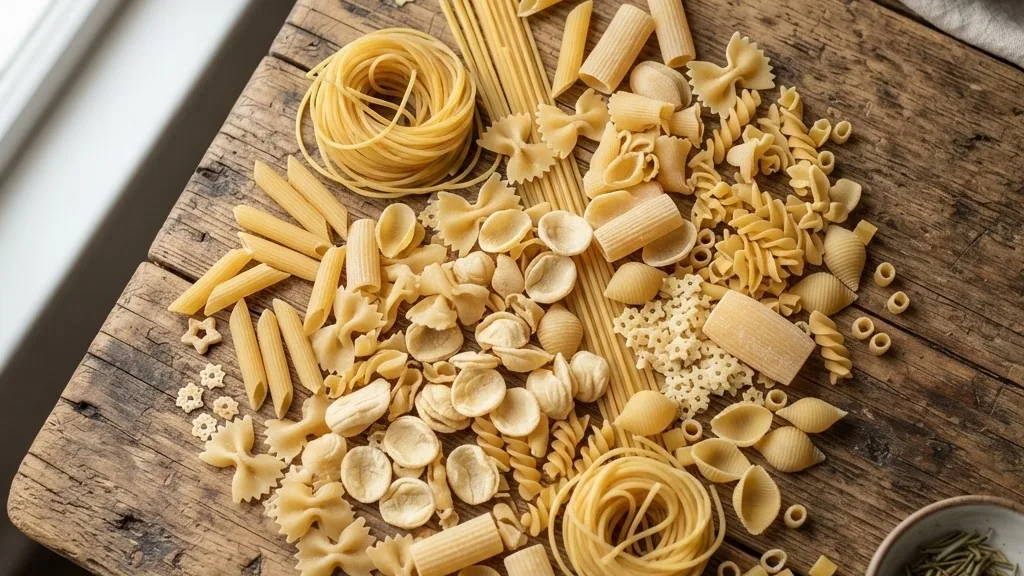
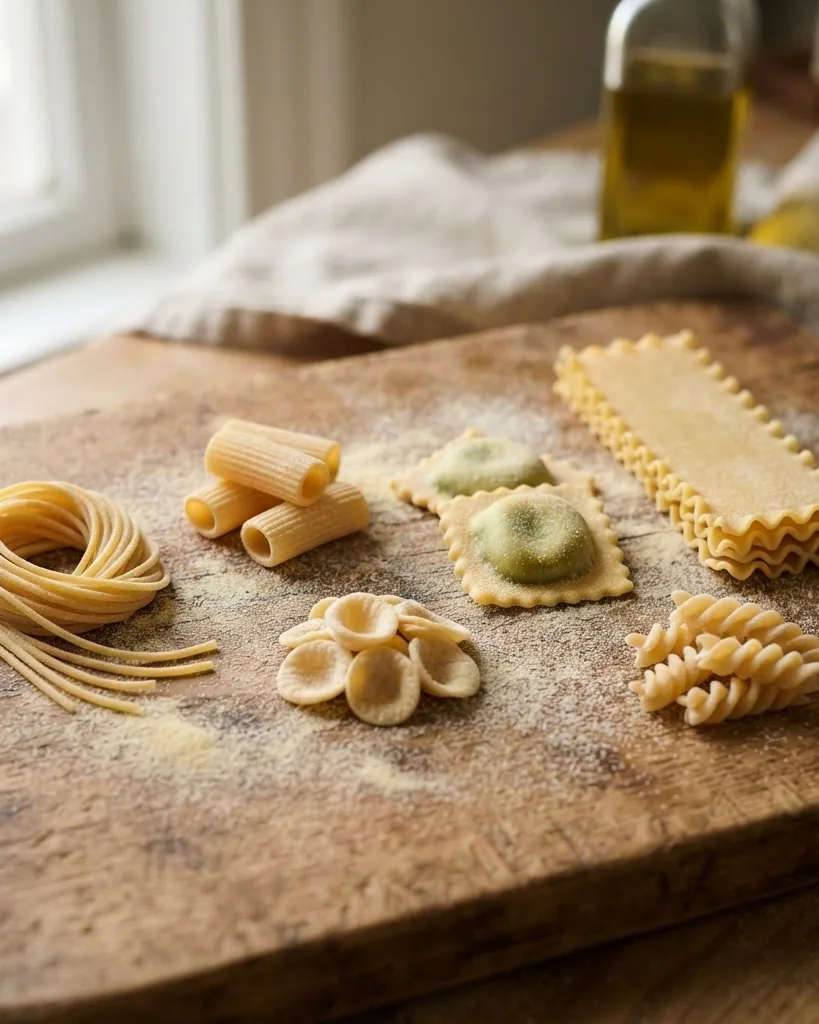
Every pasta shape belongs to one of six families that Oretta Zanini De Vita uses to structure the Encyclopedia of Pasta. Pasta lunga covers long strands like spaghetti and bucatini. Pasta corta covers short cuts like penne and rigatoni. Pasta ripiena covers stuffed forms like ravioli and tortellini. Pastina covers the tiny shapes made for broth. Pasta a nastro or sfoglia covers ribbons and sheets such as tagliatelle and lasagne. Strascinati covers dragged and hand-formed pieces like orecchiette and cavatelli. This spine matters because it predicts behavior: a hollow short tube handles chunky sauce, while a soft-wheat ribbon soaks up meat ragu.
The framework does more than tidy a list. It tells you what a shape wants before you taste anything.
- Pasta lunga: long strands, both solid (spaghetti) and hollow (bucatini), sized in diameter.
- Pasta corta: short cuts, tubes and twists, sold ridged (rigate) or smooth (lisce).
- Pasta ripiena: stuffed pockets, legally a distinct category, with the shortest shelf life.
- Pastina: tiny grains and stars that only make sense in liquid.
- Pasta a nastro / sfoglia: egg-dough ribbons and flat sheets built for absorption.
- Strascinati: hand-dragged shapes with no factory die and often no SKU.
Nobody else classifies this way in a shelf guide, which is exactly why it works.
How to Decode Pasta Names Without Memorizing Them
Italian pasta names are a system, not a random list, and the suffix is the key that unlocks the whole thing. The endings -ini and -ine signal a smaller version, -oni signals a bigger one, and -etti or -elle signal small again. Apply the rule and the map opens: spaghetto becomes the thinner spaghettini and the thicker spaghettoni; penne becomes the small pennette and the large pennoni. This one mechanic is the single most useful thing to carry into a store, because it lets you derive names you have never seen printed anywhere.
The literal translations reward a second look, because they describe the object in your hand.
- Spaghetti: little strings or twine.
- Vermicelli: little worms.
- Farfalle: butterflies.
- Conchiglie: shells.
- Penne: from the Latin penna, meaning feather or quill.
- Rigatoni: from rigato, meaning ridged or lined.
- Cavatappi: corkscrews.
- Garganelli: little chicken gullets.
The naming collision is where shoppers actually get stuck. Angel hair and capellini are the same strand sold under two labels. Ditalini means little thimbles, cannelloni means large reeds, and gemelli means twins, so the shape is literally two strands wound together. When you learn the vocabulary as description rather than branding, a bag stops being a mystery. If you want a dish that shows the payoff, a creamy chicken vodka rigatoni uses ridged tubes precisely because rigatoni was built to trap thick, clingy sauce.
Permits, Inspections and the Laws That Define Real Pasta
Pasta is not a vibe in Italy; it is a legally defined product, and the governing text is D.P.R. 9 febbraio 2001, n. 187, which replaced Legge 4 luglio 1967, n. 580 and was amended by D.P.R. 5 marzo 2013, n. 41. Under article 6, dry pasta sold in Italy must be made exclusively from durum wheat semolina and water; producing dry pasta from soft-wheat flour is prohibited, with a tolerated soft-wheat presence of up to 3 percent and export exemptions under article 12. That single rule shapes texture, protein, and how the shape holds its bite. For an operator, compliance is not optional paperwork, it is the difference between a sellable product and a seized one.
The compositional limits are strict and measurable. For pasta di semola di grano duro, maximum moisture sits at 12.50 percent, ash at a maximum 0.90 percent on dry matter, protein at a minimum 10.50 percent, and acidity at a maximum 4 degrees. Whole-grain semolina pasta must hit ash between 1.40 and 1.80 percent and protein of at least 11.50 percent.
Egg pasta carries its own bar: a minimum of 4 whole hen eggs, meaning 200 grams of egg per 1 kilogram of semolina. Dry pasta must be sold sealed in packs of 100, 250, 500 or 1000 grams, or multiples of 100 grams. Loose sale is prohibited. The full decree is archived through FAOLEX, which you can consult at the FAOLEX document for D.P.R. 187/2001.
Geography adds a second legal layer through the European Commission DOP and IGP scheme, managed in the eAmbrosia register. Pasta di Gragnano IGP, registered in 2013, is the only dry pasta in Italy holding IGP status. Its specification is exacting: durum semolina plus water from the local Gragnano aquifer, with water no more than 30 percent of the total mix, extrusion exclusively through bronze dies, gradual drying at 40 to 85 degrees Celsius for 4 to 60 hours depending on the shape, and packaging within 24 hours at the place of production. Sources differ on the drying window; figures of 6 to 60 hours and 40 to 80 degrees also circulate, so treat the 40 to 85 degree figure as the Commission-aligned number rather than the only one quoted.
Enforcement is not self-declared. The Consorzio Gragnano Citta della Pasta runs an annual third-party audit before the IGP sticker is granted, which is the practical cost of the name: a producer pays for verification, not just for milling. Gragnano earned that infrastructure the slow way. By the early 19th century the town had more than 70 pasta workshops, rising to roughly 100 by mid-century, and Via Roma was laid out in the 18th century specifically to channel sea breezes and sun for open-air drying.
Not every regional shape gets EU protection. MASAF, the Italian Ministry of Agriculture, maintains the PAT list of traditional agri-food products, which recognizes regional shapes that have no DOP or IGP designation. That list is where the handmade obscurities live.
The United States regulates the same foods differently. The US FDA sets standards of identity for macaroni products under 21 CFR Part 139, which governs what may be labelled macaroni, spaghetti, or vermicelli, and the enrichment requirements that come with the term. This is why American “macaroni” collapsed a broad Italian category into elbow macaroni: the label followed the law and the market, not the Italian taxonomy. For general food-safety context on grains and enriched products, the USDA maintains public guidance at the USDA food and nutrition topic hub.
Why Ridges, Bronze Dies and Hollows Change the Sauce
Sauce pairing is not decoration; it is physics driven by surface and shape. Ridged pasta (rigate) and bronze-die extrusion create micro-porosity that grips sauce, because the trafila di bronzo leaves a rough matte finish where PTFE or Teflon dies leave a slick one. Hollow tubes like rigatoni and paccheri scoop and hold chunky ragu inside and out. Long solid strands suit emulsified oil sauces that coat rather than cling. Pastina only works in liquid, because a tiny grain has no structure to carry anything thicker than broth. Egg ribbons behave differently again, since soft-wheat dough with egg absorbs fat-rich meat sauces the way semolina extrusions never do.
That absorption difference is the reason Emilia-Romagna pairs tagliatelle with meat ragu rather than a smooth tomato sauce.
- Ridged short tubes: chunky, meaty, vegetable-heavy sauces that lodge in the grooves.
- Long solid strands: oil and emulsion sauces, aglio e olio, cacio e pepe.
- Egg ribbons: fat-rich meat ragu, because soft-wheat egg dough drinks it in.
- Tiny pastina: broths and light liquids only.
If you want to see the ribbon logic in a full build, the classic homemade lasagna uses flat egg sheets precisely because they absorb layered sauce without turning to mush. The same reasoning explains why the sister-site breakdown of a fiery arrabbiata sauce works so well over ridged short cuts rather than delicate long strands.
The Naming Problem: One Shape, Five Names
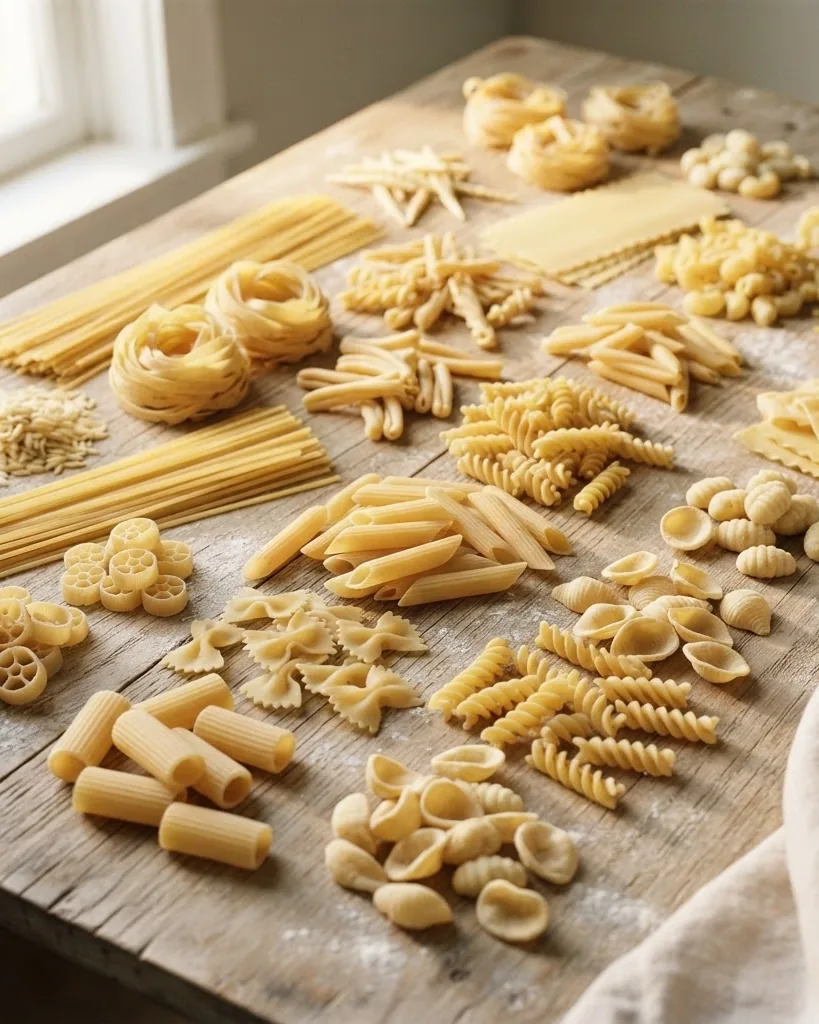
The core reason this query exists is that one shape can carry many names across regions, and one name can describe different shapes depending on where you stand. Oretta Zanini De Vita documented exactly this in the Encyclopedia of Pasta, organizing entries A to Z within the six macro-categories and giving each shape its primary ingredients, technique, variant names, and locality. A cook in Puglia and a cook in Sicily can make what looks like the same twist and call it two different things, both correct in their own place. That is not sloppiness. It is a living naming system that never had a central authority to freeze it.
Italian-American inventions compound the confusion. Manicotti is largely an American shape name, and “macaroni” in the United States collapsed a broad Italian category into elbow macaroni alone.
Zanini De Vita also uses the book to debunk the Marco Polo origin myth explicitly. Pasta was a Mediterranean staple long before the 13th century, so the story of Polo carrying noodles home from China is charming and false. The Encyclopedia, published in the California Studies in Food and Culture series as volume 26 and running to xxi plus 374 pages, is available on JSTOR and the Internet Archive if you want the primary reference rather than a retelling.
The canon is also still open. Cascatelli, designed by Dan Pashman, host of The Sporkful, launched in early 2021 around three named criteria he coined: sauceability, forkability, and toothsinkability. The name means little waterfalls. New shapes still get invented, which means “all pasta shapes and names” is a moving target, not a closed dictionary.
The Tagliatella Standard and the Numbers Behind the Plate
The most precise pasta measurement in the world is not a law at all; it is a deposited convention held in Bologna. On 16 April 1972, Francesco Majani and Alcino Cesari, acting for the Accademia Italiana della Cucina with the Confraternita del Tortellino, deposited a notarial act and a gold sample tagliatella at the Camera di Commercio di Bologna, housed in the Palazzo della Mercanzia. The official width is 8 millimetres cooked, roughly 6.5 to 7 millimetres raw depending on dough firmness, and it is defined as 1/12,270 of the height of the Torre degli Asinelli, which stands at 97.2 metres. Traditional sfoglia thickness runs about 0.6 to 0.8 millimetres. This is a standard by agreement, not an EU designation, and saying so is the honest part.
The scale numbers are just as concrete. Italy consumes 23.3 kilograms of pasta per capita per year, the highest in the world, ahead of Tunisia at 17 kilograms, Venezuela at 13.6, Greece at 12.2, and Peru at 9.9.
- World production: roughly 17 million tonnes in 2023, made in 52 countries.
- Growth: up from 9.1 million tonnes about 25 years earlier, an increase of around 85 percent.
- Top producer: Italy, at 3.9 million tonnes.
- 2024 exports: Italy shipped 2.42 million tonnes, up 9.1 percent year on year, worth 4.02 billion euros, up 4.8 percent, to nearly 200 countries.
- EU market: consumption passed 4 million tonnes for the first time in 2024, at an average selling price of 1.50 euros per kilogram.
These figures come from Unione Italiana Food, formerly AIDEPI, built on ISTAT data, and are echoed by the International Pasta Organisation, which also runs World Pasta Day on 25 October, and by UN.A.F.P.A. at the EU level. Preferences split by country too: per a Unione Italiana Food and DOXA survey of more than 5,000 respondents, Italians prefer short ridged shapes, British and American shoppers prefer long, Germans lean toward fresh pasta, and the French favor short smooth shapes. Per-capita consumption outside Italy in the 2023 release put the US at 8.8 kilograms, France at 8.3, and Germany at 7.9.
Substitutions, Storage and Pronunciation You Can Use Tonight
The practical rescue you need most is a substitution that behaves the same, not just one that looks similar. If a shape is missing, match it by category and surface rather than by name. No orecchiette on the shelf means conchiglie or cavatelli, because all three are small concave catchers that trap the same sauces. No rigatoni means penne rigate, since both are ridged tubes built for chunky ragu. Storage follows the six categories too: dry semolina pasta keeps for a long sealed shelf life, fresh pasta is far more perishable, and stuffed pasta ripiena spoils fastest because it carries a moist filling. Legal categories, not marketing, define those differences.
Pronunciation is the quiet long-tail nobody owns, so learn the four that trip people most.
- Gnocchi: NYOH-kee, with a silent g.
- Bucatini: boo-kah-TEE-nee.
- Orecchiette: oh-reck-YET-teh, meaning little ears.
- Cavatappi: kah-vah-TAH-pee, meaning corkscrews.
If you are cooking around dietary needs, the naming logic still holds. A guide to vegan pasta and a clear read on whether pasta is vegan both hinge on the water-versus-egg distinction set in D.P.R. 187/2001, since egg pasta by law contains 200 grams of egg per kilogram of semolina. Those needing wheat alternatives can compare shapes and doughs through a gluten-free pasta resource. For a lighter shape-forward weeknight plate, the one-pan garlic shrimp and orzo shows how a pastina-adjacent grain shape carries a quick sauce without turning heavy. And if you enjoy the science of how ingredients behave under heat and extraction, the deep dive into coffee science uses the same porosity-and-surface thinking that explains why a bronze-die shape grips sauce.
Frequently Asked Questions
Is angel hair the same as capellini?
Yes, angel hair and capellini are essentially the same very thin long strand sold under two labels, which is why shoppers get confused comparing bags. Both belong to the pasta lunga family and suit light oil or seafood sauces rather than heavy ragu. Some brands market them slightly differently, but functionally you can swap one for the other without changing your dish.
What is the difference between manicotti and cannelloni?
Cannelloni are large reeds, an Italian tube you stuff and bake, while manicotti is largely an American shape name for a similar ridged stuffed tube. Cannelloni traces to the Italian taxonomy documented by Oretta Zanini De Vita, and manicotti reflects Italian-American kitchens adapting the format. In practice both hold a ricotta or meat filling under sauce, so cooks often use the terms interchangeably.
Why does the same pasta shape have different names?
The same shape carries different names because Italian regions developed their own vocabularies with no central naming authority, a pattern Oretta Zanini De Vita mapped across localities in the Encyclopedia of Pasta. A twist made in Puglia and one made in Sicily can look identical yet carry separate local names, both correct. The suffix system, where -ini means smaller and -oni means bigger, adds another layer of variation.
Can dry pasta legally be made from soft-wheat flour in Italy?
No. Under D.P.R. 9 febbraio 2001, n. 187, article 6, dry pasta sold in Italy must be made exclusively from durum wheat semolina and water, and manufacturing it from soft-wheat flour is prohibited. A soft-wheat presence of up to 3 percent is tolerated, and export production has exemptions under article 12, but domestically the durum rule is the law rather than tradition.
What makes bronze-die pasta better for sauce?
Bronze dies, the trafila di bronzo, drag the dough across a rough metal surface and leave micro-porosity, giving the pasta a matte, slightly gritty finish that grips sauce far better than the slick surface left by PTFE or Teflon dies. Pasta di Gragnano IGP requires extrusion exclusively through bronze dies for this reason. The rougher surface is why the same sauce clings noticeably more to a quality bronze-die shape.
How precise is the official tagliatella measurement?
Extremely precise, though by convention rather than law. On 16 April 1972 the Accademia Italiana della Cucina deposited a gold sample tagliatella at the Camera di Commercio di Bologna, fixing the width at 8 millimetres cooked, defined as 1/12,270 of the Torre degli Asinelli height of 97.2 metres. It is a deposited standard, not an EU designation, which distinguishes it from protected marks like Pasta di Gragnano IGP.