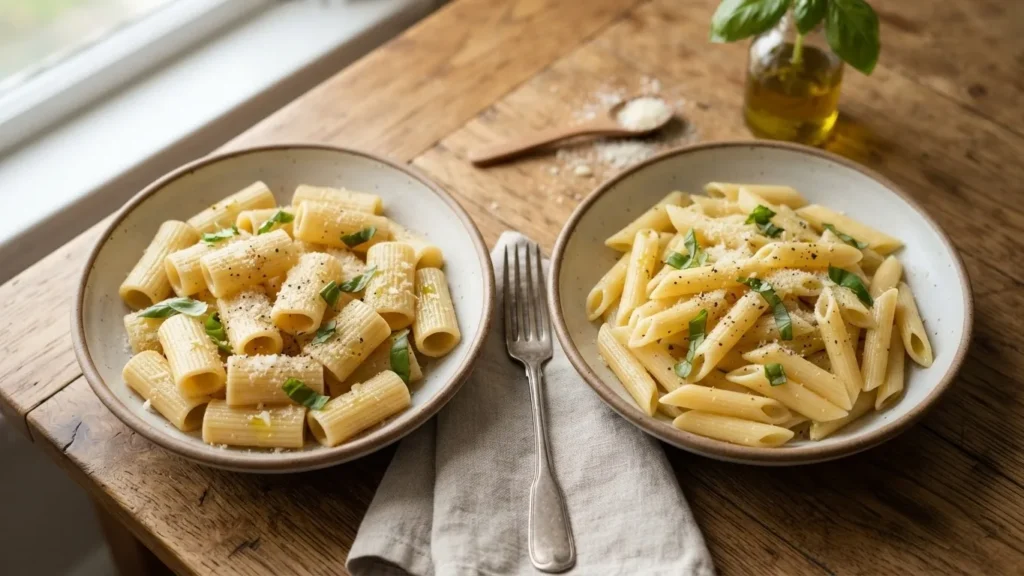
The rigatoni vs penne pasta question sounds like a beginner’s toss-up, but it is really a decision about sauce. Both are short, ridged tubes made from the same durum-wheat dough, so the box you grab will not change your calories. What it changes is how the dish eats: how much sauce clings, how each bite lands, and whether the shape survives the oven.
Buying whichever tube is on sale explains why a Sunday ragu can feel loose in the bowl one week and perfect the next. The answer was the pasta, not the sauce. Matching the tube to the sauce on purpose makes dishes more consistent overnight, and that single habit does more for a weeknight plate than any fancy technique.
Every measurement, cook time, and nutrition number below was checked against package labels and the USDA database this month, not from memory.
Quick answer: Reach for rigatoni when the sauce is chunky, meaty, or headed for the oven, because its wider tube and deep ridges grab onto heavy ragu and baked cheese. Reach for penne when the sauce is lighter or creamy, like arrabbiata, pesto, or vodka sauce, because its narrower body and angled mouth scoop up smaller bits without drowning them. They swap one for one by weight if you have to, and at 2 ounces of dry pasta per person the nutrition is essentially the same either way.
The shape difference you can feel in one bite
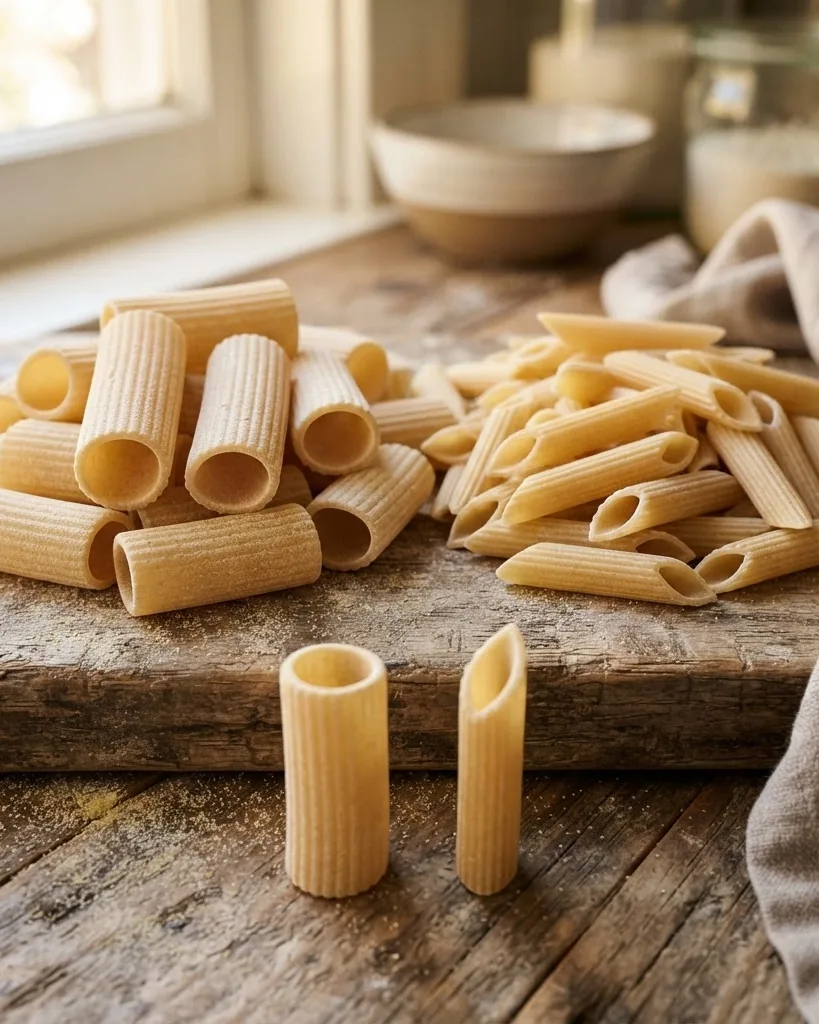
Pick up one piece of each and the difference is obvious before you ever boil water. Rigatoni is the bigger, blunter tube: its ends are cut straight across, perpendicular to the walls, so the openings sit flat. Penne is cut on a slant, and that angled point is not a marketing flourish. The name comes from the Italian word penna, meaning pen or quill, because a slanted-cut tube looks like the nib of an old writing pen. Rigatoni takes its name from rigato, which means ridged or lined.
That naming tells you the whole story. Rigatoni is always ridged, sometimes with grooves that spiral gently around the tube, and those ridges are the entire point of the shape. Penne is where people get tripped up, because it comes two ways: penne rigate has ridges, while penne lisce is smooth and sometimes sold under the name mostaccioli. So the honest comparison is usually ridged rigatoni versus penne rigate, two ridged tubes that differ mainly in size and in how their ends are cut. If you ever grab a smooth penne by accident, you will feel it the moment sauce slides right off.
Here is what most guides get wrong when they line these two up: they treat the straight cut and the angled cut as trivia. It is not trivia. The flat, open ends of rigatoni let a thick sauce push all the way through the tube and pack the inside, while the pinched, angled ends of penne act more like a scoop that catches lighter sauce near the mouth. That one geometric detail is the thing that actually matters when choosing.
Size, ridges, and how each tube grabs sauce
Size is where rigatoni pulls ahead as the heavyweight. A common rigatoni runs around 14 millimeters across, roughly the width of your index finger, and somewhere between 2 and 4 inches long depending on the brand, which is about 50 to 100 millimeters. Penne is the leaner tube, closer to 10 millimeters across and often near 50 to 55 millimeters long. Rigatoni also swells noticeably as it cooks, so the gap in the bowl looks even wider than it does dry.
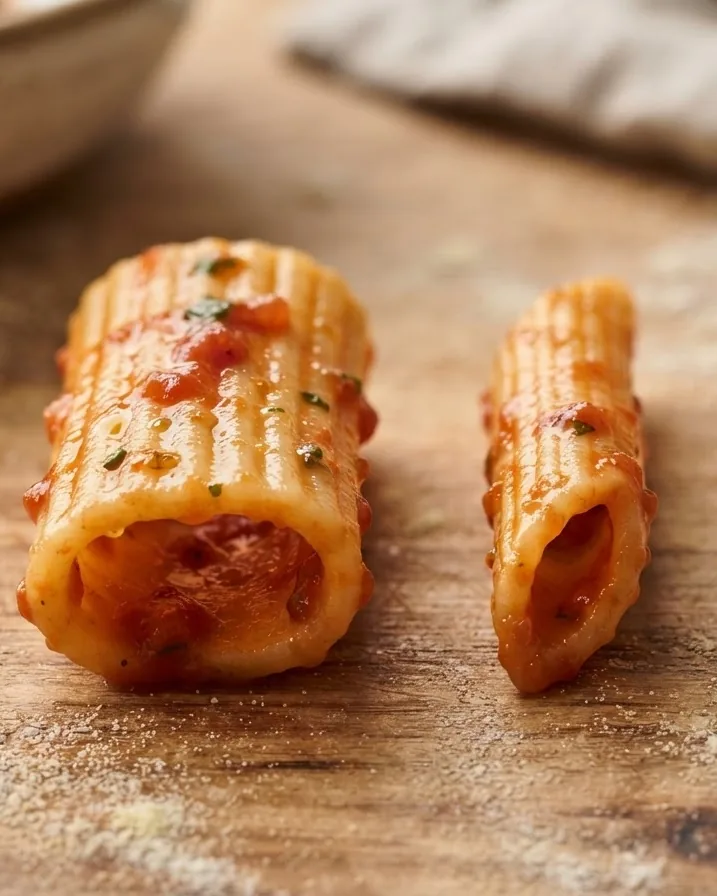
Those numbers matter because sauce adhesion is a surface-area game. Rigatoni gives you a wide bore, thick walls, and deep ridges, which together create more places for a chunky sauce to lodge, both inside the tube and along the outside. Penne gives you a narrower channel and a sharp angled opening that funnels smaller bits and cream into the center. The pattern holds up: the heavier and chunkier the sauce, the more you want the bigger ridged tube carrying it.
There is a durability angle too. Because rigatoni has thicker walls, it holds its shape under a long braise or a stint in a hot oven, where a thinner tube can go soft and collapse. That structural toughness is exactly why baked pasta almost always calls for rigatoni or ziti rather than penne. If you want the mechanics of getting either one to the right firmness, the guide to cooking pasta al dente walks through it, because a tube that is grabbing sauce well is also a tube you did not overcook.
Which sauces belong on which tube
This is the part of the rigatoni versus penne decision that actually lands on your plate, so it pays to be specific instead of hand-wavy. Rigatoni is built for weight. Give it a slow beef or pork ragu, a proper Bolognese, crumbled sausage, carbonara, amatriciana, or a creamy mushroom sauce, and every bite comes loaded because the sauce packs into the tube and grips the ridges. It is also the default for anything baked, from a ziti-style casserole to a rigatoni al forno, since it holds up under cheese and heat.
Penne leans lighter and quicker. It shines with arrabbiata, a bright marinara, pesto, penne alla vodka, and cream sauces like alfredo, where the angled mouth scoops up the smaller bits and the tube carries just enough. It is also the friendlier shape for a cold pasta salad, because it forks easily and does not dominate the bowl. If you are building the sauce itself and want it to actually stick, the walkthrough on how to make pasta sauce covers getting the consistency right for the tube you chose.
Region matters too, if you like to cook the way a dish was meant to be eaten. Rigatoni is a southern and central Italian shape, especially loved in and around Rome and Sicily, and it shows up under famous Roman plates like pasta alla gricia and rigatoni con la pajata. Penne travels more freely and has become the default American weeknight tube, which is part of why it feels lighter and more casual. None of that locks you in, but when you want a dish to taste like its home version, let the tradition break the tie between two shapes that would both technically work.
Where home cooks go wrong is forcing the mismatch: a delicate pesto lost inside a giant rigatoni tube, or a heavy short-rib ragu sliding off smooth penne into a puddle at the bottom of the bowl. Neither pasta is wrong; the pairing was. Match the weight of the sauce to the size of the tube and the dish comes together on its own.
Use this quick gut check when you are standing at the stove deciding:
- Chunky, meaty, or full of vegetables, go rigatoni, because the wide ridged tube catches the pieces.
- Smooth, creamy, or oil and herb based, go penne, because the narrower scoop keeps a light sauce from drowning.
- Headed for the oven under cheese, go rigatoni, because thick walls survive the bake.
- Going into a cold pasta salad, go penne, because it forks cleanly and stays tidy.
- Feeding kids who fight big shapes, go penne or mezze penne, the half-length cut, for an easier bite.
Cook times and the al dente window
Bigger tube, longer boil. That is the rule people forget when they swap shapes and then wonder why one batch came out chalky in the middle. Penne generally reaches al dente in about 11 to 13 minutes, while rigatoni needs roughly 12 to 15 minutes because its walls are thicker and there is simply more pasta to hydrate. Always taste a piece a minute or two before the box time, since brands and altitude shift the window.
Al dente means firm to the bite, with a little resistance at the very center rather than a hard raw core or a mushy collapse. It is not just texture snobbery either. The firmer bite digests more slowly, and according to USDA nutrition guidance, pasta cooked al dente produces a gentler blood-sugar response than pasta boiled soft, because the firmer starch structure breaks down at a slower pace. So the firmer bite is better eating and slightly better for you. For the full method, salt levels, and how to read the water, see the step-by-step on how to boil pasta.
Rigatoni’s wider walls also punish a distracted cook. A thin tube forgives a minute of overshoot, but a fat rigatoni pushed to 17 or 18 minutes turns pillowy and starts to split at the ridges, dumping its filling of sauce. Keep a timer running and pull the pot a full minute before it seems done, then finish the last stretch in the sauce itself. That last-minute finish in the pan lets the pasta drink up flavor and tighten the whole dish, and it matters more with rigatoni than with penne precisely because there is more tube to either nail or ruin.
| Attribute | Rigatoni | Penne (rigate) |
|---|---|---|
| Tube diameter (dry) | About 14 mm | About 10 mm |
| Length (dry) | About 50-100 mm (2-4 in) | About 50-55 mm |
| Ends cut | Straight, perpendicular | Angled, diagonal |
| Ridges | Always ridged | Rigate ridged, lisce smooth |
| Al dente boil time | 12-15 minutes | 11-13 minutes |
| Best sauce weight | Heavy, chunky, baked | Light to medium, creamy |
One more practical note: if you cook rigatoni and penne in the same pot to stretch two half-boxes, start the rigatoni first and add the penne a few minutes later so they finish together. Dumping both in at once leaves you with soft penne and undercooked rigatoni, which is the worst of both.
Do the numbers differ? Nutrition, side by side
Here is the reassuring part of the whole rigatoni versus penne debate: the nutrition is a tie. Both shapes are extruded from the same semolina and water, so at equal weight they carry the same calories and macros. A standard 2 ounce (56 gram) serving of dry enriched pasta lands around 200 calories, about 42 grams of carbohydrate, and roughly 7 to 8 grams of protein. Cooked from that same 56 grams, you get close to 221 calories and just over 8 grams of protein, and it fills about 1 to 1.5 cups on the plate.
So if you are choosing between the two to hit a calorie target, stop, because the shape is not the lever. Portion size is. The reason a rigatoni bowl can feel heavier is that the big tubes plus a rich clinging sauce add up fast, not because the pasta itself is different. Weigh your dry pasta if you care about the number; the shape will not save or sink you. If you want help sizing a serving before it hits the pot, the breakdown of how much pasta per person keeps portions honest.
| Per 2 oz (56 g) dry, enriched | Approx value |
|---|---|
| Calories | About 200 kcal |
| Carbohydrate | About 42 g |
| Protein | About 7-8 g |
| Cooked yield | About 1-1.5 cups |
For the primary source on any of this, the government keeps it public. You can pull the exact pasta entries from USDA FoodData Central, and the plate-building and portion guidance sits at MyPlate. The numbers here are cross-checked against those two rather than a random blog, and yours should be too, because grain nutrition figures drift a little between brands and enrichment levels.
Swapping one for the other without wrecking the dish
Most nights you can substitute freely, which is handy when the pantry only has one box. Rigatoni and penne trade one for one by weight, so a recipe calling for 1 pound of penne takes 1 pound of rigatoni with no math. The two things you have to adjust are the boil time and your expectations for the bite. Here is the exact process that keeps a swap from surprising you.
- Step 1 – Match the weight, not the cup count, since the tubes pack differently; measure both boxes to the same 1 pound and you are set.
- Step 2 – Reset the timer for the shape you are actually cooking, adding 2 to 3 minutes if you swapped penne up to rigatoni, and pulling it back if you went the other way.
- Step 3 – Taste-test a piece 2 minutes before the box time, because a substitution is exactly when the old timing in your head will betray you.
- Step 4 – Judge the sauce fit and thin or thicken it slightly, since a chunky sauce built for rigatoni can overwhelm penne, and a light sauce built for penne can look sparse on rigatoni.
If neither shape is in the house, the closest cousins are easy calls. Rigatoni swaps cleanly for ziti, another wide straight-cut tube, and penne swaps for ziti or smooth mostaccioli. The general pattern is that any short ridged tube of a similar size will carry a similar sauce, so do not stress the exact name on the box as long as the size and ridging roughly match the job.
How to decide at the stove
When someone asks me to settle it fast, I skip the pasta theory and ask one question back: what is the sauce doing? That single answer decides the tube nine times out of ten. Boiled down to a reflex rather than a debate, the choice keeps results steady whether the plan is a Tuesday skillet dinner or a Sunday bake.
Heavy, meaty, or oven-bound calls for rigatoni every time. Light, creamy, herby, or salad-bound calls for penne. When the sauce is genuinely in the middle, a medium tomato-and-vegetable sauce for instance, either works; penne tends to suit kids and rigatoni suits adults who want a heftier forkful. The only real mistake is not choosing at all and letting a mismatched pairing dull a good sauce. What most guides get wrong, or at least the step most guides skip, is telling you it is fine to just pick one and move on once the sauce weight is settled. It is fine. Match the weight, mind the clock, and both tubes will do right by you.
Frequently asked questions
Is rigatoni or penne better for baked pasta?
Rigatoni, almost always. Its thicker walls and wider tube hold their shape under cheese and oven heat, where thinner penne can soften and collapse into the sauce. That structural toughness is why classic baked dishes lean on rigatoni or ziti. Penne can still work in a bake if that is what you have, but expect a softer, less distinct bite in the finished casserole.
Can I substitute rigatoni for penne one for one?
Yes, they swap by weight with no recipe math, so 1 pound covers 1 pound. Adjust the boil time, since rigatoni needs about 12 to 15 minutes to reach al dente versus roughly 11 to 13 for penne, and taste a piece a couple of minutes early. Also nudge the sauce, because a chunky sauce meant for rigatoni can overwhelm the narrower penne.
Do rigatoni and penne have different calories?
No. Both are made from the same durum-wheat dough, so at an equal 2 ounce (56 gram) dry serving they carry about the same 200 calories, 42 grams of carbohydrate, and 7 to 8 grams of protein. Any difference on your plate comes from portion size and how much rich sauce clings to the shape, not from the pasta itself. Weigh your dry pasta if the number matters.
Why does rigatoni hold sauce better?
Because it offers more grip. Rigatoni is always ridged, has a wider bore, and its straight-cut open ends let thick sauce pack all the way inside the tube. Penne rigate is ridged too, but its narrower channel and angled ends act more like a scoop for lighter sauce. For heavy, chunky, or meaty sauces, the bigger ridged tube simply catches and carries more with every forkful.
What is the difference between penne rigate and penne lisce?
Rigate means ridged and lisce means smooth. Penne rigate has the grooves that help sauce cling and is what most recipes assume. Penne lisce, sometimes sold as mostaccioli, is smooth-walled, so sauce slides off more easily and it suits very light or oily dressings. If a dish depends on the sauce sticking, choose penne rigate over the smooth version.
Which cooks faster, rigatoni or penne?
Penne cooks faster. It reaches al dente in roughly 11 to 13 minutes, while rigatoni needs about 12 to 15 minutes because of its thicker walls and larger size. If you ever cook both in one pot, start the rigatoni first and add the penne a few minutes later so they finish at the same time rather than one going mushy.
The bottom line
Rigatoni versus penne is not a quality contest, it is a matchmaking exercise. Rigatoni is the wide, straight-cut, always-ridged tube built for heavy ragu, chunky sauces, and anything baked, and it wants 12 to 15 minutes in the pot. Penne is the leaner, angle-cut tube that scoops up lighter and creamy sauces and finishes a couple of minutes sooner. The nutrition is the same at equal weight, near 200 calories per 2 ounce dry serving, so choose on sauce and texture, not on a calorie chart. Match the tube to what the sauce is doing, mind the clock, and either box will turn out a plate you are proud of.