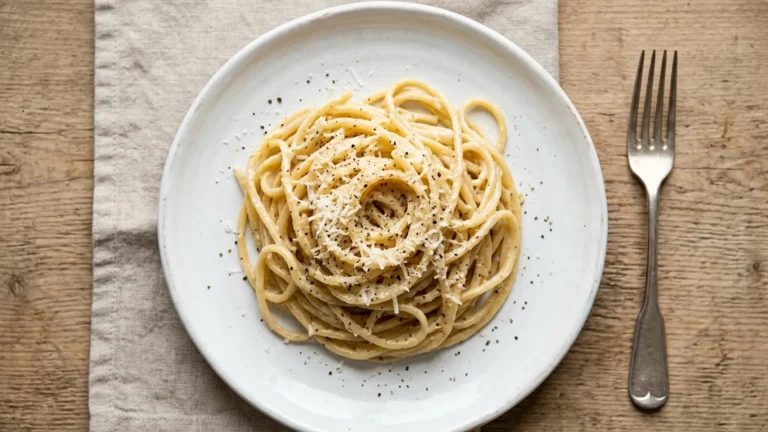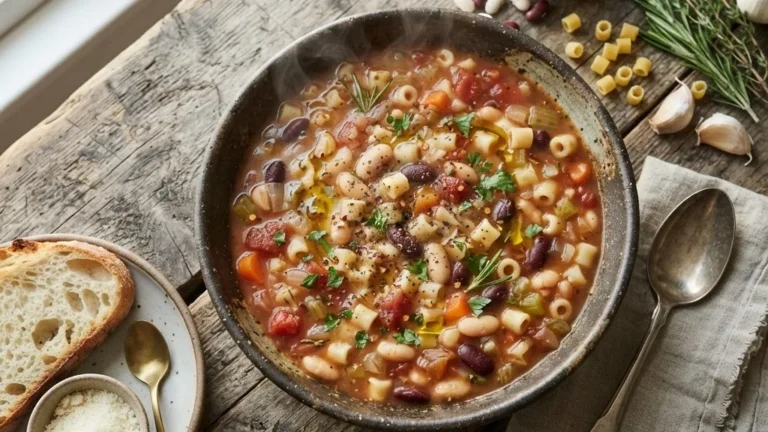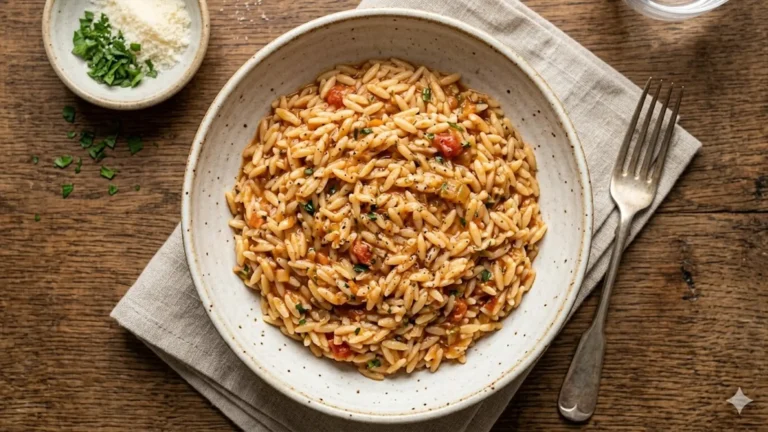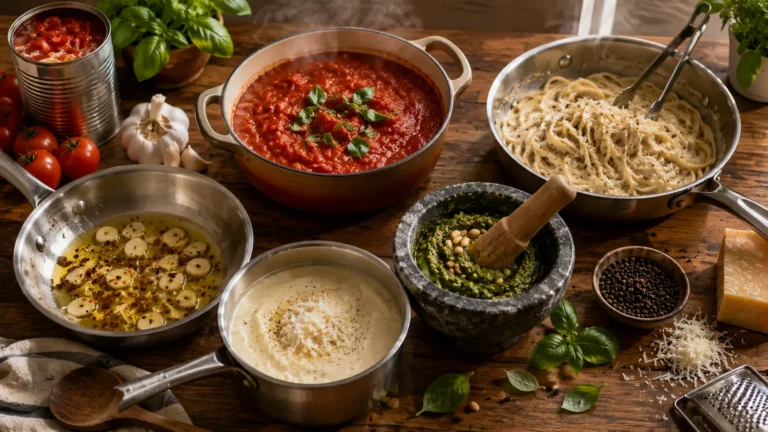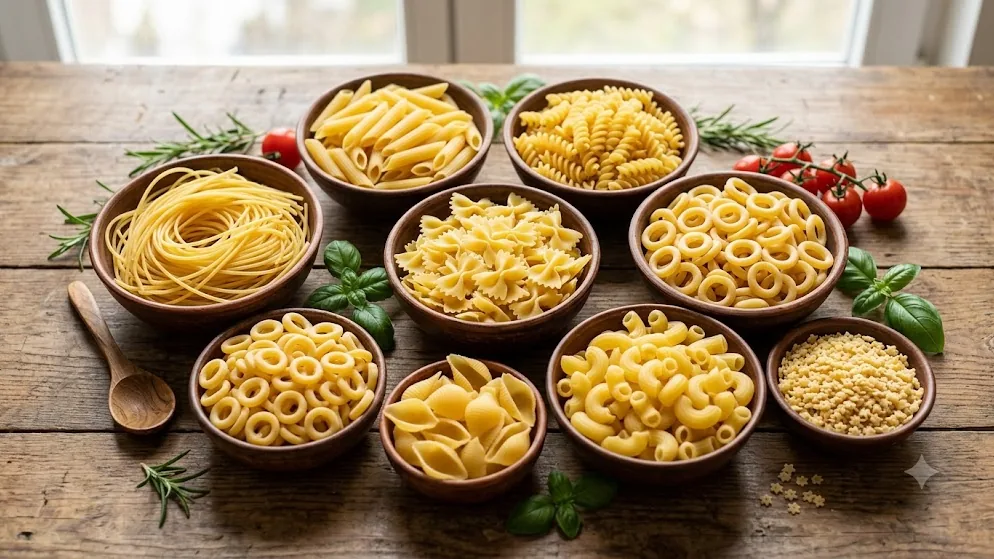
Different kinds of pasta are not sorted by taste but by geometry, and that geometry decides which sauce clings and which one slides off the plate. Ridges hold weight. Hollows trap chunks. Wide ribbons carry slow-cooked meat. Once you read shape as a delivery system rather than decoration, the wall of boxes at the store stops being a guessing game.
This guide merges the catalog, the pairing logic, and the food-law framing that most single pages skip, and it backs each claim with a named source instead of folklore. It also adds a cooking-mechanics section and a troubleshooting list so the guide is usable at the stove, not just at the shelf.
The International Pasta Organisation counts roughly 17 million tonnes produced across 52 countries in 2023, so the variety you see is a global habit, not an Italian curiosity.
Quick answer: The main split among different kinds of pasta is fresh (pasta fresca, often soft wheat and egg) versus dried (pasta secca, durum wheat semolina and water). Within those, shapes group into long strands, short tubes, ribbons, shells, twists, stuffed parcels, tiny soup shapes, sheets, and dumpling-type gnocchi.
Pick smooth long shapes for light oil and tomato, ridged or hollow shapes for thick sauces, and wide ribbons for meat ragu. The Encyclopedia of Pasta documents over 300 shapes, with estimates near 350.
Pasta fresca versus pasta secca: the split that changes everything
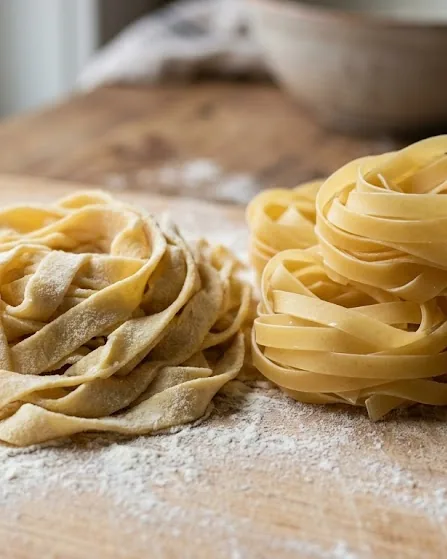
Fresh pasta and dried pasta are two different products, not two grades of one. Pasta fresca is typically made with softer wheat and egg, giving a tender, porous surface that drinks up butter and cream. Pasta secca is durum wheat semolina mixed with water and dried hard, which gives it a firmer bite and the ability to hold structure in boiling water.
Saveur frames this as a regional habit: in northern Italy egg pasta dominates, while in the south dried durum pasta with no egg prevails. That single distinction explains why a Bolognese ribbon behaves nothing like a bowl of spaghetti aglio e olio, and why the same recipe can feel wrong with the wrong base.
The moisture content also drives cook time. Fresh pasta usually cooks in two to four minutes because the dough is already hydrated and soft. Dried pasta needs eight to thirteen minutes depending on thickness, because the water has to work its way into a hard, dehydrated matrix before the starch can gelatinize evenly. Judging both by the same clock is a common reason home cooks end up with mushy fresh pasta or undercooked dried pasta in the same meal.
- Pasta fresca: soft wheat and egg common, tender, absorbent, quick to cook, best with rich dairy or delicate fillings.
- Pasta secca: durum semolina and water, firm, shelf-stable, holds bite, best with robust sauces and long strands.
If you want a worked example of egg-rich sheets in action, our indulgent seafood lasagna recipe shows how fresh-style layers carry a heavy filling without collapsing.
What pasta is legally allowed to be: durum wheat and the 3 percent rule
Dried pasta sold in Italy is not a free-for-all recipe. Under Italian law, specifically DPR n. 187/2001, dried pasta must be made only from durum wheat, with a maximum of 3 percent soft (common) wheat tolerated purely as cross-contamination. That legal floor is why the durum-semolina texture is so consistent across Italian dried brands, and why the ridged, matte surface of a properly made shape is not marketing but a manufacturing outcome.
The Camera di Commercio di Bolzano publishes the labeling and durum-origin guidance that manufacturers follow, and this framing is exactly what most shape-list articles leave out.
Durum matters because its high protein and gluten strength let a strand stay al dente instead of turning to paste. Semolina, the coarsely ground endosperm of durum wheat, also carries the yellow-gold color you see in a quality box of dried pasta; a pale or grayish tint often signals a higher share of soft wheat or an aged batch.
The surface finish adds another layer of texture on top of the wheat itself. Bronze-die pasta comes out rougher and grips sauce, while teflon-die pasta comes out smoother and slicker. Ridged shapes (rigate) hold more than smooth ones (lisce) for the same reason a textured wall holds paint. Manufacturers often print “trafilata al bronzo” on premium boxes specifically to flag that rougher, sauce-gripping surface.
You can read the durum labeling and origin rules directly from the Bolzano Chamber of Commerce guidance, which sets out what the package must declare.
The nine shape families, with a named shape for each
Different kinds of pasta fall into recognizable families, and learning the family teaches you the behavior of every member. Long shapes carry light sauces along their length. Short tubes trap thick sauce inside and out. Ribbons hug meat. Shells scoop. Twists snag.
Stuffed shapes deliver a filling. Tiny pastina disappear into broth. Sheets layer. Gnocchi eat like dumplings. Below is the working map, with one anchor shape per family so you can extend the logic to any box you find, including the long-tail shapes that shorter guides never name.
- Long (lunga): spaghetti, bucatini, linguine. Bucatini is a hollow strand that carries a Sicilian sauce beautifully.
- Ribbons: tagliatelle, fettuccine, pappardelle. Pappardelle is the widest, built for slow ragu.
- Short tubes (corta): penne, rigatoni, paccheri. Paccheri are giant tubes that swallow chunky sauce.
- Shells and twists: orecchiette, fusilli, trofie, cavatelli, farfalle. Orecchiette means “little ears.”
- Stuffed (ripiena): ravioli, tortellini. These carry the sauce inside as filling.
- Pastina and sheets: orzo for soup, lasagna sheets for baking.
- Dumpling-type: gnocchi, potato-based, eaten like pasta but made differently.
The long tail is where flavor hunters live: strozzapreti (the name translates to “priest stranglers”), cascatelli, malloreddus, corzetti. Size suffixes tell you scale, with -ini meaning smaller and -oni meaning larger, so spaghettini is thinner than spaghetti and rigatoni is a bigger tube than its cousins.
Corzetti carries an extra layer of craft: the disks are traditionally stamped with a carved wooden press that leaves a family crest or geometric pattern, a detail that turns a simple flour-and-water dough into a piece of regional identity. Malloreddus, sometimes called Sardinian gnocchetti despite not being potato-based, gets its ridges from being rolled across a wicker basket or a ridged wooden tool, and those grooves exist for the same sauce-gripping reason as any factory-made rigate shape.
For a stuffed shape done as a full buying and cooking walkthrough, see our complete gluten free tortellini guide.
Matching shape to sauce so nothing slides off the fork
Sauce pairing is the single skill that separates a good plate from a wasted one, and it follows three plain rules. Ridged and hollow shapes grip thick, clingy sauces because their surface area is huge. Long, smooth strands suit light oil-based or thin tomato sauces that coat rather than cling. Wide ribbons carry heavy meat ragu because the sheet can hold weight without snapping. Get these three right and you rarely make a bad match, whatever the shape’s name.
Think of the sauce as cargo and the shape as the vehicle. A watery pesto on a smooth tube leaves a puddle at the bottom of the bowl. The same pesto on trofie, the twisted Ligurian shape it evolved beside, holds in every groove.
Size matching matters as much as shape family. A very fine strand like angel hair or capellini overwhelms quickly under a heavy meat sauce and turns to clumps, while it shines under a thin butter or seafood broth that needs almost no help staying on the noodle. A thick, dense tube like paccheri can carry a whole meatball or a spoonful of ricotta inside it, which is why it often gets baked rather than simply boiled and sauced.
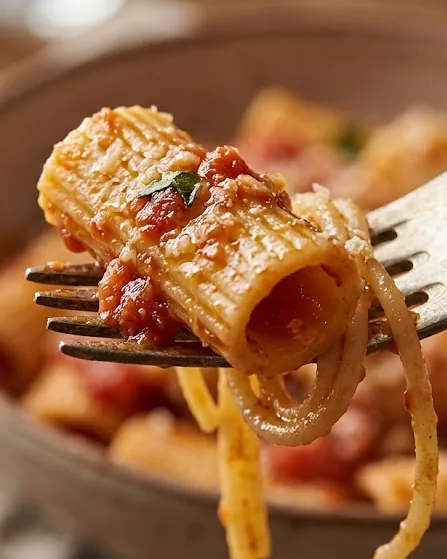
- Thick, chunky, cheesy: rigatoni, penne rigate, paccheri. Ridges and hollows do the work.
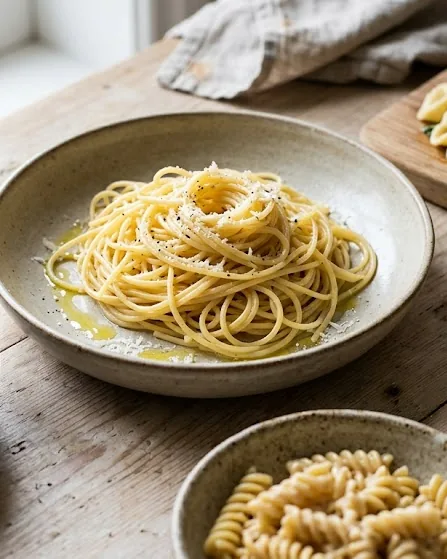
- Light oil or fresh tomato: spaghetti, linguine, bucatini. Smooth strands coat evenly.
- Slow meat ragu: pappardelle, tagliatelle. Width carries weight.
- Pesto and delicate dressings: trofie, fusilli, orecchiette. Twists and cups trap sauce.
The pairing logic also travels beyond Italian dishes. A twist or ribbon that grips sauce well is the same reason a stir-fried noodle carries glaze, as in our quick veggie lo mein, where surface texture decides how much flavor stays on each strand.
A regional map: where each shape actually comes from
Origin is not trivia, because a shape and its native sauce usually evolved together. Liguria gave us trofie, the twisted shape built for basil pesto. Emilia-Romagna, the northern egg-pasta heartland, is home to tagliatelle, tortellini, and the ragu that dresses them, and it is where Barilla, the world’s largest pasta company, was founded in 1877.
Puglia in the south is orecchiette country, those little ears tossed with greens and garlic. Sicily pairs bucatini with sardines and fennel in bucatini con le sarde. Read the map and the pairing rules stop feeling arbitrary.
This north-south pattern lines up with the egg-versus-durum split. The northern kitchens leaned on egg and softer wheat for tender ribbons and filled parcels, food meant for a shorter shelf life in a cooler climate close to dairy country. The southern kitchens, working with durum and long hours of sun-drying, produced the firm dried shapes that ship and store well, suited to a hotter climate and a longer trade history around the Mediterranean.
Sardinia adds a third strand to the map with malloreddus, and central Italy contributes its own dried tradition around Abruzzo’s chitarra-cut spaghetti, made by pressing sheets of dough through wire strings that leave a square-edged strand rougher than a standard round-cut spaghetti. That texture, again, exists to hold more sauce per bite.
That geography also shows up in every regional dish name you meet, from a Ligurian pesto to a Cajun-Italian mashup like our irresistible pastalaya, which borrows the durum shape’s sturdiness for a long simmer.
How many kinds of pasta are there, honestly
There is no exact registry, so any precise count should raise an eyebrow. The Encyclopedia of Pasta documents over 300 distinct shapes, and the figure commonly repeated is around 350. Treat 350 as a rough estimate rather than a hard number, because names collide across regions: rotelle, ruote, and “wagon wheels” can all point at the same shape, while one name can describe different shapes in different provinces.
The honest answer is “several hundred, roughly 350,” and that honesty is itself a trust signal that inflated round numbers lack.
The naming system is more reliable than the count. Plurals are standard because you rarely eat one piece, and the -ini and -oni suffixes scale a base shape up or down. Once you know spaghetti is the base, spaghettini and spaghettoni need no separate memorizing. The same logic applies across families: tagliolini are a narrower cut of tagliatelle, and conchiglioni are simply oversized shells meant for stuffing rather than tossing.
How to cook each family without guessing
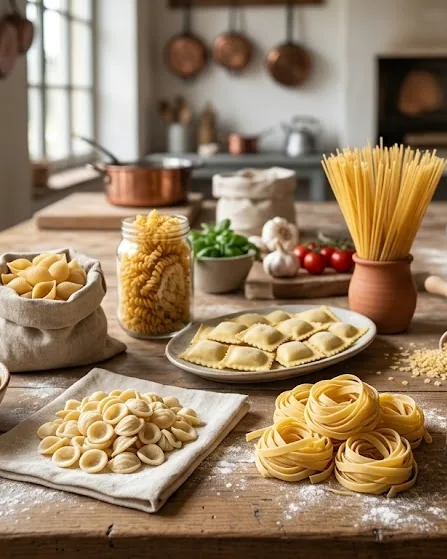
Shape decides not just the sauce but the cooking method. Long, thin strands like spaghetti and linguine want a large pot of generously salted, rapidly boiling water so the strands separate instead of clumping. Salt should taste noticeably like the sea; under-salted water is the single most common reason home-cooked pasta tastes flat no matter how good the sauce is.
Short tubes and shells tolerate a slightly gentler boil and benefit from stirring in the first minute, since their shape makes them prone to sticking to the pot bottom and to each other before the water returns to a full boil. Stuffed shapes like ravioli and tortellini need the gentlest simmer of all; a rolling boil can tear the seam and spill the filling into the pot, so a slow, steady simmer with occasional stirring is the safer choice.
Al dente, meaning “to the tooth” in Italian, describes pasta cooked so the center still offers slight resistance rather than being fully soft. Reaching it reliably means starting to taste-test one to two minutes before the package’s stated time, since box times are averages and stovetop conditions vary. Reserving a cup of the starchy cooking water before draining gives you a tool for finishing the dish: adding a splash to the pan while tossing pasta with sauce helps the sauce cling and loosens it without watering down the flavor.
Common mistakes and quick fixes
A few recurring mistakes account for most disappointing pasta dinners, and each has a simple fix rooted in the mechanics already covered above.
- Rinsing pasta after draining: this washes away the starchy surface that helps sauce cling. Skip rinsing except for cold pasta salads.
- Adding oil to the boiling water: it does not stop sticking in a well-salted, well-stirred pot, and it coats the strands so sauce slides off later. Stir instead.
- Matching the wrong shape to the sauce: a thin sauce on a giant tube, or a chunky ragu on angel hair, both leave sauce pooled at the bottom rather than distributed. Use the pairing rules above.
- Overcooking fresh pasta on a dried-pasta clock: fresh pasta needs only two to four minutes; treating it like dried pasta produces a soft, gluey result.
- Discarding all the pasta water: that starchy liquid is the easiest way to bind a sauce to the noodles; save at least a cup before draining.
Pasta nutrition by the numbers, from the USDA record
Plain cooked pasta is a modest, carbohydrate-forward food, and the USDA FoodData Central record for unenriched cooked pasta (FDC #168928) gives the specifics. Per 100 grams cooked, no added salt, it lands at about 157 kcal, 30.7 grams of carbohydrate, 5.8 grams of protein, 1.8 grams of fiber, and 0.9 grams of fat.
That baseline shifts with the base: whole-wheat versions add fiber, enriched versions add B-vitamins and iron, and legume-based shapes push protein higher. The shape does not change the calories, but the sauce and portion certainly do.
Whole-wheat pasta typically carries more fiber per serving than the plain semolina baseline above, which can support steadier digestion and a slower rise in blood sugar after the meal. Legume-based shapes made from chickpea, lentil, or black bean flour can roughly double the protein per serving compared to standard wheat pasta, which is why they have become common in higher-protein meal plans. Gluten-free shapes, usually built from rice, corn, or a blend of alternative flours, match the wheat-based calorie range closely but can behave differently in the pot, often needing a shorter cook time and a gentler stir to avoid breaking apart.
Here is the cooked, plain baseline in a compact form.
- Calories: about 157 kcal per 100 g cooked.
- Carbohydrate: about 30.7 g.
- Protein: about 5.8 g.
- Fiber: about 1.8 g.
- Fat: about 0.9 g.
You can pull the full nutrient breakdown from the USDA-sourced cooked pasta record, and if calorie targets matter to you, our sourced ranking of lowest-calorie pasta puts real numbers against specific dishes under 400.
The market behind the shapes: production and consumption figures
Pasta variety exists because demand is enormous and global. The International Pasta Organisation reports world production reached about 17 million tonnes in 2023 across 52 countries, up roughly 85 percent over 25 years from about 9.1 million tonnes.
Italy leads consumption at 23.3 kilograms per capita per year, ahead of Tunisia at 17 kilograms, Venezuela at 13.6 kilograms, and Greece at 12.2 kilograms. Italy also exported over 2.4 million tonnes in 2024, about 58 percent of national production, worth 4.02 billion euros. Scale like that funds the long tail of shapes you find on shelves.
Those numbers explain the sheer range. When a category moves millions of tonnes and travels to dozens of countries, regional shapes get industrialized, exported, and copied, which is how a Ligurian twist ends up in a supermarket three time zones away. Export volume also explains why some regional shapes, like orecchiette or trofie, are now easy to find outside Italy, while rarer local shapes made in small batches by hand, like certain corzetti stamps, largely stay within their home region.
You can see the production and consumption data in the International Pasta Organisation’s World Pasta Day report. For a plain-English tour of a classic combination, our creamy pasta with peas and ham shows how a short shape carries a light cream sauce.
Frequently asked questions
Is gnocchi pasta?
Gnocchi is usually grouped with pasta on menus and in shops, but it is technically a dumpling made from potato, flour, and sometimes egg rather than a durum semolina dough. It cooks and eats like pasta, floating when done, and pairs with the same sauces. Call it a pasta cousin: it belongs in the family conversation even though its recipe is different.
What is the difference between long and short pasta?
Long pasta means strands like spaghetti, linguine, and bucatini that carry sauce along their length and suit light oil or tomato dressings. Short pasta means tubes, shells, and twists like penne, rigatoni, and fusilli that trap thicker, chunkier sauce inside and around each piece. The choice is about how the sauce needs to be held, not about which one is better.
Why is dried pasta made from durum wheat?
Durum wheat has high protein and strong gluten, which lets a strand stay firm and al dente instead of turning soft. Under Italian law (DPR n. 187/2001), dried pasta must be made only from durum wheat, with a maximum of 3 percent soft wheat tolerated as cross-contamination. That legal standard keeps texture consistent and is why proper dried pasta holds its bite.
What is the best sauce for ridged pasta?
Ridged shapes such as penne rigate and rigatoni are built for thick, clingy sauces because their grooved surface grips far more than a smooth shape. Meat ragu, chunky vegetable sauces, and cheese-heavy bakes all work well. Save the thin oil-based or delicate sauces for smooth long strands, where a light coating is exactly what you want rather than heavy cling.
How many kinds of pasta are there?
There is no official registry, so counts are estimates. The Encyclopedia of Pasta documents over 300 distinct shapes, and the figure most often repeated is around 350. Treat that as a rough estimate, since names vary by region and one shape can carry several names. The safe answer is several hundred, roughly 350, spanning long, short, ribbon, shell, twist, stuffed, and dumpling-type families.
What makes fresh pasta different from dried pasta?
Fresh pasta (pasta fresca) is often made with softer wheat and egg, giving a tender, absorbent texture that suits rich dairy sauces and delicate fillings. Dried pasta (pasta secca) uses durum semolina and water, dried hard for a firm bite and long shelf life. In Italy, egg pasta prevails in the north and durum dried pasta in the south, according to Saveur.
How much salt should go in pasta water?
A common working rule is about one to two tablespoons of salt per four to six liters of water, enough that the water tastes clearly salty rather than flat. Since the pasta itself absorbs only a small fraction of that salt during cooking, the water needs to be salted more assertively than most home cooks expect. Under-salting the water is one of the easiest ways to end up with a bland finished dish, even with a well-made sauce.