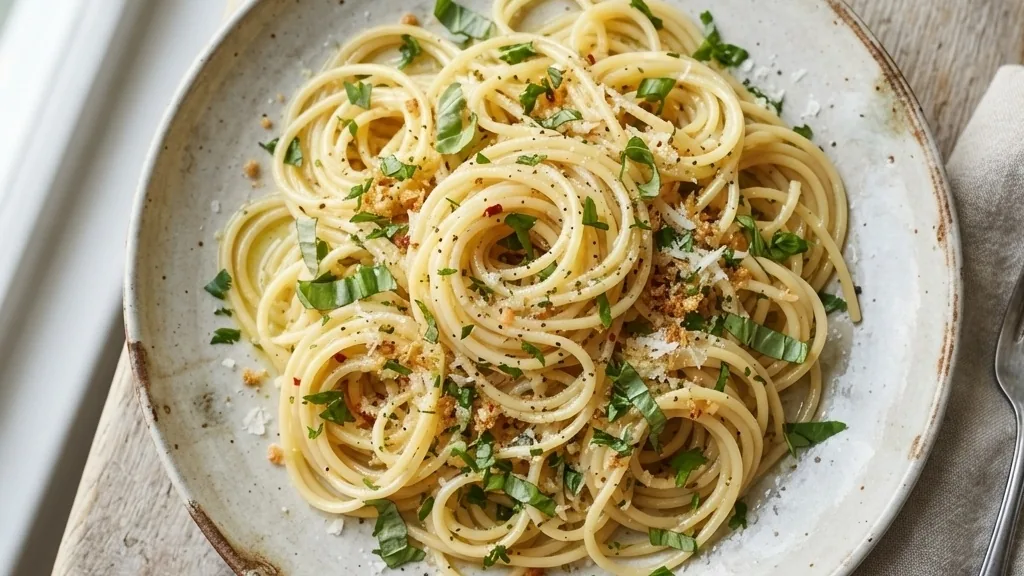
Al dente pasta is dried durum wheat cooked until a thin white line still sits at the core of each strand, the point where starch has gelatinized enough to soften but the protein network still bites back against the tooth. That center line, called the anima, is not a flaw. It is the visual proof that the strand stopped short of the “fully cooked” state the box aims for. The phrase itself means “to the tooth” in Italian (see Wikipedia’s entry on al dente for the full etymology and history), and it marks a texture with measurable consequences for chewiness, sauce grip, and how fast the starch inside actually digests once you eat it.
Quick answer: Al dente pasta means the strand is firm to the bite with a faint white core still visible. Cook dried pasta in a hard rolling boil, then taste 1 to 2 minutes before the box time, since package times target the softer fully cooked stage. Reserve some starchy water, drain without rinsing, and finish the pasta in its sauce. Al dente spaghetti carries a glycemic index of 45, which sits in the low range.
The rest of this guide breaks that quick answer down into the actual mechanics behind it: what is physically happening to the starch as the water boils, why the timing on the box is the wrong number to trust, how altitude and pasta type shift the window, and what the research says about how al dente pasta digests differently than the same noodle boiled soft. None of it is guesswork. Every figure below traces back to a peer-reviewed study, a food science lab, or an industry body, and the links are there if you want to read the source material yourself.
What the white line at the core actually tells you
The white line at the center of a cut strand is the single most reliable signal that pasta has reached al dente. When you slice a piece in half, a tiny pale dot or streak in the middle means the starch there has not fully absorbed water. Around it, the outer ring looks translucent and evenly colored. Cooks call that center the anima. Let it vanish completely and the strand crosses into fully cooked territory, softer and stickier. Push a shade earlier and you land at “molto al dente,” a firmer bite favored when the pasta will keep cooking inside a hot sauce.
- Molto al dente: a wider white core, chosen when you plan a long finish in sauce.
- Al dente: a hairline white core, springy resistance at the bite.
- Fully cooked: no core, uniform color, softer and more absorbent.
Barilla’s own food scientists, in a segment produced with Iowa PBS, define the target in production by measuring firmness and color rather than by clock alone, which is why tasting beats trusting a timer. Their process cuts a sample strand, checks the diameter of the remaining white core against a reference, and cross-checks that against a firmness reading, essentially doing at industrial scale what you are doing with a fork and a bite. Tasting itself takes about 1 sec longer than glancing at a timer, but it is the only step that actually works. For a broader look at how strand thickness changes all of this, the guide to different pasta shapes and their sauces is worth a detour, since a 2 mm bucatini and a 1 mm capellini do not share the same al dente window at all.
The gelatinization numbers behind that bite
Al dente texture comes down to partial starch gelatinization inside a durum protein matrix. When durum wheat starch heats in water, its granules absorb liquid and swell, then lose their crystalline order in a process differential scanning calorimetry can pin to exact temperatures, as documented in a ScienceDirect study on durum wheat starch structural changes. For durum wheat starch, gelatinization begins at an onset near 58 degrees Celsius (58 °C) and peaks around 64 degrees Celsius (64 °C). Wheat starch as a broader category gelatinizes across roughly 60 to 80 degrees Celsius (80 °C at the top of that range). At al dente, the outer starch has gelatinized and the surface has softened, while the very core has not fully hydrated, which is exactly what leaves the strand its spring.
The structure matters more than most cooks assume. Research published through PubMed Central describes cooked pasta as a compact matrix of starch granules embedded in a protein network, with water acting as a plasticizer. That protein cage is why durum, with its higher protein, holds firmness under heat. A softer wheat flour, the kind used in cake or all-purpose baking, lacks that same dense gluten network, which is one reason substituting regular flour for durum semolina in homemade pasta produces a strand that turns mushy well before the center hydrates evenly.
Practically, this means the last minute or two of cooking is where most of the change happens. Between minute eight and minute ten of a ten-minute box time, the core temperature of a strand is climbing through that 58 to 64 degree Celsius window, and the starch there is converting from a hard, glassy state to a soft, gelled one. Pull the pot one minute early and you catch that transition mid-way, which is precisely the mechanism behind the anima. This is also why a rolling boil matters more than a gentle simmer: a weaker boil means the water temperature recovers slower after the pasta goes in, stretching out that transition window unpredictably.
Why al dente pasta lands at a glycemic index of 45
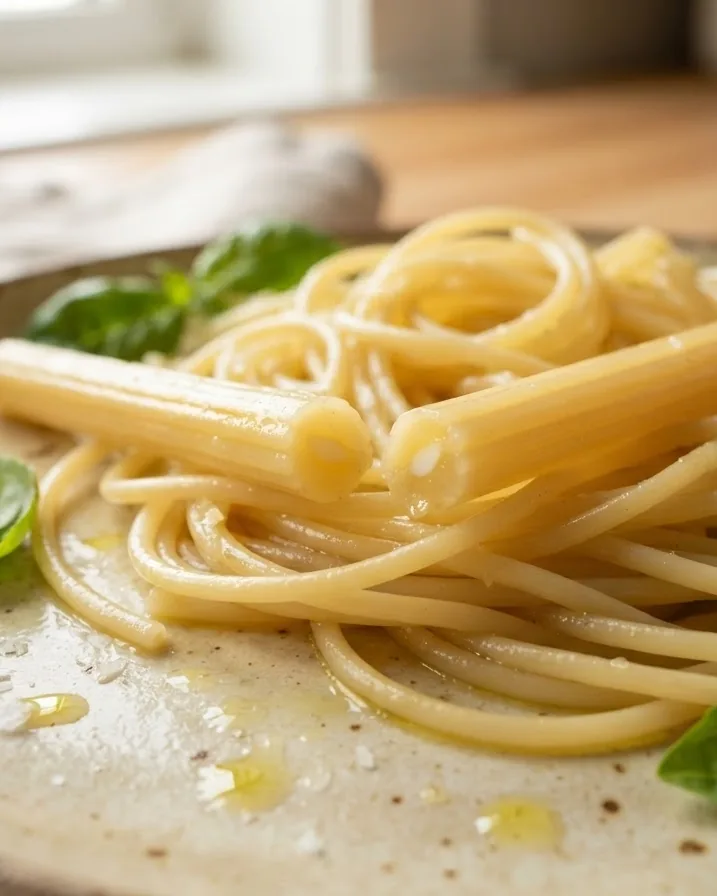
Al dente pasta digests more slowly than soft pasta, and that shows up in hard glycemic numbers. Spaghetti cooked al dente carries a glycemic index of 45, which puts it in the low-GI category, alongside a glycemic load of 21.5 per 100 grams (100 g). Compare that to the same strand boiled soft, where the fully swollen, thoroughly gelatinized starch surrenders to digestive enzymes faster and pushes blood sugar higher. The firmer, more compact structure of an al dente strand simply gives amylase less easy access to the starch it breaks down into glucose.
A study indexed on PubMed Central on durum spaghetti starch digestion tested this directly on durum semolina spaghetti. Reducing cooking from fully cooked to al dente, using pasta with a very high protein content of 17 percent (17 %), lowered the extent of in vitro starch digestion. The takeaway for anyone watching blood sugar: how long you boil is a lever, not a footnote.
A second study, also indexed on PubMed Central comparing al dente and soft-cooked pasta texture, compared al dente against a deliberately soft cook and looked past the glucose numbers to texture and mastication itself. It found that the firmer structure changes how much chewing breaks the strand down before it even reaches the stomach, which affects how accessible both the starch and the protein inside are to digestive enzymes downstream. In plain terms, a strand that resists your teeth a little also resists your gut a little, and that resistance is measurable rather than a texture preference dressed up as health advice.
Here is the nutritional profile per 100 grams (100 g) of al dente spaghetti: 271 kcal, 9.3 g protein (9,3 g), 47.8 g carbohydrates (47,8 g), and 0.7 g fat (0,7 g).
| Metric | Value (per 100 g) |
|---|---|
| Energy | 271 kcal |
| Protein | 9.3 g |
| Carbohydrates | 47.8 g |
| Fat | 0.7 g |
Anyone managing diabetes should weigh these figures against guidance from a clinician rather than treating a single number as a plan.
The cool-then-reheat trick
Cooking, cooling, then reheating pasta drives a change called starch retrogradation, where some gelatinized starch recrystallizes into resistant starch that resists digestion. In the durum spaghetti study on PubMed Central, cold storage produced a real but minor rise in resistant starch, with no large shift in the overall extent of digestion measured. So the effect is directionally helpful and modest, not a magic reset. Al dente plus a chill still stacks in the right direction, and the practical version of this trick is simply cooking pasta the night before, refrigerating it, and reheating gently in sauce rather than in a microwave, which tends to overcook the surface before the center warms through.
Water, salt, and the rolling boil that make or break it
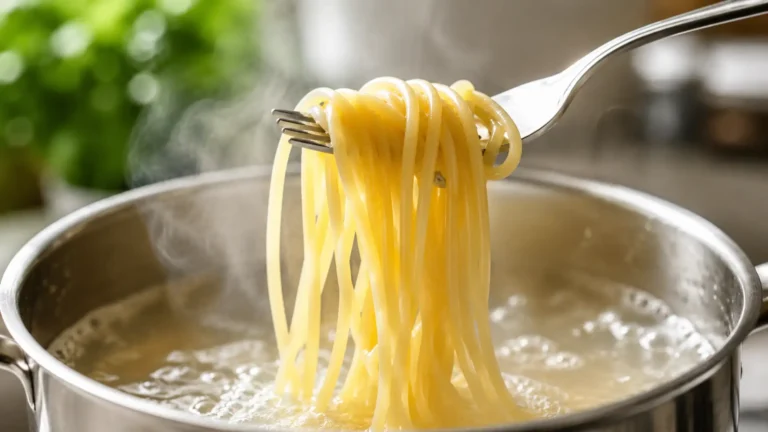
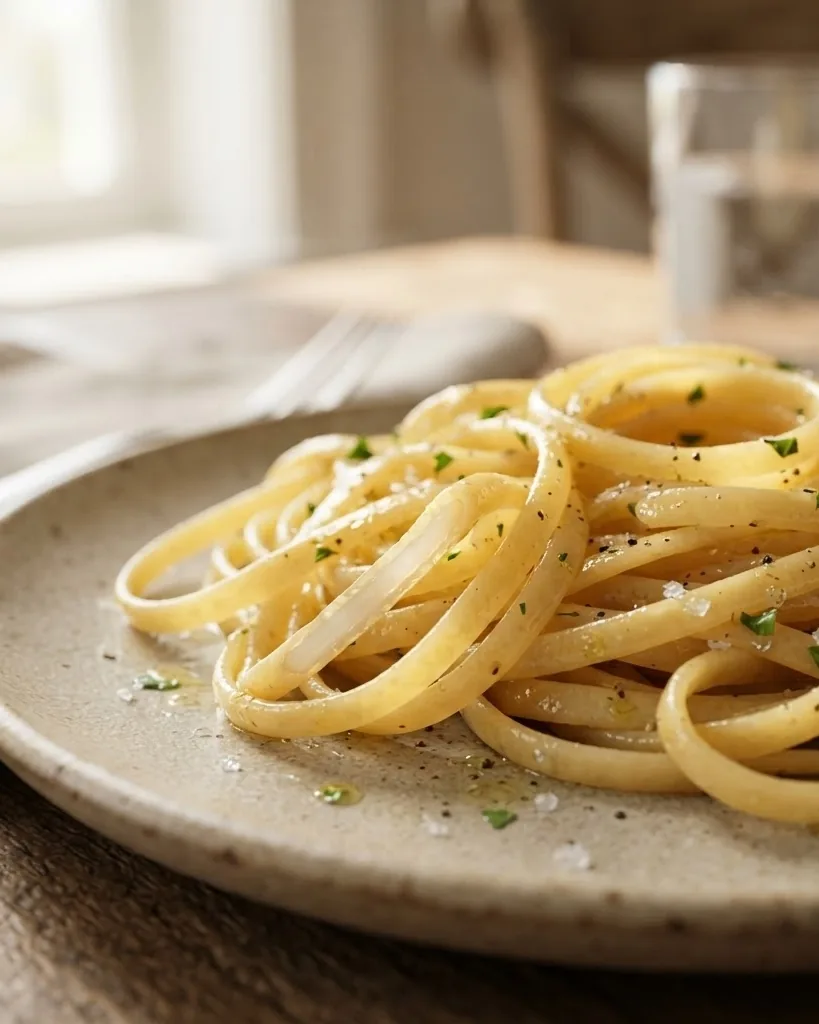
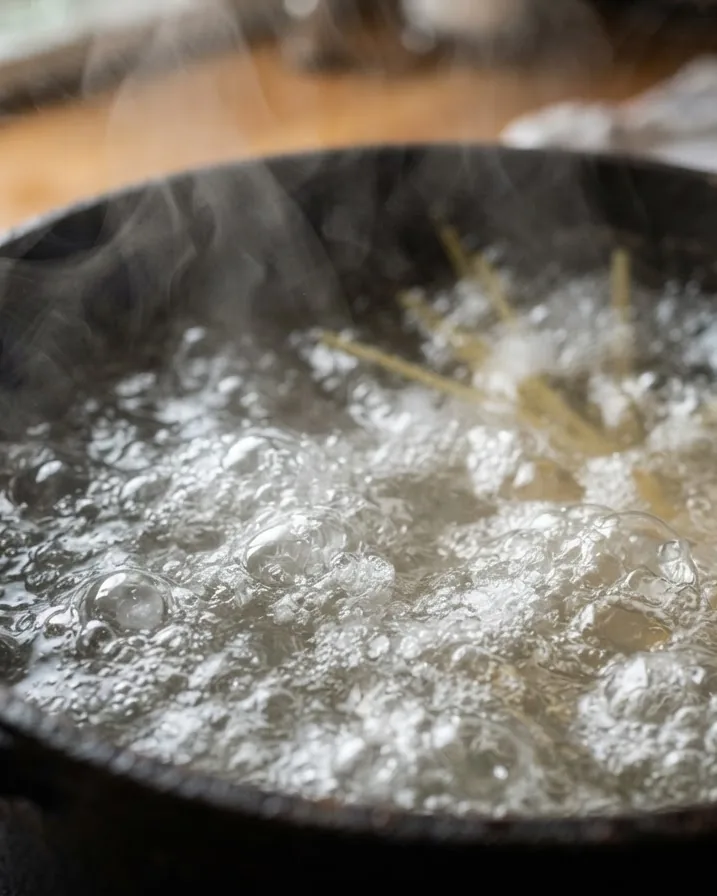
The method that produces reliable al dente pasta starts before the noodles touch the pot. You need enough water at a genuine hard boil so the temperature barely dips when pasta goes in, and you need to stir during the first two minutes so strands do not fuse while their surface starch is at its stickiest. Salt the water once it boils. Skip any oil in the water, since it coats strands and blocks the surface starch that later grabs sauce. These are not aesthetic preferences. They control hydration speed and the final grip between noodle and sauce.
- Boil hard first, then add pasta so the water recovers fast.
- Stir the first two minutes to stop strands sticking as surface starch releases.
- No oil in the water, which would coat the strand and repel sauce later.
- Taste, do not trust the timer, since box times aim at fully cooked.
Underfilling the pot is the most common water mistake. A crowded pot means the water temperature crashes hard the moment pasta goes in, and it can take several minutes to climb back to a true boil, during which strands sit in tepid water and release starch unevenly. That uneven release is what produces gluey pasta water and clumped strands, independent of how long the pasta actually cooks. A pot that looks generously sized for the amount of pasta going in almost always is not; erring toward more water than seems necessary is the safer default.
A garlicky, minimal sauce shows off al dente texture better than a heavy ragu, which is why the technique pairs so naturally with a dish like this garlic lover’s aglio e olio, where the noodle itself is the star.
Finishing in the sauce and the cup of water you almost threw out
The finish is where home cooks lose the most flavor. Reserve some starchy cooking water before you drain, and do not rinse the pasta unless it is headed for a cold salad. That surface starch is what lets the sauce cling. Then move the drained pasta straight into the hot sauce and let the two cook together, adding splashes of the reserved water as needed. Italian cooks call this mantecatura, and it emulsifies fat, starch, and water into a glossy coat that plain draining never gives you.
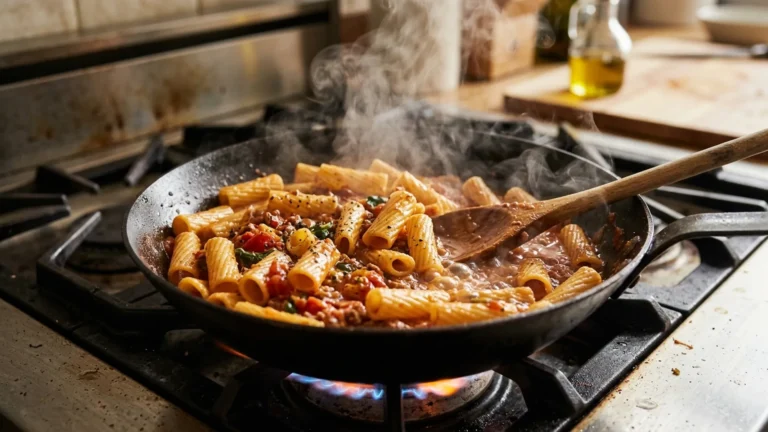
Because the pasta keeps cooking during that finish, pull it a touch earlier than your target. Molto al dente going into the pan lands at al dente on the plate. This is also why a saucy skillet dish behaves differently: in a build like this one-pan skillet lasagna, the noodles absorb liquid as they simmer, so you compensate by starting firmer.
The reserved water does two jobs at once, not one. First, its starch content acts as a thickener, letting an oil-and-garlic sauce or a butter-based one grip the noodle instead of pooling separately in the bowl. Second, its temperature and volume let you loosen a sauce that has reduced too far without diluting its flavor the way plain tap water would, since the pasta water already carries salt and starch from the pot. A sauce that looks broken or greasy, with oil visibly separated from the rest, almost always needs a splash of this water and thirty more seconds of active stirring over heat rather than a change of ingredients.
Worked example: timing a pot of dried spaghetti step by step
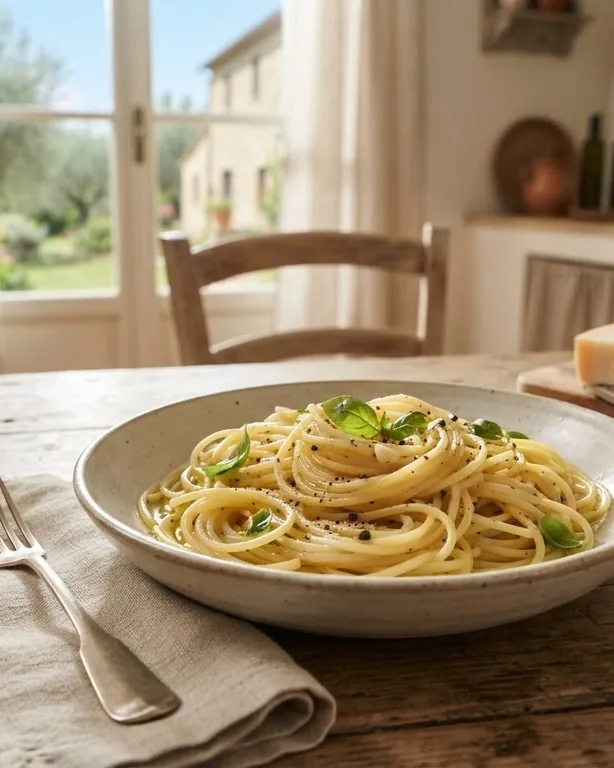
Consider a box of dried spaghetti with a printed cook time, going into a pot of well-salted water at a full rolling boil. The first two minutes are for stirring, not tasting, since this is when strands are most likely to stick together as their outer starch layer softens fastest. As it gets close, start fishing out a strand periodically and biting into it. At minute 9, you are likely looking at molto al dente, a visible white core still thick enough to see without cutting the strand in half.
By minute 10, the core has thinned to a hairline, which is your al dente target, and this is the moment to pull the pot off heat and drain, reserving that cup of water first. If your plan is a hot sauce finish, stop at minute 9 instead and let the last minute of cooking happen in the pan with the sauce, which keeps the noodle from overshooting into fully cooked by the time it reaches the plate. Waiting until the time printed on the box passes, without tasting at all, is the single most common way home cooks end up with soft, fully cooked pasta despite following the instructions exactly as written.
Fresh, stuffed, and gluten-free: where the rules bend
Not all pasta obeys the same clock, and treating fresh, stuffed, or gluten-free like dried semolina is the fastest route to mush. Fresh egg pasta cooks in roughly 1 to 3 minutes because it is already hydrated and thin, so the al dente window is short and unforgiving. Stuffed shapes like ravioli need enough time for the filling to heat through, which means the pasta shell often runs slightly past what you would call al dente on a bare strand. Gluten-free pasta lacks the wheat protein network that gives durum its bite, so it softens fast and turns gummy if you overshoot even by a minute.
- Fresh egg pasta: about 1 to 3 minutes, taste early and often.
- Stuffed pasta: cook until the filling is hot, shell slightly softer than bare-strand al dente.
- Gluten-free pasta: no wheat protein cage, so it drops from firm to gummy quickly.
Durum wheat, also called semolina when milled, is the backbone of dried pasta precisely because its protein content holds structure under boiling. That protein network is what a gluten-free strand has to imitate with binders and starches, and none of them match durum’s tolerance for a hard boil. Rice-flour and corn-flour based pastas in particular tend to have a much narrower window between undercooked and falling apart, which is why constant tasting matters even more with these products than with wheat pasta.
Stuffed pasta carries its own separate risk: overcooking the shell while waiting for the filling to heat is common, but so is the opposite mistake of pulling ravioli the moment they float, assuming floating means done. Floating only means the shell has trapped enough steam to lift the piece, not that the filling has reached temperature throughout. For meat or cheese fillings made from raw ingredients, extra time past the float point is usually the safer call, tested by cutting one piece open rather than trusting buoyancy alone.
Altitude, timing, and the mistakes that ruin a good box of pasta
Altitude quietly sabotages al dente. Water boils below 100 degrees Celsius (100°C) as elevation climbs, so the pot never reaches the temperature that gelatinizes starch at sea-level speed, and pasta takes longer than any box time promises. The fix is simple: ignore the printed minutes entirely and taste your way to the white line. That habit protects you everywhere, because package times are written for the fully cooked stage, not for al dente.
The most common failures cluster around a few decisions.
- Too little water, which crashes the boil and cooks strands unevenly.
- Oil in the water, which blocks sauce from ever grabbing the noodle.
- Salting wrong, either too early before the boil or not at all.
- Trusting the timer over your teeth, the single biggest reason pasta turns soft.
A less obvious mistake is walking away from the pot in the last few minutes. Al dente pasta lives in a narrow window between molto al dente and fully cooked, and that window closes faster than most people expect because the core keeps absorbing heat even while you are elsewhere in the kitchen finishing a sauce. Staying near the stove and tasting on a short interval during that final stretch matters more than any single ingredient choice in the pot.
Pasta is a global staple worth getting right. The International Pasta Organisation (IPO) detailed pasta production in its report titled “A Billion Plates of Pasta in 10-years to Feed the Planet,” which is a lot of dinners riding on a two-minute judgment call. When you get comfortable tasting instead of timing, dishes as different as a 15-minute cheeseburger pasta and a delicate seafood plate all improve. For the broader consumption data, the International Pasta Organisation’s World Pasta Day report lays out the figures, and America’s Test Kitchen offers well-tested method breakdowns for cooks who want a second reference on technique.
Frequently asked questions
How much before the box time should I taste al dente pasta?
Start tasting 1 to 2 minutes before the time printed on the package. Box times are calibrated for the fully cooked stage, where the white core has vanished, so following them exactly overshoots al dente. Bite a strand: when a hairline of pale, uncooked starch still sits at the center, drain immediately and move it into your sauce.
Does al dente pasta really have a lower glycemic index?
Yes. Al dente spaghetti carries a glycemic index of 45, a low-GI value, because its firmer, more compact starch structure slows digestion. A study on PubMed Central found that cooking durum spaghetti only to al dente, rather than fully cooked, reduced the extent of in vitro starch digestion, especially with high-protein pasta at 17 percent (17 %) protein.
Why should I never rinse pasta I plan to sauce?
Rinsing washes away the surface starch that lets sauce cling to each strand. That starch is the glue behind a glossy, well-coated plate. Rinse only when the pasta is destined for a cold salad, where you want strands loose and separate. For hot dishes, drain and go straight into the sauce, keeping some cooking water on hand.
What does the white line in the center mean?
The thin white line, called the anima, is uncooked starch that has not fully absorbed water. It is the visual marker of al dente. A faint hairline signals the strand is ready; a thicker line means molto al dente, firmer still. Once that line disappears entirely, the pasta has reached the softer fully cooked stage.
How does altitude change al dente cooking?
At higher elevations, water boils below 100 degrees Celsius (100°C), so starch gelatinizes more slowly and pasta needs extra time. Durum wheat starch begins gelatinizing near an onset of 58 degrees Celsius (58 °C) and peaks around 64 degrees Celsius (64 °C), and a cooler boil delays those transitions. The reliable fix everywhere is the same: taste for the white core instead of trusting printed minutes.
Can reheating pasta lower its glycemic impact?
Somewhat. Cooling and reheating cooked pasta triggers starch retrogradation, forming resistant starch that resists digestion. In durum spaghetti testing published via PubMed Central, cold storage raised resistant starch without dramatically changing overall digestion. So the effect is real but small, and it stacks on top of the larger benefit you already get from cooking al dente in the first place.
Does the shape of the pasta change the al dente timing?
Yes, thickness and surface area matter as much as the clock. A thin shape like angel hair can cross from al dente to fully cooked in under a minute, while a thick shape like bucatini or a dense short shape like rigatoni holds its al dente window open several minutes longer because heat takes longer to reach the center. Tasting still beats guessing by shape alone, but starting to check earlier with thinner shapes and later with thicker ones saves wasted attempts.