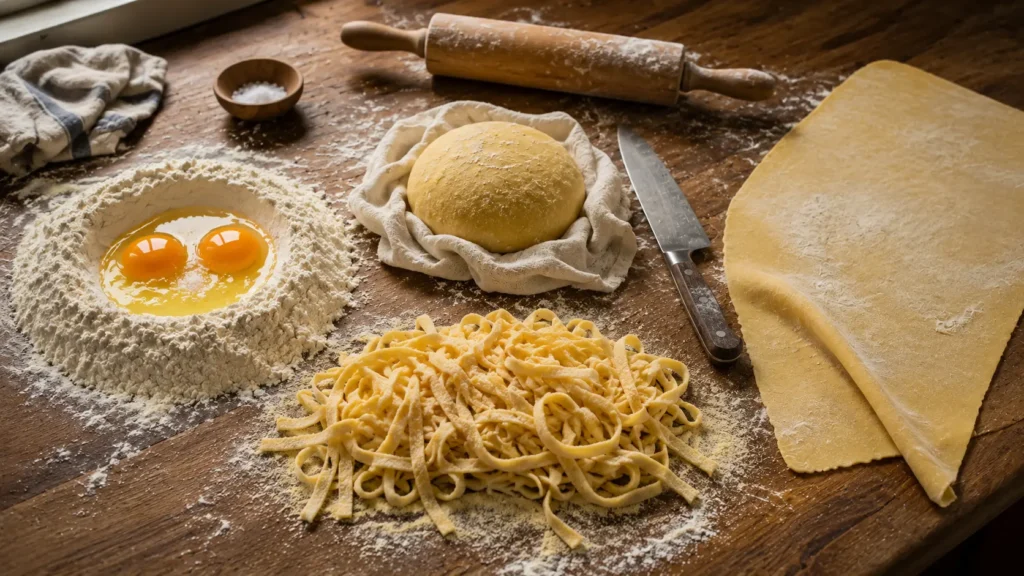
How can we make pasta at home with no machine, no special skills, and barely any ingredients? It’s gloriously simple: flour and eggs, a fork, your hands, and a rolling pin. Pile the flour on the counter, crack eggs into a well in the center, pull the flour into the eggs until a shaggy dough forms, then knead it smooth for about five minutes. Rest it for half an hour, roll it thin with a pin, cut it into ribbons, and cook it in two to three minutes of boiling water. That’s the entire process, and it’s the same one Italian home cooks have used for centuries, long before stand mixers and pasta machines existed. The result, silky fresh pasta with a tender bite no dried box can match, comes from technique and a little patience, not equipment. This guide walks every step by hand, with the flour-to-egg ratio, how to roll without a machine, ways to shape it, and an eggless version too.
The Short Answer: Two Ingredients and Your Hands
At its core, fresh pasta is just flour bound with egg into a smooth, elastic dough that gets rolled thin and cut. You don’t need a machine for any of it; a rolling pin and a knife do everything a pasta roller does, just with a bit more elbow grease. The dough comes together in minutes, rests while you tidy up, and rolls and cuts in the time it takes a pot of water to boil. Everything below is the detail that turns those simple moves into reliably good pasta: the right ratio so the dough isn’t too dry or too sticky, the rest that makes it roll instead of fight back, and the rolling and cutting technique that gives you even, tender noodles. Make it once and the mystery evaporates.
What You Need
The beauty of homemade pasta is how little it asks for. You need flour, eggs, a clean work surface, a fork, a rolling pin, and a knife or pizza cutter. That’s genuinely it. A bench scraper helps for handling the dough and cleaning the counter, and a little extra flour for dusting keeps things from sticking, but neither is essential. No mixer, no machine, no gadgets. This is the most equipment-light cooking project there is, which is exactly why it’s such a satisfying thing to learn: the gap between “I bought pasta” and “I made pasta” is just a counter and an hour. If you’ve ever held off because you assumed you needed an expensive machine, this is your permission to start tonight with what’s already in your kitchen, because the tools you need are the ones you already own.
The Dough: Getting the Flour-to-Egg Ratio Right
The classic ratio is 1 large egg per 100 grams (about 3/4 cup) of flour, which makes roughly one generous serving. Scale it straight up: two eggs and 200 grams of flour for two, four eggs and about 3 1/2 cups for four. The flour you choose changes the texture and how much moisture the dough wants.
| Flour | Texture | Notes |
|---|---|---|
| All-purpose | Tender, forgiving | Best for first-timers |
| 00 (doppio zero) | Silky, classic | Traditional for fresh pasta |
| Semolina | Firm, toothy | Often blended 50/50 with AP |
Don’t treat the ratio as exact, because eggs vary in size and flours drink different amounts of moisture. The dough should come together into a firm but pliable ball that’s slightly tacky, not wet and not crumbly. Keep a little extra flour and a little water within reach to adjust as you go.
Step by Step: Mixing and Kneading by Hand

This is the part that looks intimidating and isn’t. Pile your flour into a mound on a clean counter and make a wide well in the center, like a volcano crater. Crack the eggs into the well, add a pinch of salt and a drizzle of olive oil if you like, and beat the eggs lightly with a fork. Now, with the fork, start pulling flour from the inner walls of the well into the eggs, a little at a time, so the eggs slowly thicken without bursting the wall and running everywhere. Once it’s too stiff to stir, switch to your hands and bring it into a shaggy ball, then knead by pressing the heel of your hand into the dough, folding it over, turning, and repeating for about five minutes until it transforms from rough and lumpy into smooth, springy, and elastic. If it’s sticky, add a dusting of flour; if it’s dry and cracking, wet your hands and keep kneading. The dough is ready when it springs back slowly when pressed. Don’t rush the kneading, because those five minutes are what build the gluten network that gives fresh pasta its tender chew and lets it roll thin without tearing. You’ll feel the dough change under your hands, from a rough, reluctant lump into something smooth, warm, and almost satiny; that transformation is your signal it’s done. If your arms tire, rest for a moment and come back, since a short pause won’t hurt the dough at all. Kneading by hand is the one part that takes real effort, but it’s also strangely meditative, and it’s the step that most connects you to how this food has been made for generations.
The Rest: Don’t Skip It
Wrap the dough ball tightly in plastic or cover it with a bowl and let it rest for at least 30 minutes at room temperature. This isn’t downtime to ignore; it’s where the magic happens. Resting lets the flour fully absorb the moisture and relaxes the gluten you just built up by kneading, so the dough rolls out smoothly instead of snapping back and fighting you. Skip the rest and you’ll struggle to roll it thin, with the dough shrinking back the moment you stop pressing. Thirty minutes is the minimum; up to a couple of hours is fine, and it holds in the fridge for a day if you wrap it well and bring it back to room temperature before rolling.
Rolling It Out with Just a Rolling Pin
Here’s the proof you don’t need a machine. Cut the rested dough into two or three pieces and keep the ones you’re not using covered. Flatten a piece into a disk on a lightly floured surface, then roll: start the pin in the middle and roll away from you, bring it back to the middle and roll toward you, turning the dough a quarter turn now and then for an even sheet. Keep going, dusting with flour as needed, until the dough is very thin, about 1 millimeter, thin enough that you can almost see your hand through it. An old test: lay the sheet at the table’s edge and blow on it; if it ruffles like a curtain, it’s thin enough. Thin is the goal, because fresh pasta plumps as it cooks and a too-thick sheet turns doughy.
Cutting and Shaping by Hand

With a thin sheet rolled, shaping is easy and needs no special tools. For ribbons like fettuccine, tagliatelle, or pappardelle, dust the sheet with flour, loosely roll it into a flat cylinder, and slice crosswise with a knife at your chosen width, then unfurl the cut strands and dust them with semolina so they don’t stick. Wider slices give pappardelle, perfect for a hearty mushroom fettuccine or a meaty ragù. For lasagna sheets, just cut the rolled dough into rectangles. For filled pasta like ravioli, lay small spoonfuls of filling on one sheet, brush around them with water, lay a second sheet on top, press out the air, and cut around each mound, the same way a homemade butternut squash ravioli comes together. You can even shape little hand-formed pastas like orecchiette by pressing small pieces of dough with your thumb, no equipment at all.
Eggless Pasta: Just Flour and Water
If you’re out of eggs or want a traditional Southern-Italian style, you can make pasta with just semolina flour and warm water. Use about 2 cups of fine semolina to roughly 2/3 cup of warm water, mixing and kneading until it forms a firm, smooth dough, then rest it a full hour because eggless dough is less elastic. It rolls and cuts the same way, though it’s sturdier and best for shapes like orecchiette and cavatelli. It has a cleaner, springier bite than egg pasta and happens to be naturally vegan, making it a great base for a plant-based bowl; it’s the kind of dough behind much of a vegan pasta repertoire. The technique is identical, just water in place of eggs.
Drying, Cooking, and Storing
Once your pasta is cut, let it dry for 15 to 30 minutes on a semolina-dusted tray or draped over a rack, which firms the strands so they hold their shape and stick less. To cook, drop it into well-salted boiling water and watch closely, because fresh pasta cooks fast, usually just 2 to 3 minutes, and it’s done when it floats and bites tender. To store, dust cut pasta generously with semolina, form loose nests, and refrigerate for a couple of days or freeze for up to a month, cooking it straight from frozen with an extra minute in the water. For a deeper look at the food itself and its endless regional shapes, pasta has a history as rich as its variety.
Why Fresh Pasta Tastes Different from Dried
It’s worth knowing what you’re gaining, because fresh and dried pasta aren’t just two versions of the same thing. Fresh egg pasta is softer, more tender, and richer, with a silky texture and a delicate bite that comes from the eggs and the higher moisture. It cooks in a fraction of the time and soaks up sauce beautifully, which is why it shines under cream sauces, butter, and delicate ragùs. Dried pasta, usually made from just semolina and water and extruded through dies, has a firmer, chewier bite and holds its shape under bold, chunky sauces and long cooking. Neither is better, they’re suited to different dishes, but there’s a particular pleasure to fresh pasta you simply can’t buy in a box: the tender chew, the eggy richness, and the quiet pride of having made it with your own hands. Once you’ve tasted homemade tagliatelle still warm from the pot, the difference is obvious and a little addictive.
What to Serve with Fresh Pasta
Fresh pasta is delicate, so it pairs best with sauces that flatter rather than overpower it. Light and silky wins: a simple butter and sage, a good olive oil with garlic, a light cream sauce, or a delicate tomato. Tender ribbons like tagliatelle and pappardelle were practically invented for slow-cooked meat sauces, where the soft pasta and rich sausage ragù cling to each other in a way dried pasta can’t quite match. Filled shapes like ravioli want the lightest touch of all, often just browned butter, so the filling stays the star. The rule of thumb is to let the pasta lead: you went to the trouble of making it, so dress it in something that lets its tender texture shine rather than burying it under a heavy, aggressive sauce. A little restraint here is what makes a homemade-pasta dinner feel special.
Troubleshooting Homemade Pasta
A few common snags, all easy to fix. If the dough is too dry and crumbly, it won’t come together; wet your hands or add water a few drops at a time and keep kneading. If it’s too sticky, dust in a little more flour until it’s tacky but not gluey. If it springs back and won’t roll thin, it hasn’t rested enough, so cover it and wait another 15 minutes. If the sheets tear, they may be too dry or rolled unevenly, so patch and re-roll. And if the cooked pasta is gummy, it was rolled too thick or crowded in too little water. None of these ruin the batch; pasta dough is remarkably forgiving, which is part of why it’s such a good thing to learn by hand.
FAQ
How can we make pasta without a machine?
Make a flour-and-egg dough, knead it smooth, rest it 30 minutes, then roll it thin with a rolling pin and cut it with a knife. A pin and a blade do everything a pasta machine does; you just supply the elbow grease.
What is the ratio of flour to eggs for pasta?
About 1 large egg per 100 grams (3/4 cup) of flour, which makes roughly one serving. Scale it up directly. Adjust with a little extra flour or water, since egg sizes and flours vary.
Do I have to let pasta dough rest?
Yes. A 30-minute rest hydrates the flour and relaxes the gluten so the dough rolls thin instead of springing back. It’s the most skipped step and the one that causes the most frustration at the rolling pin.
Can I make pasta without eggs?
Yes. Use semolina flour and warm water, about 2 cups flour to 2/3 cup water, kneaded into a firm dough and rested an hour. It’s sturdier, naturally vegan, and great for shapes like orecchiette and cavatelli.
How thin should I roll homemade pasta?
About 1 millimeter, thin enough that you can nearly see through it, because fresh pasta plumps as it cooks. If you lay the sheet at the table edge and blow on it and it ruffles, it’s thin enough.
How long does fresh pasta take to cook?
Only 2 to 3 minutes in well-salted boiling water, far less than dried. It’s done when it floats and bites tender, so start checking almost immediately.
What flour is best for homemade pasta?
All-purpose is the most forgiving for beginners, 00 flour gives the silkiest traditional texture, and semolina adds a firm, toothy bite. A 50/50 blend of all-purpose and semolina is a sturdy all-rounder. Use what you have; great pasta has been made from plain flour for centuries.
Can I make homemade pasta ahead of time?
Yes. Cut pasta keeps a couple of days in the fridge dusted with semolina, or freezes for up to a month formed into loose nests. Cook it straight from frozen with an extra minute in the water; there’s no need to thaw it first.
Bottom Line
So, how can we make pasta from scratch with nothing fancier than a rolling pin? Bind flour with eggs, knead until smooth, rest the dough so it relaxes, then roll it thin and cut it into whatever shape the night calls for. Cook it in two minutes of salted water and you’ve turned two pantry staples into something that tastes like a small celebration. No machine, no special skill, just your hands and a little patience. Make it once and you’ll understand why people who learn it rarely go back; fresh pasta by hand is one of those rare kitchen projects that’s far easier than it looks and far better than anything from a box.