It earns a place in the kitchen the way a kitchen scale does: not because it is glamorous, but because it quietly solves a real problem. A microwave pasta cooker is a vented plastic vessel that boils pasta in the microwave, then drains it through a built-in strainer lid. No stockpot, no waiting on a rolling boil, no second pan to scrub. For a single bowl of penne at 9 p.m., it is genuinely faster and cleaner than firing up the range.
That said, these gadgets are sold on a promise that runs ahead of the physics. They do not cook pasta in some magic half-time, and they punish you for ignoring foam and starch. So here is the honest version: how the thing actually works, the exact way to use one without a boilover, how to pick a good one, and the cases where a pot is still the better tool. By the end you will know whether a microwave pasta cooker earns its drawer space in your kitchen.
What a Microwave Pasta Cooker Actually Is
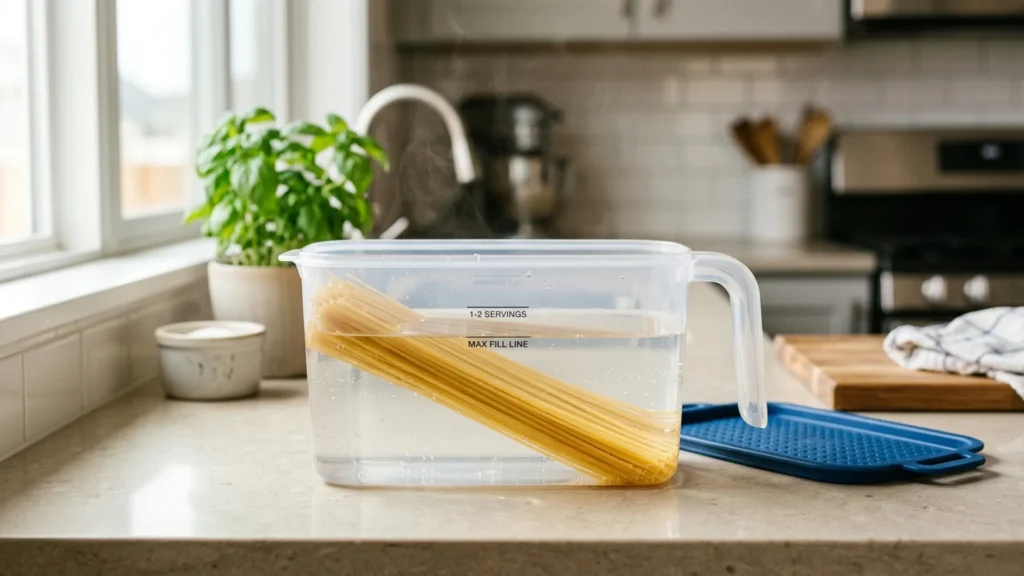
Strip away the marketing and you have three parts: a deep, microwave-safe base sized to hold pasta plus water, a lid that doubles as a colander, and usually a set of engraved fill lines for portioning. You measure pasta into the base, add water to a marked line, microwave uncovered or loosely vented, then lock the lid and tip the whole thing over the sink to drain. The pasta never leaves the vessel until it is on your plate.
The popular designs split into two camps. The simple box style, like the Nordic Ware and Fasta Pasta cookers, is a rectangular tub long enough to lay full-length spaghetti flat without snapping it. The Fasta Pasta runs about 12 inches long; the Nordic Ware holds roughly 9 cups and fits angel hair, fettuccine, and spaghetti at their full length. The second camp is the silicone bowl style, like the Lekue, which holds around 6 cups and folds flat for storage but asks you to break long strands to fit.
None of this changes the pasta itself. Inside the microwave you are still doing what a pot does: hydrating starch and gelatinizing it in near-boiling water. The cooker is a delivery system, not a different cooking method. That distinction matters because it tells you exactly where the device helps (convenience, cleanup, portion control) and where it cannot help (it will not make gummy supermarket pasta taste like fresh, and it will not beat the laws of heat transfer).
How to Use a Microwave Pasta Cooker, Step by Step
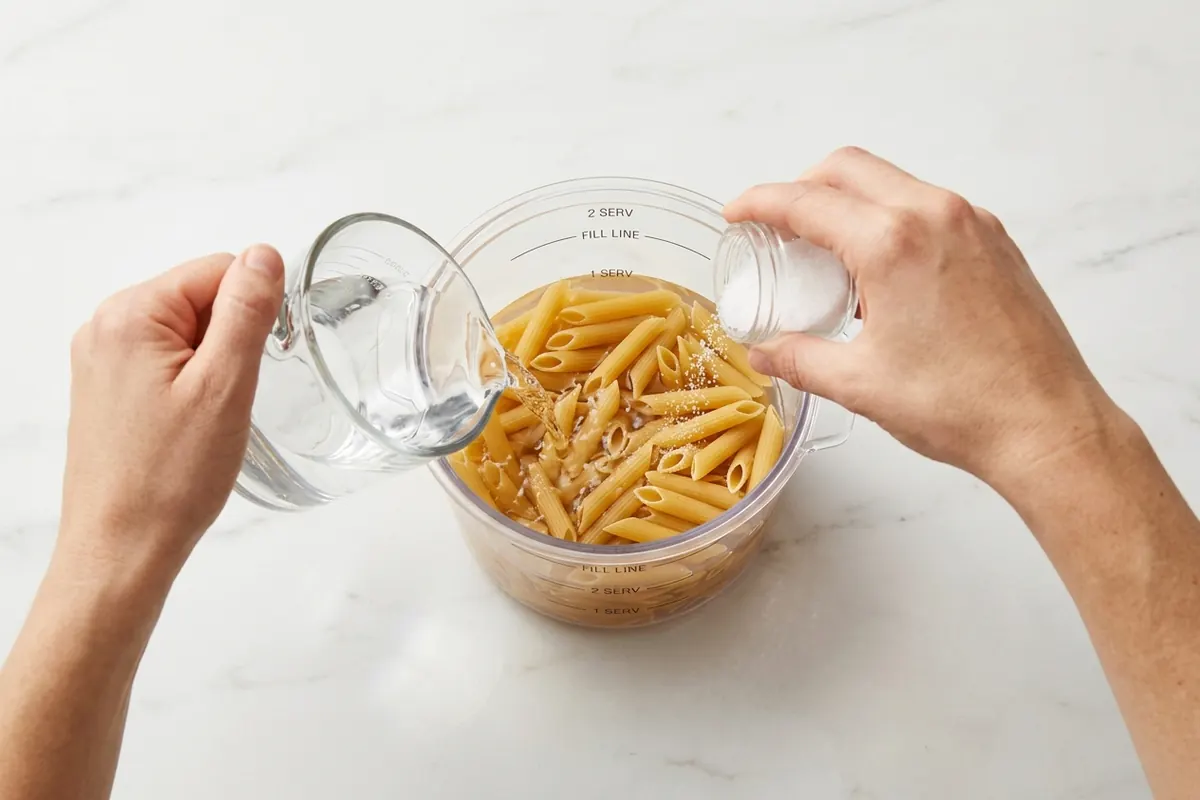
The single biggest reason people give up on these cookers is a starchy volcano in the microwave. Avoiding it is almost entirely about water level, power, and a quick mid-cook stir. Here is the sequence to follow every time.
1. Measure the pasta first, then the water. Use the engraved rings if your cooker has them, or weigh a 2-ounce (about 56 g) portion of dry pasta per person. Add the pasta to the empty base before the water so it settles flat. For most box-style cookers, fill with cool tap water until the pasta is covered by at least an inch, staying below the maximum line. Too little water and the pasta cooks unevenly and sticks; too much and it foams over.
2. Do not salt the water before it is hot, but do salt it. Salt does not pit modern cookware, and salting the water is the only chance you get to season pasta from the inside. Stir in about half a teaspoon of fine salt per serving once you add the water. Skip oil entirely; it coats the noodles and keeps sauce from clinging later.
3. Microwave uncovered, or with the lid fully vented. This is the rule that prevents boilovers. A sealed lid traps steam and pressure and the starchy water climbs straight up and out. Leave the lid off the box-style cookers, or set the silicone lid in its vented position. Cook at full power.
4. Use the box time plus a buffer, and stir at the halfway mark. Microwaves do not preheat water, so the total time is longer than the stovetop number on the box even though there is no wait for a boil. A practical starting point: take the package cook time and add roughly the same number of minutes again, then check. Pause once around the midpoint, open the door, and stir to break up clumps and knock down foam. For full-length spaghetti, Nordic Ware suggests about 12 to 13 minutes for one serving and 13 to 14 for two, adding a minute per extra serving. Treat any printed time as a first guess for your wattage.
5. Test, then drain through the lid. Pull a strand and bite it. You want it just past chalky in the center, tender with a faint firmness, which is what al dente actually means. When it is right, lock the strainer lid and invert the cooker over the sink. Give it a few seconds to fully drain. Be careful, the base and water are very hot, so use a towel.
6. Sauce in the same vessel. Most cookers let you stir warmed sauce right into the drained pasta, so you finish and serve from one container. If you want a glossier sauce, scoop out a few tablespoons of the starchy cooking water before you drain and stir it into the sauce.
If you want a deeper primer on what al dente means and why the center matters, the al dente cooking standard is a clean reference. And if you are matching shape to sauce while you are at it, our pasta shapes guide walks through which cuts hold which sauces, which is exactly the kind of decision a microwave cooker does not make for you.
Microwave Timing by Pasta Shape
Wattage is the wild card. A 1,200-watt microwave will run faster than a 700-watt one, so the only honest timing table is a starting range you verify by tasting. The numbers below are for a single 2-ounce serving in a box-style cooker filled to the line, at full power, stirred once at the midpoint. Add about a minute per additional serving and re-check.
| Pasta shape | Starting time (1 serving) | Notes |
|---|---|---|
| Angel hair | 7-9 min | Checks fastest; overcooks in seconds |
| Spaghetti / linguine | 12-14 min | Lay flat; box-style cooker needed for full length |
| Penne / rigatoni | 11-14 min | Sturdy; forgiving of a minute over |
| Macaroni / rotini | 10-13 min | Stir well; small shapes clump |
| Orzo | 9-11 min | Needs a fine strainer lid |
| Tortellini / ravioli | 8-12 min | Vent and stir gently; can split |
| Fresh pasta | 2-4 min | Watch constantly; cooks very fast |
Two patterns are worth internalizing. Thin shapes like angel hair finish fast and overcook in seconds, so check them early and often. Dense or stuffed shapes need more time and gentler handling; tortellini and ravioli can split if the water boils too violently, which is another argument for venting and stirring rather than cranking and walking away. Fresh pasta is a different animal entirely and cooks in a fraction of the time, often two to four minutes, so watch it like a hawk.
Microwave Cooker vs. the Stovetop Pot
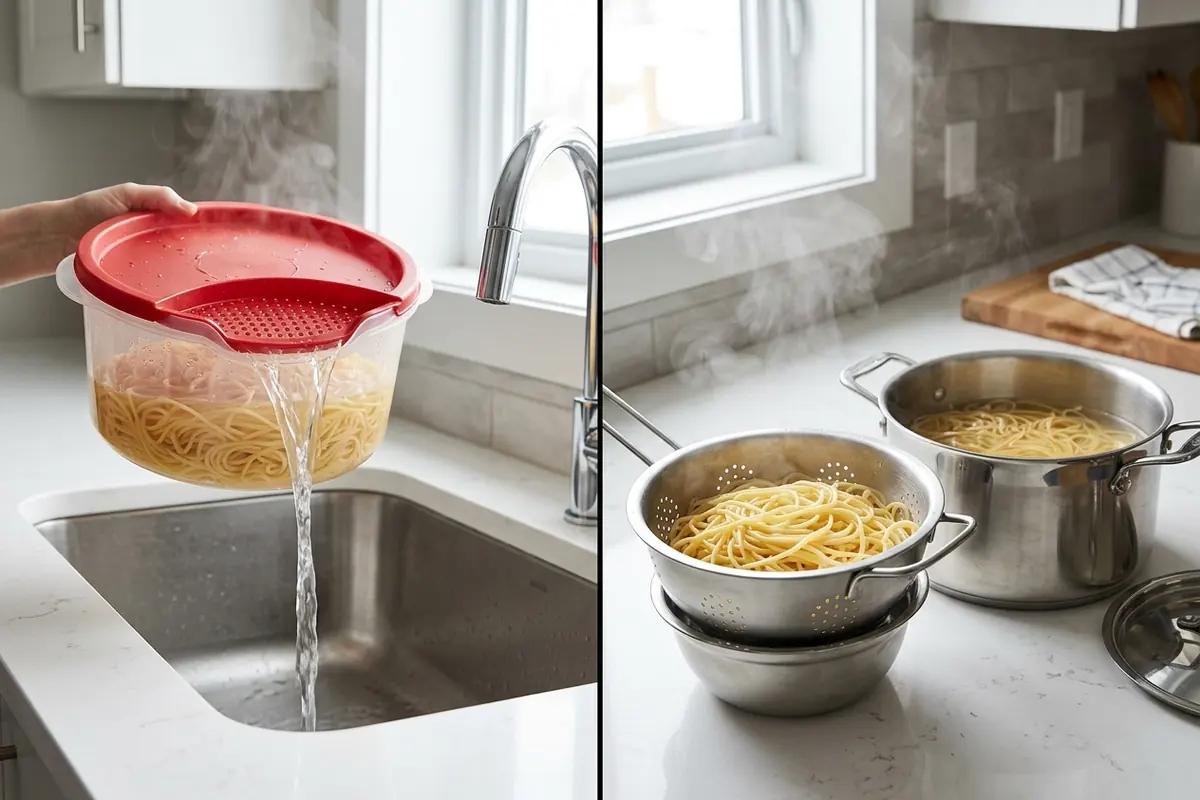
The cooker does not win every round. It wins some decisively and loses others. Here is how the two compare.
| Factor | Microwave cooker | Stovetop pot |
|---|---|---|
| Best batch size | 1-2 servings | 2-8 servings |
| Hands-on time | Low (set and stir once) | Moderate (watch the boil) |
| Cleanup | One vessel, often dishwasher-safe | Pot plus colander |
| Doneness control | Good with tasting | Best; full visual control |
| Boilover risk | Real if lid sealed | Lower with a big pot |
| Works without a stove | Yes | No |
| Baked / browned dishes | No | Yes |
The summary: the microwave cooker is a small-batch convenience tool. For one or two servings, a dorm room, an office kitchen, or a household with no working stove, it is excellent and the cleanup savings are real. For a family dinner, a big batch of baked ziti, or any time you want maximum control over doneness, the pot still rules. Think of the cooker the way you would a single-serve coffee maker: not better, just right for a specific moment.
How to Choose a Microwave Pasta Cooker
Most of these products look interchangeable and are not. When evaluating one, weigh six things, roughly in this order.
Length and capacity. If you eat long pasta, buy a cooker long enough to lay spaghetti flat. Snapping strands to fit is a small daily annoyance that adds up. For capacity, a 6-cup vessel handles one to two servings comfortably; 9 cups is the sweet spot for up to four. Bigger is not always better, because a large vessel of water takes longer to heat.
The lid and strainer. This is where cheap cookers fail. You want a lid that locks positively to the base so it cannot pop off mid-drain and dump scalding water and pasta into the sink. Look for a real latching mechanism, not a loose press-fit. Strain holes should be small enough to hold orzo and other tiny shapes.
Fill-line clarity. Engraved, easy-to-read measuring rings for both pasta and water take the guesswork out and are the difference between a reliable cooker and a foamy mess. Faint or missing lines mean you are eyeballing it every time.
Material and microwave safety. Choose BPA-free, microwave-safe plastic or food-grade silicone. The vessel should stay structurally sound at boiling temperatures. The FDA has regulated microwave oven safety standards since 1971, and the appliance itself is safe when intact, but your cookware needs to be rated for microwave use; the EPA’s overview of microwave oven radiation is a good plain-language explainer of why a properly built oven and microwave-safe vessel are the two halves of safe use.
Dishwasher safe. The whole point is less cleanup, so a top-rack dishwasher-safe cooker, like the Fasta Pasta, keeps the convenience promise intact.
Storage footprint. Box-style cookers are rigid and take up a fixed slot. Collapsible silicone models fold nearly flat, which matters in a small kitchen even if they hold a bit less.
If you are buying a cooker mainly to handle specialty pasta, factor that in. Gentle, even microwave cooking is forgiving for delicate gluten-free shapes that tend to fall apart at a hard boil; if that is your world, our friends at gluten-free pasta and pizza recipes have a deep bench of dishes built for exactly those noodles.
Common Mistakes and How to Fix Them
Almost every complaint about microwave pasta cookers traces back to one of a handful of fixable errors.
Boilovers. The cause is nearly always a sealed lid or too much water. Vent the lid or leave it off, drop the water to the marked line, and stir at the midpoint to collapse the foam. High-starch pastas foam more, so for those, pause and stir twice.
Gummy, sticky pasta. Two culprits: not enough water, so the pasta cannot move and the starch glues it together, or skipping the midpoint stir. Make sure the noodles are fully submerged and stir at least once. A quick rinse is a last resort for pasta salad only; for hot pasta, the surface starch is what helps sauce grip.
Unevenly cooked pasta. Microwaves heat unevenly and can leave cold spots, a point USDA food-safety guidance makes about all microwave cooking. Stirring redistributes the heat. If one batch keeps coming out uneven, your microwave may have hot and cold zones; rotate the cooker halfway if it does not sit on a turntable.
Overcooked mush. You trusted a printed time instead of your teeth. Always check a couple of minutes before the time you expect, especially with thin shapes. Pasta keeps cooking from residual heat after you drain, so pull it a hair early.
Watery, weak sauce. You drained every drop. Reserve a few tablespoons of the starchy water to loosen and bind the sauce. This is the same trick that makes restaurant pasta look silky, and it works identically out of a microwave cooker.
What Not to Cook in a Microwave Pasta Cooker
The vessel is good at boiling starchy water and not much else, so know its limits. Baked pasta dishes are out; there is no browning, no crisp top, no melty bubbling crust, because a microwave cannot dry-roast a surface. Large family batches overload the water-to-pasta ratio and cook unevenly, so stay within the cooker’s serving lines. Delicate fresh ravioli can survive but only with careful, low-energy timing. And while many of these cookers also handle rice and vegetables, treat that as a bonus rather than the main job.
If your craving is really for a brothy, slurpable noodle bowl rather than a drained-and-sauced plate, you are better served by a proper simmered broth than by a drain-style cooker; a pot of broth and noodle soups gives you the layered flavor a microwave cannot build. For everything else weeknight and pasta-shaped, our roundup of easy pasta recipes pairs neatly with a quick microwave boil, and the lighter dishes in our healthy pasta recipes collection are a smart match when you are cooking a single sensible portion.
Is It Worth Buying?
For the right cook, absolutely. If you regularly make one or two servings, live somewhere a stovetop is impractical, or simply hate scrubbing a pasta pot, a good microwave cooker pays for itself in saved time and saved cleanup within a month. The all-in-one measure-cook-drain-serve flow is genuinely tidy, and a quality cooker is inexpensive.
For households that cook big, want browned baked dishes, or care about millimeter-precise doneness, it is a niche second tool, not a pot replacement. Buy one with a positively locking strainer lid, clear fill lines, and a length that fits your favorite pasta, learn its timing for your microwave’s wattage in a session or two, and it will quietly earn its keep. Just remember it is a convenience device built on ordinary physics, and use it for the jobs it does well. For dialing in dry portions and water amounts precisely, the NIST metric kitchen reference and the per-shape data on USDA FoodData Central are both handy for getting servings right.
Frequently Asked Questions
How long does it take to cook pasta in a microwave pasta cooker?
Plan on roughly the package cook time plus the same amount again, because the microwave has to heat the water from cold with no preheat. For a single serving of dried pasta that usually lands between 9 and 15 minutes depending on shape and your microwave’s wattage. Start checking a couple of minutes before you expect it to be done, since thin shapes overcook fast and pasta firms up less the moment you drain it.
Why does my microwave pasta cooker boil over?
Almost always a sealed lid or too much water. Cook with the lid off or fully vented so steam escapes, keep the water at or below the fill line, and stir once at the halfway point to knock down the starchy foam. High-starch pastas foam more, so pause and stir twice if you see it climbing.
Do you need to add salt or oil to the water?
Add salt, skip oil. About half a teaspoon of fine salt per serving seasons the pasta from the inside, the only point in the process where you can. Oil coats the noodles and stops sauce from clinging later, so leave it out and rely on stirring and enough water to prevent sticking.
Is it safe to cook pasta in a microwave with a plastic cooker?
Yes, as long as the cooker is labeled BPA-free and microwave-safe and the microwave itself is intact with a working door seal. The FDA has regulated microwave oven safety since 1971, and a vessel rated for microwave use is built to stay sound at boiling temperatures. Use a towel when you handle and drain it, because the base and water get very hot.