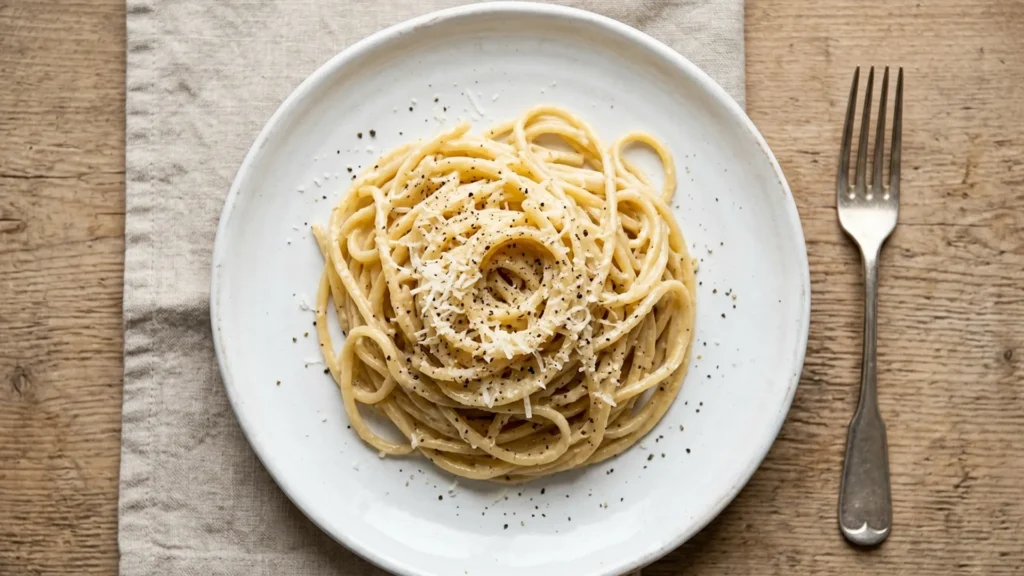
How much pasta per person comes down to one easy rule: about 2 ounces of dry pasta per person for a main dish, which cooks up to roughly 1 cup of finished pasta. That is the standard portion that restaurants and pasta makers use, and it is the number to anchor everything else to. For a side dish, drop to about 1 ounce of dry pasta per person, and for big eaters or a hearty main, you can stretch to 3 or even 4 ounces. Once you know the 2-ounce baseline, scaling up for a crowd or down for a light lunch becomes simple arithmetic.
The tricky part is that dry pasta is hard to eyeball, especially long shapes like spaghetti and small shapes like orzo. This guide gives you the per-person numbers for mains and sides, easy ways to measure pasta with no scale at all, a dry-to-cooked conversion so you know what 2 ounces becomes on the plate, and a ready-made chart for cooking pasta for a crowd. By the end you will never overcook a mountain of pasta or come up short again.
The standard pasta portion per person
The widely accepted serving of dry pasta is 2 ounces per person for a main course. That weight of dry pasta absorbs water as it cooks and roughly doubles, landing at about 1 cup of cooked pasta, which is a satisfying main-dish portion alongside sauce. This 2-ounce figure is what pasta brands print on the box and what most recipes assume, so it is a reliable anchor.
Your exact portion depends on the role the pasta plays in the meal and on who is eating. Here is the quick breakdown so you can match the portion to the occasion.
| Role or eater | Dry pasta per person | Cooked volume |
|---|---|---|
| Side dish | 1 ounce | About 1/2 cup |
| Standard main dish | 2 ounces | About 1 cup |
| Hearty main or big eater | 3 to 4 ounces | 1 1/2 to 2 cups |
| Young child | 1 ounce | About 1/2 cup |
| Pasta with hearty sauce or add-ins | 1.5 to 2 ounces | Sauce fills the plate |
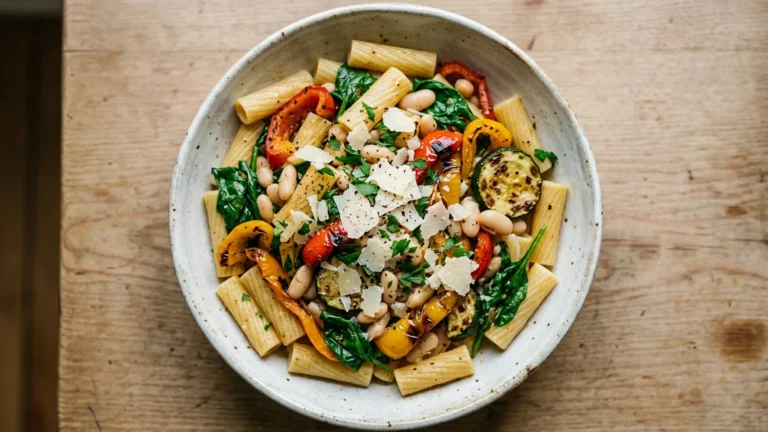
Notice the last row: when a dish is loaded with a chunky meat sauce, vegetables, or protein, the pasta itself can be slightly less because the add-ins bulk out the plate. A light olive-oil or butter pasta, where the noodles are the main event, calls for the full 2 ounces or a touch more. Read the meal, not just the rule.
It also helps to think of the 2-ounce figure as a center of gravity rather than a hard limit. Almost no one weighs to the exact ounce at home, and you do not need to. The goal is to land in the right neighborhood so you are not boiling half a box for two people or coming up a serving short at a dinner for six. Treat the number as a confident starting point, then trust your read of the table and the appetites in front of you to fine-tune it.
How to measure pasta without a scale
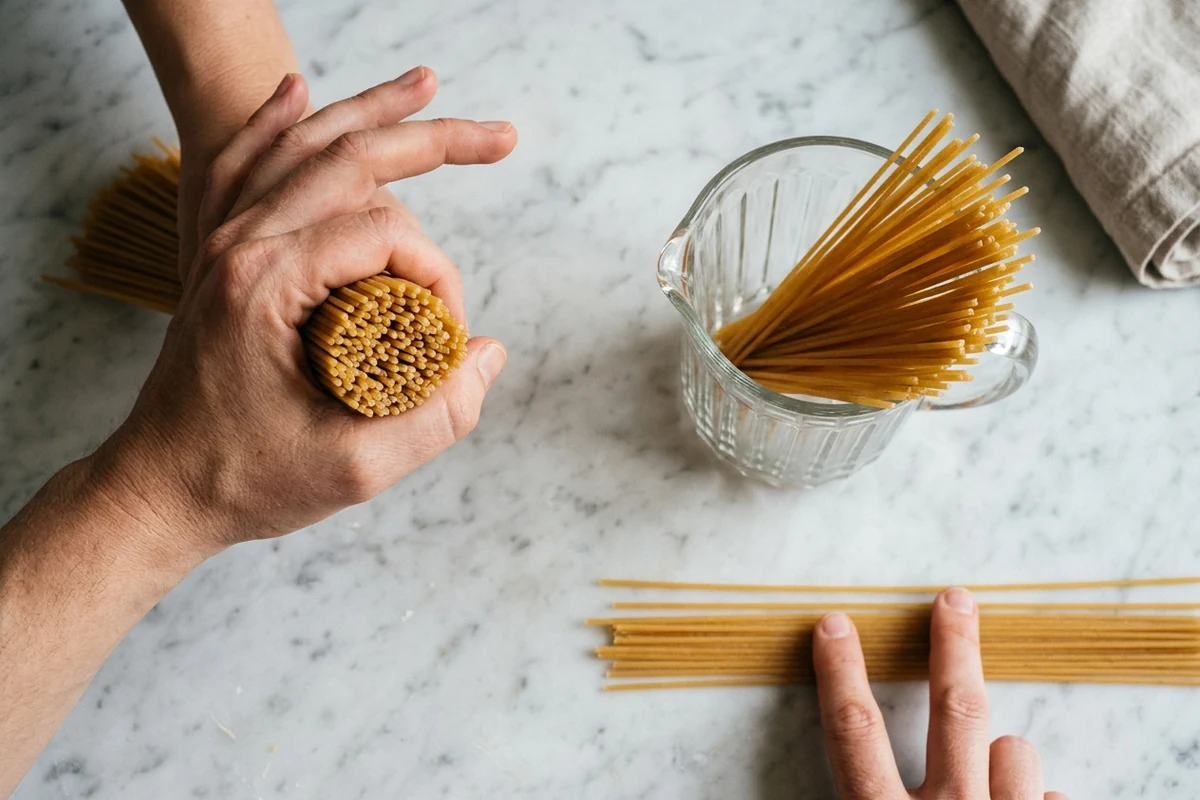
A kitchen scale is the most accurate way to portion pasta, but most people do not weigh their dinner, and you do not have to. There are reliable tricks for both long and short shapes that get you close enough every time.
Measuring long pasta like spaghetti
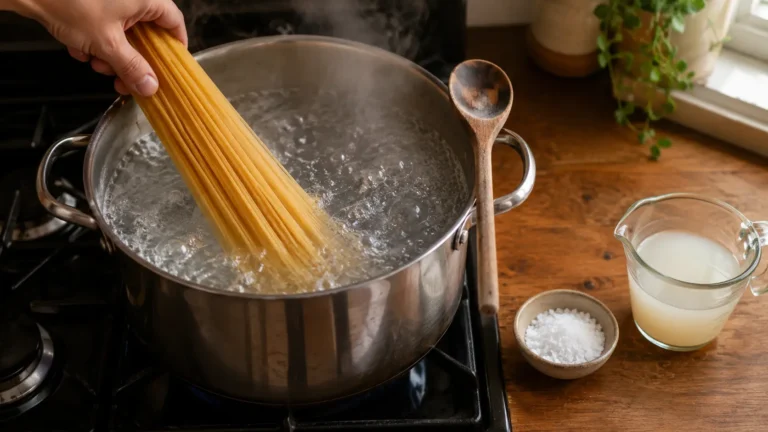
For long strands such as spaghetti, linguine, or fettuccine, the classic trick is to gather a bundle between your thumb and forefinger. A bunch about the diameter of a US quarter, roughly seven-eighths of an inch, is close to a single 2-ounce serving. Another handy tool is the hole in the middle of many pasta serving spoons: it is sized to hold one portion of spaghetti, so fill it snugly and you have one serving. Both methods are approximate, but they are surprisingly consistent once you get a feel for them.
Measuring short pasta like penne
Short shapes are easiest to measure by volume with a standard measuring cup. As a rule of thumb, about 1 cup of dry short pasta, such as penne, rotini, or farfalle, is close to 2 servings, so half a cup is a single main-dish portion for many shapes. Shapes vary in density, so this is a ballpark, but for everyday cooking it is plenty accurate. When in doubt, a slightly heaped half-cup of dry short pasta per person rarely steers you wrong.
If you cook pasta often, it is worth taking the guesswork out just once. Weigh a 2-ounce portion of your most-used short shape on a scale, pour it into a measuring cup, and note where it lands. From then on you can use that cup line as your portion marker and skip the scale entirely. The same one-time calibration works for long pasta: weigh a 2-ounce bundle, then trace its diameter against a coin or wrap a strip of paper around it so you have a physical reference. Five minutes of measuring on a quiet afternoon pays off at every rushed dinner afterward.
Dry pasta to cooked pasta: the conversion
One reason portioning confuses people is that dry pasta looks like so little, then balloons in the pot. Understanding the conversion takes the mystery out of it. As pasta cooks, it absorbs water and roughly doubles in both weight and volume, though the exact change varies by shape.
| Dry pasta | Cooked result | Serves |
|---|---|---|
| 2 ounces | About 1 cup | 1 main portion |
| 4 ounces | About 2 cups | 2 main portions |
| 8 ounces (half pound) | About 4 cups | 4 main portions |
| 1 pound (16 ounces) | About 8 cups | About 8 main portions |
This is why a single one-pound box of pasta feeds roughly four to eight people depending on whether you serve generous mains or lighter portions. For most family dinners of four with hearty appetites, a full pound is the right call. For four lighter eaters or a side dish, half a box does the job. Keeping the doubling rule in mind lets you reverse-engineer the box from the number of mouths at the table. A good overview of types of pasta can help you pick a shape that suits the dish you are scaling.
How much pasta to cook for a crowd
Cooking for a group is where the math matters most, because the difference between not enough and a giant wasted pot is just a few ounces per head. Use this table to plan, assuming a standard 2-ounce main-dish portion per person.
| Number of people | Dry pasta needed | In pounds |
|---|---|---|
| 4 people | 8 ounces | 1/2 pound |
| 6 people | 12 ounces | 3/4 pound |
| 8 people | 16 ounces | 1 pound |
| 10 people | 20 ounces | 1 1/4 pounds |
| 12 people | 24 ounces | 1 1/2 pounds |
For a buffet or a party where pasta is one of several dishes, you can lean toward the lighter side, since people fill their plates with other options too. For a pasta-focused dinner where the noodles are the star, round up rather than down, because running out is worse than having leftovers, and cooked pasta keeps well for several days. If you are feeding a mix of adults and kids, average it out: a couple of small portions balance a couple of large ones.
Deliberate leftovers are a feature, not a bug, when you cook for a crowd. Boiling an extra half-pound of pasta costs almost nothing and gives you a head start on lunches, a quick baked pasta, or a cold pasta salad later in the week. Just store the extra plain pasta tossed with a little oil rather than drowned in sauce, so you can repurpose it freely. Planning a small surplus also protects you from the most stressful crowd-cooking moment, the one where the serving bowl empties and there are still hungry guests in line. A little extra in the pot is cheap insurance against that.
Keeping pasta warm for a group
When you cook a big batch, timing it so everything is hot at once can be tricky. Cook the pasta just to al dente, toss it with a little oil or some of the sauce so it does not clump, and hold it in a covered dish in a low oven or a slow cooker on the warm setting. Add a splash of reserved pasta water if it tightens up. This lets you cook ahead and serve a crowd without a last-minute scramble, and the noodles stay pleasant for an hour or so.
Does the pasta shape change the portion?
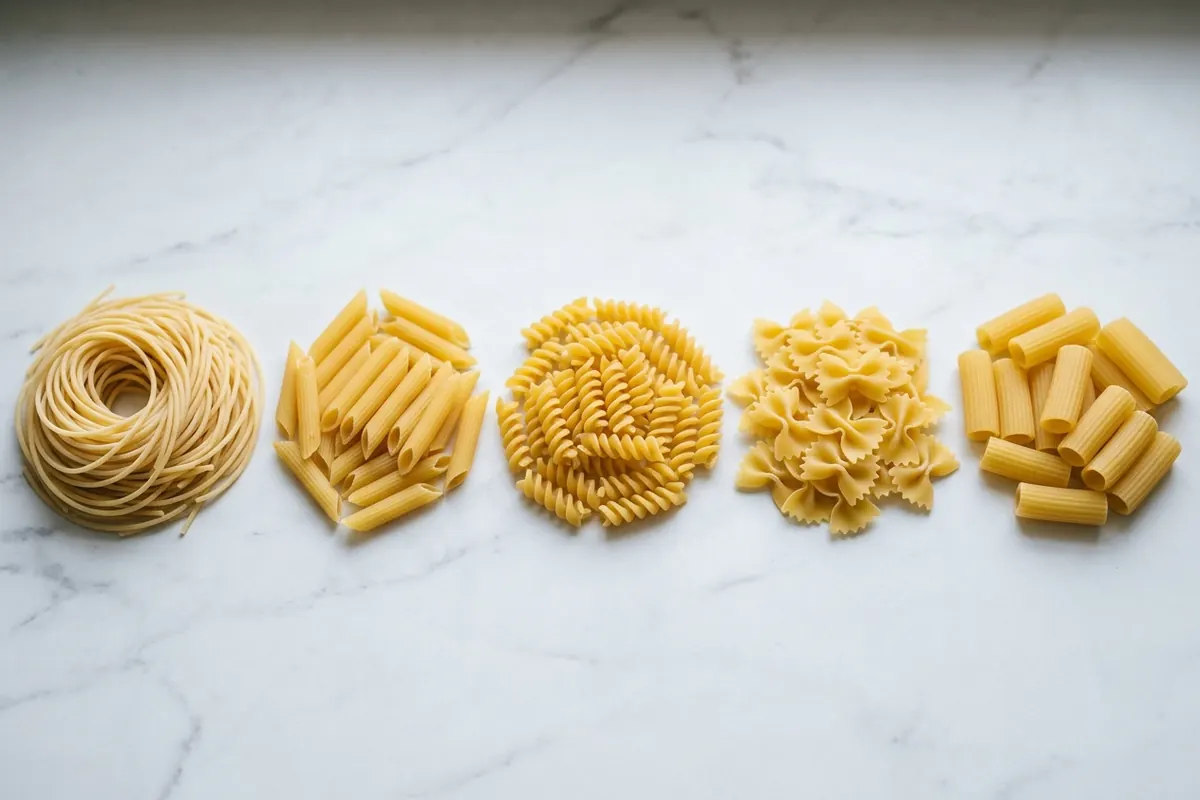
The 2-ounce-by-weight rule holds across every shape, because it is a measure of weight, not volume, and 2 ounces of spaghetti weighs the same as 2 ounces of penne. Where shapes differ is in how much space that weight takes up and how filling it feels, which is why a cup of one shape is not the same number of servings as a cup of another. Light, airy shapes like farfalle take up more room per ounce, while dense shapes like orzo pack tightly, so volume measuring needs a shape-aware eye even though the weight stays constant.
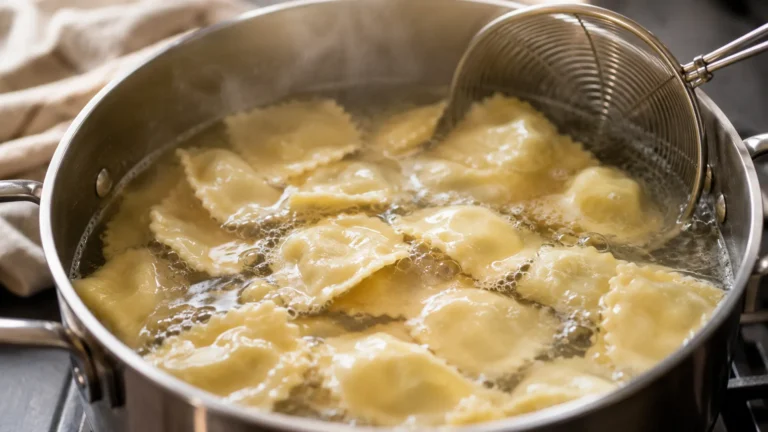
Filled pasta is the big exception to the standard math. Ravioli, tortellini, and other stuffed shapes carry cheese, meat, or vegetables inside, so they are far more filling per piece than plain noodles. For filled pasta, portion by the package or by count rather than by the 2-ounce dry rule, usually somewhere around 1 cup of cooked filled pasta or 6 to 9 large ravioli per person for a main. Because the filling does much of the work, you need less of it to satisfy than you would with plain pasta, and overserving filled pasta is an easy way to send guests home uncomfortably full.
Adjusting for appetites
Numbers on a chart meet reality at your own table. Teenagers and very active adults often eat well past the standard portion, while older adults and light eaters may be happy with less. The honest approach is to start from the 2-ounce baseline, then nudge it based on who is actually eating. If you regularly cook for the same people, you will quickly learn whether your household runs above or below the average, and you can adjust the box accordingly. A good default for a family of four mixed eaters is a full one-pound box, which leaves a little extra for the bigger appetites or for lunch the next day.
How sauce and sides change the math
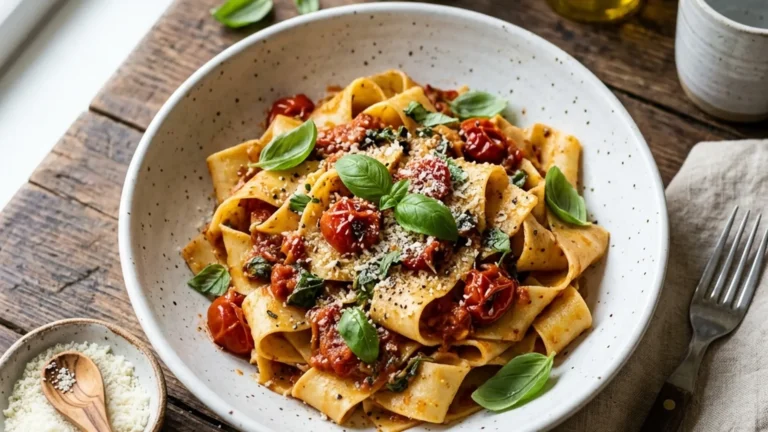
The 2-ounce rule assumes pasta is the main attraction. Real meals are rarely that simple, and a few factors shift the right amount up or down. A rich, chunky sauce loaded with meat or vegetables adds bulk, so you can serve slightly less pasta per person. A light sauce, like a simple garlic and oil or a brothy preparation, leaves the pasta to carry the plate, so portion the full amount.
Sides matter too. If pasta is sharing the table with bread, a big salad, and a protein, people eat less of it, and a lighter portion is fine. If pasta is the whole dinner, give everyone the full main-dish serving or a bit more. Appetite and context vary, but a useful habit is to cook the standard amount, then keep a little extra dry pasta on hand to boil quickly if the table is hungrier than you expected. For protein-forward meals, our guide on high protein pasta covers options that make a smaller portion more filling, and if you are building a spread, our roundup of what to serve with pasta salad helps round out the plate.
It is also worth remembering that the official USDA single serving of cooked pasta is just half a cup, far smaller than what most people actually eat or what restaurants plate. The 2-ounce dry, 1-cup cooked figure reflects a real-world dinner portion rather than a nutrition-label serving, which is why your homemade plate may look bigger than the box suggests. The nutrition rundown at Healthline puts those serving sizes and the carb question in helpful context, and authorities like Food Network use the same 2-ounce baseline.
FAQ
How much dry pasta is one serving?
One serving of dry pasta is about 2 ounces for a main dish, which cooks up to roughly 1 cup of finished pasta. For a side dish, use about 1 ounce per person, and for big eaters or a hearty main, you can go up to 3 or 4 ounces. The 2-ounce figure is the standard that pasta boxes and recipes assume.
How do I measure pasta without a scale?
For long pasta like spaghetti, gather a bundle about the diameter of a US quarter, which is close to one 2-ounce serving, or use the hole in a pasta serving spoon, which holds one portion. For short shapes like penne, use a measuring cup: about half a cup of dry short pasta is roughly one main-dish serving.
How much does dry pasta expand when cooked?
Dry pasta roughly doubles in weight and volume as it absorbs water during cooking. So 2 ounces of dry pasta becomes about 1 cup cooked, 8 ounces becomes about 4 cups, and a full one-pound box becomes about 8 cups, enough for roughly four to eight main-dish servings depending on portion size.
How much pasta do I need for a group of people?
Plan on 2 ounces of dry pasta per person for a main dish. That means about half a pound for 4 people, three-quarters of a pound for 6, a full pound for 8, and a pound and a half for 12. For a pasta-focused dinner, round up, since cooked pasta keeps several days and running out is worse than leftovers.
Does the type of sauce change how much pasta to cook?
Yes. A rich, chunky sauce with meat or vegetables adds bulk to the plate, so you can serve slightly less pasta, around 1.5 ounces per person. A light sauce, like garlic and oil, leaves the pasta as the main event, so use the full 2 ounces or a touch more. Match the portion to how much the sauce contributes.
How much pasta should I cook for a child?
For a young child, about 1 ounce of dry pasta, or roughly half a cup cooked, is usually a good portion, similar to a side-dish serving for an adult. Older kids and teenagers often eat an adult-sized 2-ounce portion or more. When feeding a mix of ages, average the amounts out so the large and small portions balance.
Bottom line
How much pasta per person really is as simple as the 2-ounce rule once you internalize it: 2 ounces of dry pasta per person for a main, about 1 ounce for a side, and a cooked result of around 1 cup per main-dish serving. Measure long shapes with a coin-sized bundle or a spoon hole, short shapes with a half-cup measure, and remember that dry pasta doubles when it cooks. Use the crowd chart to scale up for a group, round up when pasta is the star, and adjust down when a hearty sauce or big sides are sharing the plate. Get these numbers into your hands and you will cook exactly the right amount, every single time.