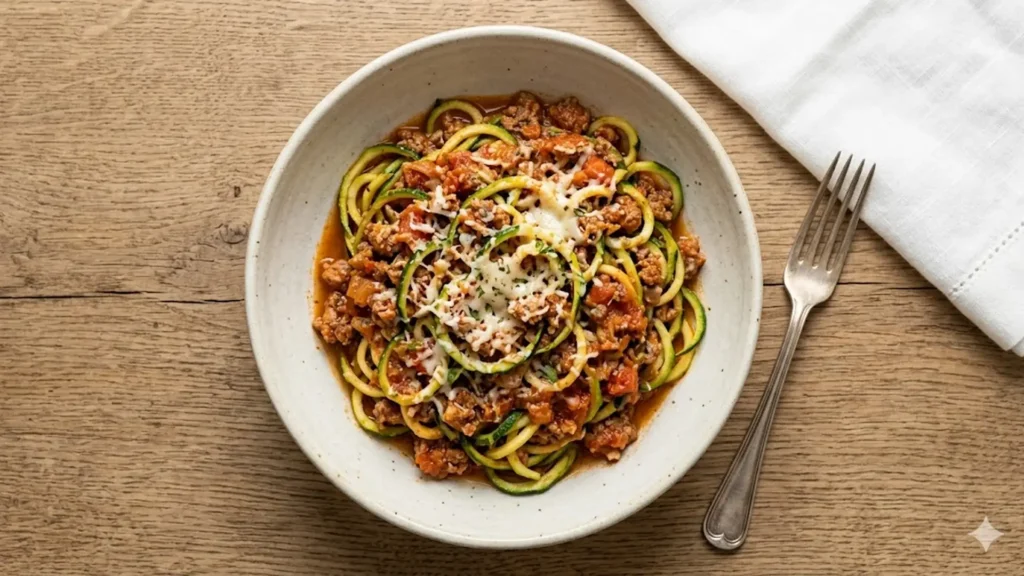
Keto pasta is any noodle low enough in net carbs to fit a ketogenic diet, usually under 5 grams of net carbs per serving, compared to the 40 to 50 grams in regular wheat pasta. The best options are shirataki (konjac) noodles at roughly 0 to 1 gram, zucchini noodles at 2 to 4 grams, hearts of palm noodles at 2 to 4 grams, and cheese-based or specialty protein pastas in the 5 to 10 gram range. The catch nobody tells you: how you cook them matters more than which one you buy.
Most keto pasta guides are just brand lists with net carb numbers and nothing else. That is half the story. I have cooked all of these, and the difference between a rubbery, fishy bowl of shirataki and a genuinely good one is a single technique that takes seven minutes. This guide gives you the carb counts, yes, but also the cooking methods that make each type edible, which sauces actually pair with them, and a homemade cheese-based recipe with real ratios.
The Keto Pasta Options, Ranked by Net Carbs
Your daily keto carb budget is usually 20 to 50 grams of net carbs, so a single serving of regular pasta can blow the whole day. These alternatives keep you well under. Here is how they stack up.
| Keto pasta | Net carbs | Made from |
|---|---|---|
| Shirataki / konjac | 0-1g | Konjac root fiber |
| Hearts of palm (Palmini) | 2-4g | Hearts of palm |
| Zucchini noodles | 2-4g | Spiralized zucchini |
| Cheese-based / fathead | 2-5g | Mozzarella, egg |
| Protein / soy keto pasta | 5-10g | Soy or wheat protein |
Shirataki wins on pure carbs, with almost none, plus only about 10 calories per serving. But lowest carb is not the same as best to eat. The specialty protein pastas taste closest to real pasta and pack 17 to 30 grams of protein, at the cost of a few more carbs. Pick by what you actually want from the meal, not just the smallest number.
How to Cook Shirataki Without the Rubber and Smell
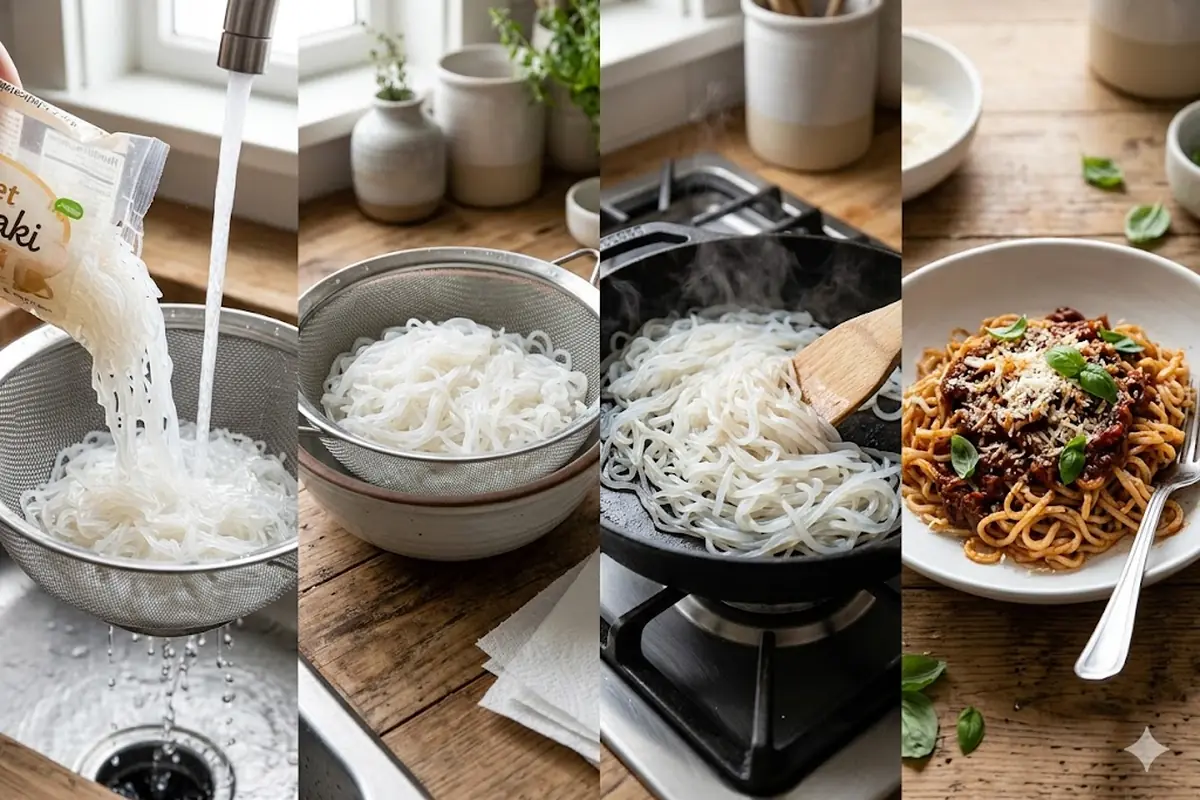
This is the section that should be in every keto pasta guide and almost never is. Shirataki noodles come packed in a konjac liquid that smells faintly fishy and leaves the noodles rubbery if you cook them straight from the bag. The fix has three steps and it is the difference between inedible and good.
First, drain and rinse the noodles under cold running water for a full 30 to 60 seconds to wash off the packing liquid and its smell. Second, boil them for 2 to 3 minutes. Third, and this is the move people skip, dry-fry them. Toss the drained noodles into a hot, dry nonstick pan over medium-high heat and stir for 5 to 7 minutes until they squeak and most of the surface moisture cooks off. This drives out the water trapped in the fiber, firms up the texture, and lets them grab sauce instead of repelling it. The first time I did this I could not believe it was the same product. Skipping the dry-fry is the single biggest reason people say they hate shirataki.
Cooking Zoodles and Hearts of Palm
Zucchini noodles have the opposite problem: too much water. Zucchini is about 95 percent water, and heat releases all of it, leaving you with a watery puddle and limp strands. The fix is to salt the raw zoodles and let them sit for 10 minutes, then squeeze them in a clean towel to wring out the liquid. Then cook them fast, no more than 2 minutes in a hot pan, just to warm through. Overcook them and they collapse. Honestly, zoodles are often best barely cooked or even raw, tossed with a warm sauce that gently wilts them.
Hearts of palm noodles, sold as Palmini and similar, come with a briny, slightly sour packing liquid. Rinse them well, then soak them in milk or water for about 30 minutes to mellow the brine and soften the texture toward something more pasta-like. After that they take sauce well and hold up to heat better than zoodles. A quick warm in the pan is all they need. For the sauce side of any of these, the emulsion logic in our guide to butter sauce for pasta applies directly, since low-carb noodles do not release starch to thicken a sauce the way wheat does.
Matching Sauce to Noodle
Keto noodles each have a personality, and the wrong sauce wastes them. Shirataki is essentially flavorless, which is a feature: it is a blank slate that loves bold, assertive sauces. Garlic, sesame, soy-based stir-fry sauces, and rich cream sauces all carry it well. A timid sauce leaves shirataki tasting like nothing.
Zoodles bring their own fresh, green flavor and a lot of moisture, so they pair best with light, oil-based sauces, pesto, or a quick garlic and olive oil toss. A heavy cream sauce on watery zoodles turns thin and sad. Hearts of palm noodles sit in the middle and take both light and creamy sauces. Cheese-based fathead noodles are rich on their own and pair best with simple tomato or a light cream sauce so the dish does not become too heavy. If your sauce comes out thin because the noodles will not thicken it, our notes on how to thicken pasta sauce cover keto-friendly thickeners that do not add carbs. For more low-carb noodle backgrounds, our piece on low carb pasta alternatives goes deeper on the swaps.
Homemade Cheese-Based Keto Pasta
If store-bought options leave you cold, you can make a keto pasta at home that tastes far closer to the real thing. The fathead-style noodle uses melted mozzarella and egg yolk as the dough. The basic ratio is about 1.5 cups of shredded mozzarella melted gently, mixed off heat with 2 egg yolks until it forms a smooth dough. Spread it thin between parchment, chill until firm, then slice into noodles. It comes in around 2 to 4 grams of net carbs per serving and holds up to sauce better than any water-based noodle.
An egg-white version works too, baking thin sheets of seasoned egg white and slicing them into ribbons, which gives you a fettuccine-like noodle with almost no carbs and a lot of protein. Neither is as fast as boiling water, but they make a keto pasta night feel like a real one. America’s Test Kitchen has useful science on low-carb and gluten-free doughs at americastestkitchen.com, and Bon Appetit at bonappetit.com has good ideas for the sauces to put on them.
Net Carbs, Fiber, and Why the Math Works
The whole reason these noodles fit keto comes down to net carbs, which is total carbohydrate minus fiber and certain sugar alcohols. Shirataki is almost entirely glucomannan, a soluble fiber your body does not absorb as usable carbohydrate, so its few grams of total carbs net out to nearly zero. That is the trick: it is technically a carbohydrate, but one that does not raise blood sugar or knock you out of ketosis.
This matters when you read labels, because a product can show 6 grams of total carbs and still be keto-friendly if 5 of those are fiber. Look for the net carb number, not the total. The specialty protein pastas play a different game, using soy or wheat protein isolate to replace most of the starch, which keeps carbs moderate while pushing protein high. Both approaches get you to a low net carb count, just by different routes. Knowing which route a product takes tells you what to expect: fiber-based noodles are nearly calorie-free and neutral, while protein-based ones are more filling and taste more like pasta.
Storing and Reheating Keto Pasta
Each type stores differently, and a few keep better than others. Cooked shirataki holds in the fridge for 3 to 4 days, and reheats well with a quick dry-fry to drive off any moisture it picked up. It does not freeze well, turning spongy when thawed, so cook only what you need. Hearts of palm noodles keep a similar few days and reheat fine in a pan.
Zoodles are the worst keepers. Once cooked they continue to weep water and go limp within a day, so they are best made fresh and eaten immediately. If you must prep ahead, spiralize the raw zucchini and store it dry in the fridge, then cook at the last minute. Fathead noodles store well for several days and even freeze reasonably, making them the best make-ahead option of the bunch. Whatever you store, keep it separate from any watery sauce, since these noodles soak up moisture and go soft, then add the sauce when you reheat.
Mistakes That Ruin Keto Pasta
The errors are predictable and all fixable. The biggest is cooking shirataki straight from the bag without rinsing and dry-frying, which is why so many people write the noodle off after one bad bowl. Give it the full treatment and it transforms.
The second is drowning watery noodles in a thin sauce. Zoodles and unprepped hearts of palm already carry water, and a watery sauce on top gives you soup. Wring out the noodles and use a sauce thick enough to cling. The third mistake is expecting these to behave exactly like wheat pasta. They will not. They do not release starch, they cook faster, and they have their own textures. Cooks who fight that are always disappointed, while cooks who lean into each noodle’s strengths eat well. The fourth is ignoring portion creep on the protein pastas, which do carry real carbs, so a double serving can quietly use a big chunk of your daily budget.
Buying Tips at the Store
Shopping for keto pasta has gotten easier as the category has grown, but a few habits help. Check the net carb math yourself rather than trusting front-of-package claims, since “keto-friendly” is a marketing term with no legal definition. For shirataki, the tofu-blended versions, sometimes called tofu shirataki, have a slightly more pleasant texture than pure konjac if the rubberiness bothers you, at the cost of a gram or two of carbs.
For protein pastas, weigh whether you want the extra protein or the lowest carbs, because the two goals pull in opposite directions. And buy small the first time. These noodles are polarizing, and texture preferences are personal, so test a single package before you stock the pantry. I bought a case of one brand early on, hated the texture, and ate my way through it out of stubbornness. Try one, find your favorite, then commit.
Choosing the Right One for Your Goal
There is no single best keto pasta, only the best one for what you want tonight. Use this quick logic. If your only priority is the absolute lowest carbs, go shirataki and dry-fry it. If you want the texture closest to real pasta, reach for a specialty protein pasta and accept the few extra carbs. If you want fresh and vegetable-forward, spiralize zucchini. If you want the most pasta-like homemade result, make a fathead noodle.
My own rotation leans on shirataki for Asian-style bowls where bold sauce hides its neutrality, zoodles in summer when zucchini is cheap and good, and a fathead batch when I want comfort food that feels indulgent. Treating them as different tools rather than interchangeable swaps is what makes keto pasta satisfying instead of a sad compromise. If you are watching protein as well as carbs, our breakdown of low protein pasta shows the other end of the spectrum for comparison.
A Real Keto Pasta Night, Start to Finish
Here is how a good keto pasta dinner actually comes together in my kitchen, so the techniques above stop being abstract. Say I am making a garlic-cream shirataki bowl. I open and drain the noodles, rinse them hard under cold water for a full minute, then boil them three minutes while I start the sauce. Once boiled, I drain them again and throw them into a dry, hot pan, stirring for about six minutes until they squeak and look dry rather than glossy.
Meanwhile the sauce is butter, garlic, heavy cream, and Parmesan reduced to a cling, the same kind of rich, bold sauce that hides shirataki’s blank flavor. I add the dry-fried noodles straight into the sauce and toss for a minute so they drink it in. Total time is under fifteen minutes, the bowl has maybe 3 net carbs, and it tastes like a cream pasta, not a diet substitute. The dry-fry is the whole ballgame. Skip it and the same ingredients make a watery, rubbery disappointment. That one habit is what moved keto pasta from something I tolerated to something I actually crave on a weeknight.
FAQ
What is the lowest carb keto pasta?
Shirataki, also called konjac noodles, is the lowest at roughly 0 to 1 gram of net carbs and about 10 calories per serving. It is made from konjac root fiber. The tradeoff is a neutral flavor and a texture that needs the right cooking method to be enjoyable.
Why does my shirataki pasta taste rubbery and smell fishy?
It comes packed in konjac liquid that causes both problems. Rinse the noodles well, boil them 2 to 3 minutes, then dry-fry them in a hot dry pan for 5 to 7 minutes to drive out the moisture. This removes the smell and firms the texture dramatically.
Are zucchini noodles keto?
Yes. Zucchini noodles have about 2 to 4 grams of net carbs per cup, which fits keto easily. Salt them and squeeze out the water before cooking, and cook them only 2 minutes or less so they do not turn to mush.
How many carbs can I eat on keto?
Most ketogenic diets target 20 to 50 grams of net carbs per day. A single serving of regular pasta has 40 to 50 grams, which can use your entire budget, so low-carb noodles under 5 grams per serving let you have a pasta dish and stay in ketosis.
What keto pasta tastes most like real pasta?
Specialty protein pastas made from soy or wheat protein come closest in texture, though they carry 5 to 10 grams of net carbs. Homemade fathead noodles made from mozzarella and egg are also close and lower in carbs, at about 2 to 4 grams per serving.
Can I make keto pasta at home?
Yes. The easiest is a fathead noodle: melt about 1.5 cups of mozzarella, mix in 2 egg yolks off the heat to form a dough, roll it thin, chill, and slice. It runs about 2 to 4 grams of net carbs and holds sauce well.
What sauce goes with keto pasta?
Match the sauce to the noodle. Neutral shirataki loves bold garlic, sesame, or cream sauces. Watery zoodles want light oil-based sauces or pesto. Rich fathead noodles pair best with simple tomato or a light cream sauce so the dish stays balanced.
Bottom Line
Keto pasta is genuinely good once you stop treating the noodles like wheat pasta and start respecting their quirks. Shirataki needs a dry-fry, zoodles need their water wrung out, and hearts of palm need a soak. Match a bold sauce to neutral noodles and a light one to watery ones. Buy shirataki for the lowest carbs, a protein pasta for the best texture, or make a fathead batch when you want the real comfort-food feeling, all while staying under 5 net carbs a serving.