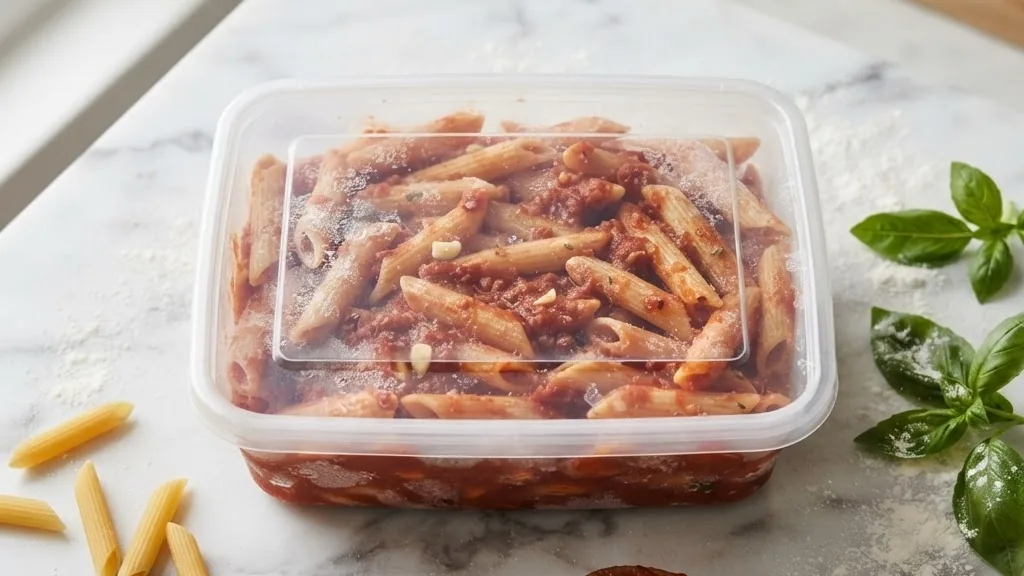
Can you freeze cooked pasta? Yes, you absolutely can, and it is an easy way to turn one big Sunday pot into three easy weeknight dinners. The question can you freeze cooked pasta comes up constantly, usually from someone staring at a mountain of leftover spaghetti and wondering if they have to eat it three nights running. The trick is not whether it survives the freezer, because it does. The trick is how you cook it, how you package it, and how you thaw it, because those three small habits are the difference between a plate of springy noodles and a gummy brick you end up scraping into the bin.
The usual approach is to freeze leftover pasta in whatever bowl is closest, seal it up warm, and shove it in the back of the freezer. Two weeks later that means a solid clump the size of a football, microwaved into a pasty lump, and the conclusion that frozen pasta is just bad. It was not the pasta that was bad. It was the method. With a handful of steps fixed, freezing becomes one of the most useful kitchen habits, and it saves more weeknight dinners than almost any other trick.
Every temperature and timeframe below was checked this month against the FDA and USDA food-safety guidance, not from memory, because the numbers are the part you actually need to get right.
Quick answer: Yes, you can freeze cooked pasta, and it keeps its best quality for about 1 to 2 months at 0 F (-18 C). Cook it 1 to 2 minutes shy of the package time so it lands al dente, cool it fully, toss it with a little olive oil, and freeze it in a single layer before bagging it into meal-size portions. To serve, drop it straight from frozen into boiling water for 30 to 60 seconds, or microwave it in short bursts with a splash of water. Freeze the sauce separately when you can, since sauce-soaked noodles turn gummy.
Why freezing cooked pasta works at all
Pasta freezes well because it is mostly starch and water, and freezing simply locks that structure in place. According to USDA food-safety guidance, freezing does not kill most bacteria, it just pauses their growth, which is why food held steadily at 0 F stays safe more or less forever. That is the reassuring part: the storage limits people quote are about quality, not safety. Your noodles will not become dangerous at eight weeks. They will just start to lose the texture that made them worth eating.
The enemy of frozen pasta is not spoilage, it is ice and mush. When cooked pasta freezes, the water inside each strand forms tiny ice crystals. Freeze it fast and portioned thin, and those crystals stay small and the texture holds. Freeze a big warm lump slowly in the center of a crowded freezer, and the crystals grow large, rupture the starch, and leave you with the soft, waterlogged noodles that give frozen pasta its bad name. Almost every step in the method below is aimed at freezing fast and freezing thin.
There is one more reason it works so well for home cooks: pasta is forgiving on the reheat if you undercook it up front. A noodle that went into the freezer slightly firm has somewhere to go when it hits hot water again. A noodle that was already soft has nowhere left to travel except to mush. If you are the kind of cook who worries about leftovers going off before freezing day, the guide on whether pasta goes bad walks through the warning signs so you freeze the batch while it is still at its best.
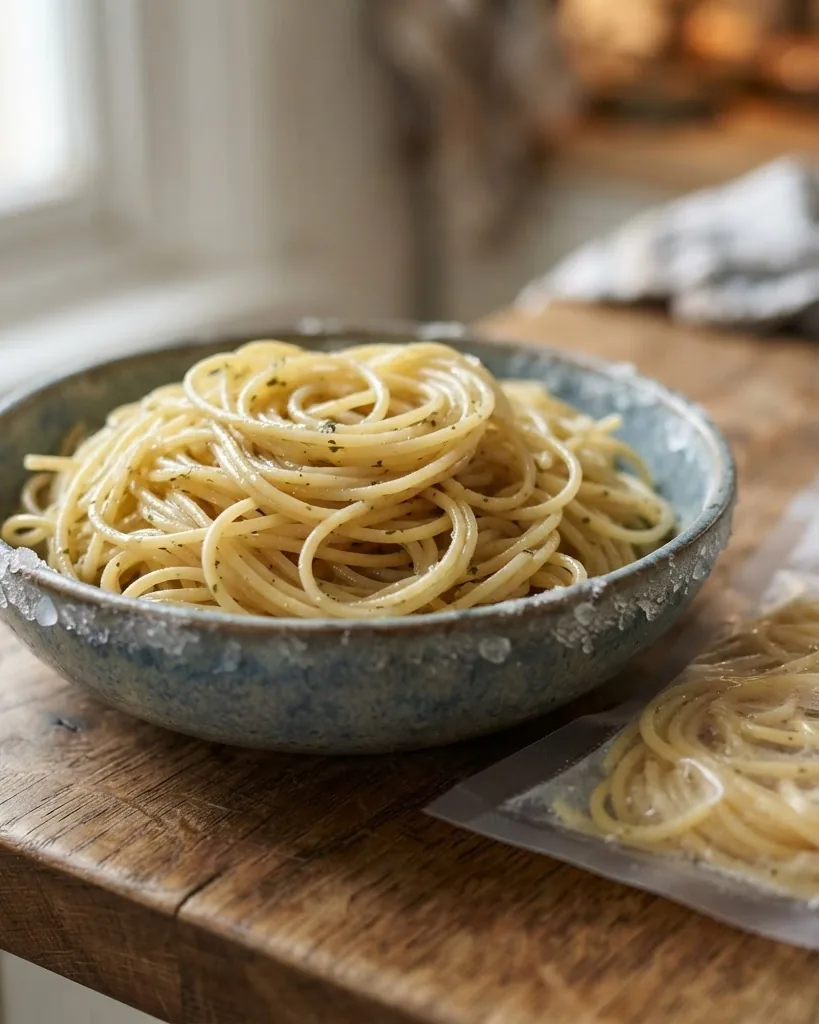
The temperatures and timeframes that actually matter
This is the part to get exactly right, because it is where guesswork causes trouble. Your freezer should sit at 0 F (-18 C). The FDA recommends keeping an inexpensive appliance thermometer in there and checking it about once a week, because a freezer that drifts up to 10 or 15 degrees will not hold quality anywhere near as long. Your refrigerator, for the days before you freeze or after you thaw, should stay at or below 40 F (4 C).
Now the clock. Cooked pasta keeps in the fridge for roughly 3 to 5 days in a sealed container, though the texture starts slipping around day 3, which makes that a sensible cutoff for freezing a batch rather than eating it fresh. In the freezer, plain cooked pasta holds its best quality for about 1 to 2 months, and stays perfectly usable up to around 3 months with a little texture loss. Baked pasta casseroles land in that same 3 month window. Past those marks it is still safe at 0 F, it just will not taste like it did going in.
One food-safety rule ties all of this together and it is worth burning into memory: cooked food should never sit at room temperature for more than 2 hours before it goes into the fridge or freezer. That two-hour window is the one line never to cross, because it is the point where bacteria on cooling food really get going. Cool your pasta quickly, spread it out to release heat, and get it cold.
| Where it lives | Target temperature | Best-quality window |
|---|---|---|
| Countertop after cooking | Room temp | 2 hours maximum |
| Refrigerator | At or below 40 F (4 C) | 3 to 5 days |
| Freezer, plain pasta | 0 F (-18 C) | 1 to 2 months (usable to 3) |
| Freezer, baked or saucy pasta | 0 F (-18 C) | About 2 to 3 months |
One cheap habit keeps those windows honest: label every bag with the contents and the freezing date, in permanent marker, before it goes in. It sounds fussy, but a freezer without labels is a mystery box, and mystery boxes are how food gets forgotten until it is freezer-burned. Thirty seconds with a marker saves the whole portion.
A quick word on why the quality clock and the safety clock are different, because it confuses a lot of people. Safety is about bacteria, and at a steady 0 F bacteria simply cannot multiply, so a bag of pasta frozen in May is technically safe to eat in December. Quality is about texture and flavor, and those degrade slowly even in a deep freeze as moisture migrates out of the noodles and freezer air dries their surface. When a guide tells you cooked pasta lasts 1 to 2 months, it is talking about that quality curve, not a spoilage deadline. Knowing the difference means you can stretch a portion a few weeks past the window in a pinch without worrying, as long as your freezer has held its temperature.
How to freeze cooked pasta, step by step
Here is the exact routine, and every step earns its place. Skip the oil and you get clumps. Skip the single-layer freeze and you get a brick. Skip the cool-down and you get sogginess. Follow all of it and you get portions that pour out loose and reheat in about a minute.
- Step 1 – Cook the pasta 1 to 2 minutes less than the package says, so it comes out firmly al dente. This is the most important step. Slightly underdone pasta has room to finish cooking when you reheat it, while fully soft pasta only has room to fall apart.
- Step 2 – Drain it well and cool it completely. Spread it on a sheet pan or rinse briefly under cool water to stop the carryover cooking and drop the temperature fast, so it is not steaming when it hits the freezer.
- Step 3 – Toss it with 1 to 2 teaspoons of olive oil per serving. Use your hands or tongs to coat every strand lightly. The oil keeps the pieces from fusing together as they freeze and as they thaw.
- Step 4 – Spread it in a single layer on a parchment-lined baking sheet and freeze for at least 1 hour, up to 8. For long noodles like spaghetti, twirl the pasta into loose half-cup nests first so they hold their shape.
- Step 5 – Transfer the frozen pasta into meal-size freezer bags or containers, press out as much air as you can, seal, and label with the date and contents. Because the pieces froze separately, they stay loose and you can pour out just what you need.
That single-layer freeze in Step 4 is the move most people skip, and it is the one that matters most. Freezing the pieces apart first means they never get the chance to lock together, so the finished bag behaves like a bag of frozen peas rather than one solid mass. If you are freezing something filled like ravioli or tortellini, the same single-layer trick keeps them from gluing into a sheet, and the notes on cooking ravioli pasta go deeper on handling those.
Freezing pasta with sauce versus plain
Given the choice, freeze pasta and sauce separately. When you freeze noodles already coated in sauce, they keep drinking up that liquid the whole time they sit in the freezer, and they come out oversaturated and gummy. Frozen plain, then sauced fresh at serving time, the pasta holds a far better bite and the sauce keeps to its own timeline.
That said, life is not always tidy, and plenty of frozen pasta is already mixed into a bake or tossed with sauce from a big batch. When that is the case, the sauce itself changes the outcome. Tomato-based and oil-based sauces actually protect the noodles a little, because the coating shields them from the dry freezer air. Cream and cheese sauces are the tricky ones. They tend to separate or turn grainy on thawing, and while a splash of milk stirred in during reheating pulls them back together, they will never be quite as smooth as the day you made them.
| Freezing scenario | How it holds up | Best-quality window |
|---|---|---|
| Plain pasta, sauce frozen separately | Best texture, most flexible | 1 to 2 months |
| Pasta in tomato or oil sauce | Very good, sauce protects noodles | About 2 months |
| Pasta in cream or cheese sauce | Can separate, stir milk in to fix | About 1 to 2 months |
| Baked pasta casserole | Freezes and reheats well whole | About 3 months |
One category deserves extra care: anything headed for a cold dish later. If you are freezing plain pasta with a pasta salad in mind, freeze it plain and dress it only after it thaws, because a vinaigrette sitting on frozen-then-thawed noodles goes soft and dull. The rundown of what goes with pasta salad gets into the dressing-and-pairing side of that, and the short version is that texture is everything in a cold bowl, so protect it.
Reheating frozen cooked pasta the right way
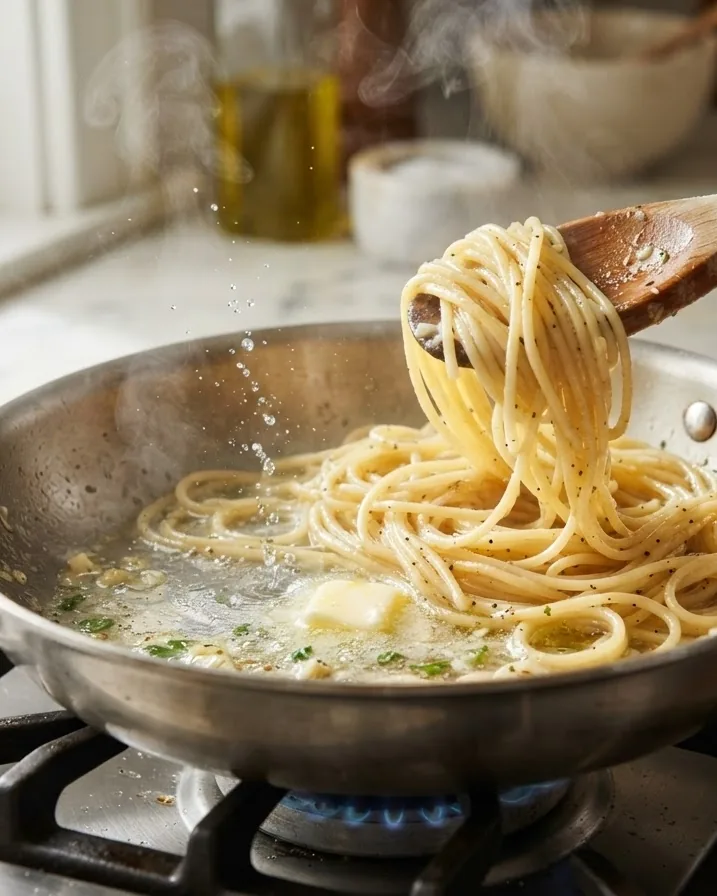
Here is the payoff, and it is faster than most people expect. You do not need to thaw frozen cooked pasta first. My go-to method is to bring a pot of water to a boil, drop the frozen portion straight in, and heat it for just 30 to 60 seconds, only long enough to warm it through. Because you cooked it al dente and froze it loose, it comes back springy rather than soft. Drain it, sauce it, and it is on the table.
The microwave works too and is the better choice for saucy leftovers. Heat the portion in 30 to 60 second bursts, stirring between each one; a frozen block usually takes about 2 to 3 minutes total on a lower power setting so the outside does not overcook while the middle is still cold. The one non-negotiable is moisture: add 1 to 3 tablespoons of water, broth, or extra sauce before you start, because that liquid turns to steam and rehydrates noodles that dried out in the freezer.
Whatever method you use, mind the safety number. The USDA advises reheating leftovers to an internal temperature of 165 F (74 C) to keep them safe to eat, and that applies to frozen pasta dishes just as it does to anything else you are warming back up. For a saucy bake, check the very center with a thermometer, because the edges heat fast while the middle can lag behind and fool you.
- Boiling water, plain pasta: 30 to 60 seconds straight from frozen, then drain and sauce.
- Microwave, saucy pasta: 30 to 60 second bursts, stir between, about 2 to 3 minutes total on lower power.
- Always add 1 to 3 tablespoons of water, broth, or sauce to bring back moisture.
- Reheat to an internal 165 F (74 C) for food safety, especially in the center of a bake.
- Do not refreeze pasta once it has fully thawed, since a second freeze wrecks the texture for good.
The mistakes that turn frozen pasta to mush
Most frozen-pasta disappointment traces back to the same short list of errors. The first is freezing pasta that was cooked all the way through or, worse, a touch overdone. That noodle has no runway left, so reheating only softens it further. Pull your pasta a minute or two early on freezing day even if you would normally cook it a hair longer.
The second mistake is freezing it warm and in a lump. Warm pasta steams inside a sealed container, that steam turns to ice, and the ice turns to sog. It also blows right past the 2 hour room-temperature safety window if you leave it out to cool slowly. Cool it fast, spread thin, then freeze thin. The third is drowning it in sauce before freezing, which, as covered above, leaves you with gummy noodles. And the fourth is skipping the label, which does not ruin texture but does mean the portion gets lost until freezer burn claims it.
There is a fifth trap worth naming because it is sneaky: overfilling the bags and freezing them thick. A fat, dense block of pasta freezes from the outside in, which means the center sits in the danger of slow freezing while the edges are already solid, and it also takes forever to reheat evenly. Keep portions flat, no more than an inch or so thick, and lay the bags down horizontally on a shelf until they are frozen solid. Flat bags freeze faster, stack neater, and thaw more evenly, so it is a small habit that pays off on both ends.
The pattern behind all of these is the same: frozen pasta rewards a little front-loaded effort and punishes shortcuts. Ten extra minutes on freezing day, spent undercooking slightly, cooling fully, oiling lightly, and freezing flat, buys you weeks of dinners that actually taste like you just made them. That trade is one of the best deals in the whole kitchen: a batch of Sunday pasta quietly becomes Tuesday and Thursday dinner without much effort.
Frequently asked questions
How long does cooked pasta last in the freezer?
Cooked pasta keeps its best quality for about 1 to 2 months at 0 F (-18 C), and plain pasta stays usable up to around 3 months with a little texture loss. Held steadily at 0 F it stays safe well beyond that, but the taste and bite decline, so aim to eat it within about two months. Label each bag with the freeze date so you can track the window.
Should I freeze pasta with or without sauce?
Freeze it plain when you can, then sauce it fresh at serving time. Noodles frozen already coated in sauce keep soaking up liquid and turn gummy. If you do freeze a saucy dish, tomato and oil-based sauces hold up best because they protect the noodles, while cream and cheese sauces can separate and may need a splash of milk stirred in when you reheat.
Do I need to thaw frozen pasta before reheating?
No, and it is usually not worth the bother. For plain pasta, drop it straight from frozen into boiling water for 30 to 60 seconds. For saucy pasta, microwave it from frozen in 30 to 60 second bursts, stirring between, for about 2 to 3 minutes total on lower power. Add a tablespoon or two of water or sauce first so it does not dry out.
Why does my frozen pasta come out mushy?
Usually because it was cooked too long before freezing or frozen in a warm lump. Pasta needs to go in firmly al dente, cooked 1 to 2 minutes under the package time, so it has room to finish when reheated. Freezing it warm creates large ice crystals that rupture the starch and leave it soft. Cool it fully and freeze it thin in a single layer to keep the texture.
Can you refreeze cooked pasta after thawing?
It is not recommended. Refreezing pasta that has fully thawed puts it through a second round of ice crystals, and the texture comes out noticeably softer and grainier. It is better to freeze in meal-size portions from the start so you only thaw exactly what you plan to eat that day, and nothing has to go back in.
What temperature should my freezer be for storing pasta?
Set your freezer to 0 F (-18 C), which the FDA identifies as the point where food stays safe indefinitely. Keep an inexpensive appliance thermometer inside and check it about once a week, since a freezer that drifts warmer will lose quality faster. Your fridge, for the days before freezing or after thawing, should stay at or below 40 F (4 C).
The bottom line
Can you freeze cooked pasta? Yes, and once you have the method it becomes one of the most useful habits in your kitchen. Cook it 1 to 2 minutes short of done so it lands al dente, cool it fully within the 2 hour safety window, toss it with a little olive oil, and freeze it thin in a single layer before bagging it into labeled, meal-size portions at 0 F. Keep it about 1 to 2 months for the best quality, freeze the sauce separately when you can, and reheat straight from frozen in 30 to 60 seconds of boiling water or a short microwave burst, up to a safe 165 F. Do that, and the frozen pasta on your plate will taste like you cooked it that afternoon. For the government sources behind these numbers, see the FDA storage guidance, the USDA freezing and food safety page, and the general storage advice at FoodSafety.gov.