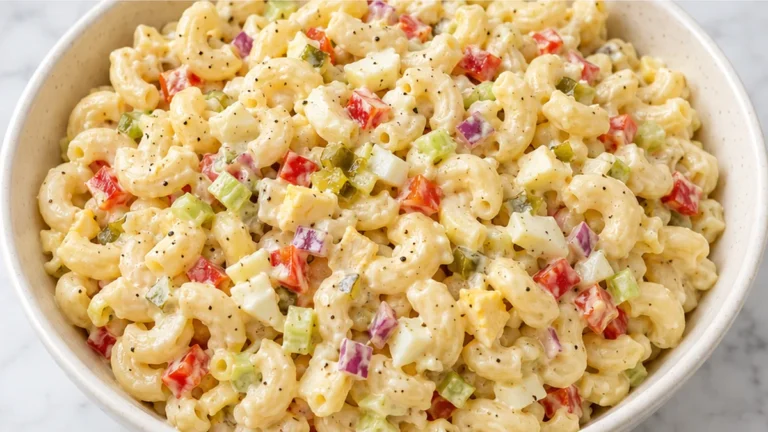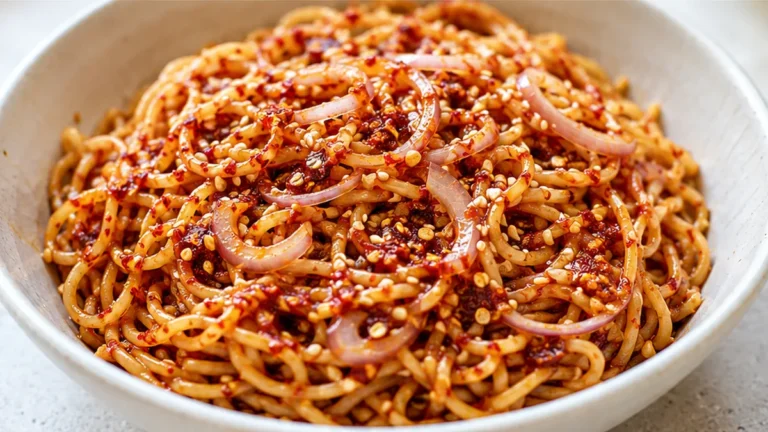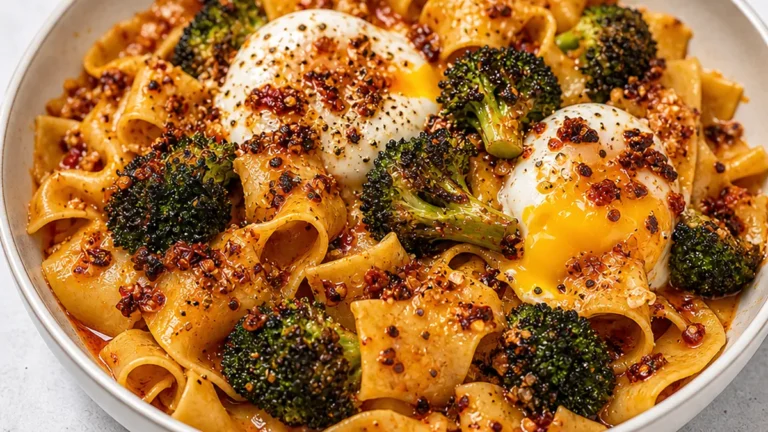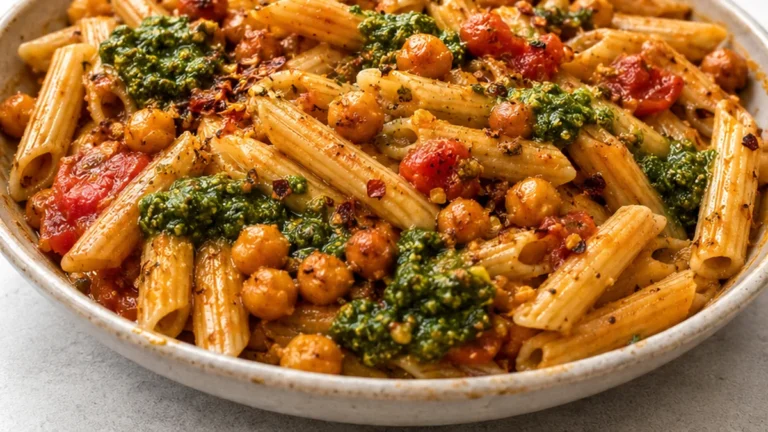
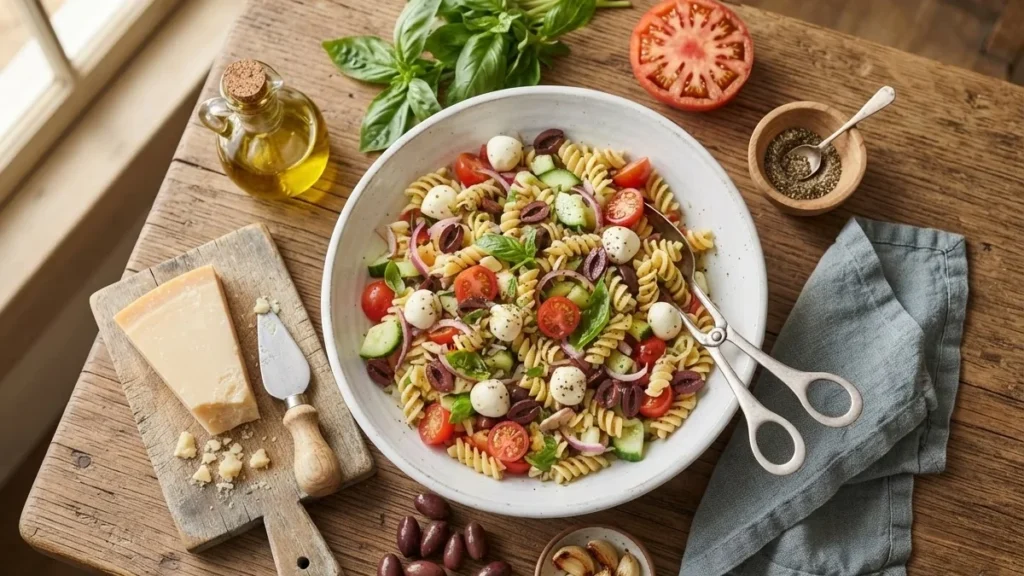
What goes with pasta salad is one of the most common questions once the grill comes out, and the honest answer is that it depends far less on the pasta than on the dressing sitting in the bowl. A creamy macaroni salad wants a different partner than a sharp Greek one with feta and olives, and once you see the plate that way, the pairing stops being guesswork. This guide shows how to build the rest of the meal so the salad has something to lean on instead of carrying dinner by itself.
Pasta salad is almost always a supporting player, which is its whole strength. You make it ahead, it holds in the fridge, and it frees you to spend your energy on one good main off the grill. The common mistake is treating it like the star and then wondering why the table feels heavy and one-note. Balance the plate around it and the same bowl suddenly reads as fresh and cooling instead of just more starch.
Every number below, from serving sizes to the food-safety windows, is checked against current USDA and FDA guidance.
Quick answer: Pair pasta salad with a single grilled or smoked protein and one bread or vegetable side, not a second heavy starch. Creamy, mayo-based salads love smoky richness like BBQ ribs, pulled pork, or fried chicken. Vinaigrette, Italian, and Greek salads love charred and grilled mains like kebabs, sausage, grilled chicken, and salmon. Plan about 3/4 cup of salad per person as a side, pour a crisp Pinot Grigio or a dry rose, and keep the bowl cold. That is the entire formula.
Side dish or the main event? Decide the role first
Before you pick a single partner, decide whether the salad is a side or the meal, because that one call changes every portion on the table. As a side alongside a protein, plan on about 3/4 cup per person. If the pasta salad is going to be dinner on its own, closer to 1.5 cups per person is honest, and you should fold in a real protein so it earns the job. That portion gap is the thing people miss most when they scale a recipe up for a party.
The math is friendlier than it looks. One pound of dry pasta, 16 ounces, cooks up into roughly 8 side servings of finished salad, which comfortably feeds a small cookout when there is a main doing the heavy lifting. If you are cooking for a bigger group and want the numbers to land, the whole scaling exercise is covered in the guide to how much pasta per person, and there is a companion piece on how big a serving of pasta really is that keeps you from either running short or drowning in leftovers.
Calories matter here too, because pasta salad ranges wildly. A classic 3/4-cup serving lands around 283 calories with about 24 grams of carbohydrate, 13 grams of protein, 14 grams of fat, and 732 milligrams of sodium. Lighter vinaigrette versions can sit near 145 calories per cup, while a heavy mayo-and-cheese bowl can climb toward 500 calories per cup. That spread is exactly why the main should either echo a light salad or cut a rich one, never pile richness on richness.
Match the dressing, not just the pasta
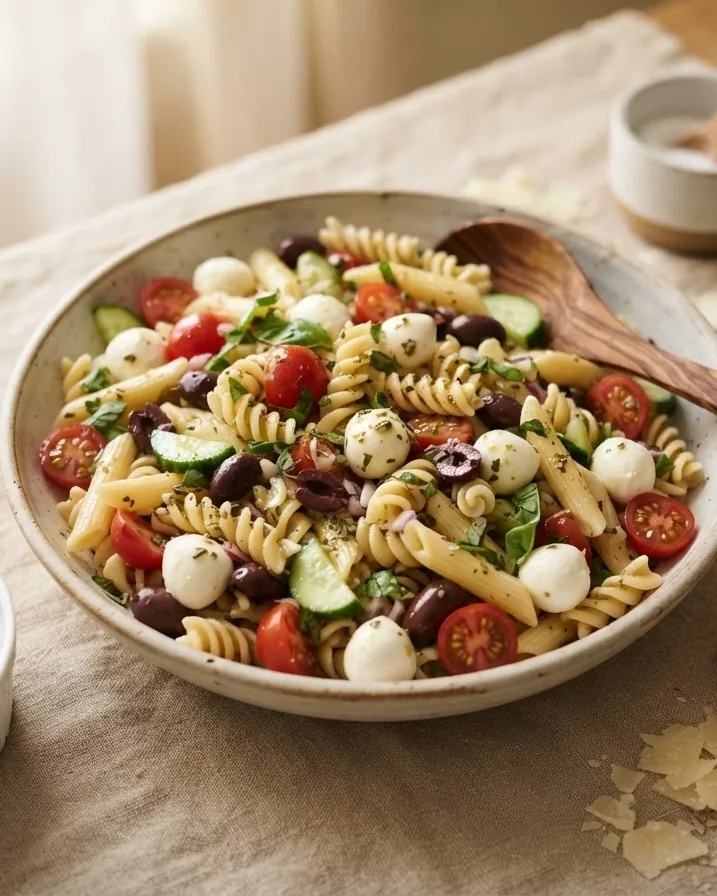
Here is what most guides get wrong. They give you a giant list of mains and never tell you which salad they belong with, so you end up serving smoky pulled pork next to a tangy Greek salad and the two just argue on the plate. In every meal that actually works, the dressing drives the pairing. Sort your salad into one of two camps first, creamy versus vinaigrette, and the right main almost picks itself.
A creamy, mayo-based salad, think classic macaroni or a ranch-style bowl, is cooling and rich, so it belongs next to mains that are smoky, saucy, or fried. The cool salad cuts the fat and the char, and the two balance. A vinaigrette-based salad built on olive oil, vinegar, tomatoes, feta, and herbs is bright and acidic, so it belongs next to grilled and charred proteins where the acid and the smoke echo each other instead of fighting. Match the salad’s cuisine to the protein while you are at it: a Greek salad next to lemon-oregano chicken or salmon, an Italian salad next to sausage or meatballs, a Southwest salad next to grilled steak. If you like to build your own dressing from scratch, the same balance-of-fat-and-acid thinking runs through the notes on how to make pasta sauce.
| Pasta salad style | Best mains to pair | Drink that fits |
|---|---|---|
| Creamy / macaroni / ranch | BBQ ribs, pulled pork, fried chicken, burgers | Light chilled red or a cold lager |
| Italian vinaigrette | Grilled sausage, meatballs, chicken thighs | Pinot Grigio or dry rose |
| Greek / feta / tomato | Lemon chicken, grilled salmon, lamb kebabs | Dry rose or Prosecco rose |
| Pesto / herb | Grilled shrimp, chicken breast, halloumi | Sauvignon Blanc |
| Southwest / smoky | Grilled steak, carne asada, spiced chicken | Sparkling water with lime or a light beer |
Grilled proteins that carry the plate
Nine times out of ten, the main next to a pasta salad comes off a grill, because grilling is fast, hands-off, and gives you the char that plays so well against a cold bowl. Grilled chicken is the workhorse: a honey-mustard or balsamic-marinated breast, thighs, or skewers all land, and you want them cooked to a safe 165 degrees Fahrenheit internal so they stay juicy without going dry. Burgers are the other default, cooked through to 160 degrees Fahrenheit for ground beef, and they are the easiest yes at any cookout.
Past those two, the grill opens up. For a crowd around a backyard grate, the proteins that work again and again are these:
- Italian sausage or kielbasa, sliced on the bias so everyone can grab a piece
- Chicken, beef, or lamb kebabs, which pair especially well with a Greek or Mediterranean salad
- Grilled pork chops, quick and lean, brushed with a little glaze in the last minute
- Turkey burgers and grilled hot dogs for a mixed crowd and for the kids
- Grilled shrimp skewers, five to six minutes total, for a lighter plate
- Grilled halloumi or firm tofu for the vegetarians, charred and squeaky
The trick with any of these is timing, not technique. Because the salad is already made and cold, you only have to babysit the one hot thing, which is why this format lets a host actually talk to guests instead of staying chained to the stove.
Low-and-slow BBQ and fried mains
When the salad is the creamy kind, this is the section that matters, because rich, smoky, saucy mains are exactly what a cool macaroni bowl was built to sit beside. Smoked or slow-cooked pork ribs, beef ribs, and pulled pork dressed in your favorite BBQ sauce all work, and the cold salad acts like a palate reset between bites of the sticky, fatty meat. Brisket does the same job if you have the time and the smoker.
Fried chicken deserves its own mention, because the pairing is close to perfect. The crackle and salt of good fried chicken against a cool, creamy salad is one of those combinations that feels bigger than the sum of its parts. If you are running a slow cooker of pulled pork, remember it is doing double duty: it can also get piled onto the pasta salad itself for a hearty one-bowl meal, which is a trick for feeding a crowd on a budget.
One planning note that saves headaches. Ribs and pulled pork take hours, while the pasta salad takes minutes and holds for days, so make the salad the day before and let the meat own your afternoon. If you end up with extra salad, it keeps well, and a simple rule of thumb on shelf life sits in the piece on how long pasta is good for in the fridge so nobody is guessing on day four.
Fish, seafood, and lighter mains
If you want the plate to feel fresh rather than heavy, lean on fish and seafood, and pair them with the brighter, vinaigrette-style salads. Roasted or grilled salmon, cooked to a safe 145 degrees Fahrenheit, is a standout next to a Greek or lemon-herb pasta salad, because the richness of the fish and the acid of the dressing balance each other cleanly. Grilled shrimp skewers do the same in a faster, more casual way, and they scale beautifully for a party.
These lighter mains are also your friend on a hot night when nobody wants to stand over heat for long. A quick fillet or a few skewers plus a bowl of salad you already made is a full dinner in under 20 minutes, which makes this combination an easy weeknight option. For a meatless plate that still satisfies, grilled halloumi, marinated tofu, or a big pan of roasted vegetables carries the protein load, and a scoop of chickpeas stirred right into the salad adds staying power without any cooking at all.
Breads and second sides that finish the table
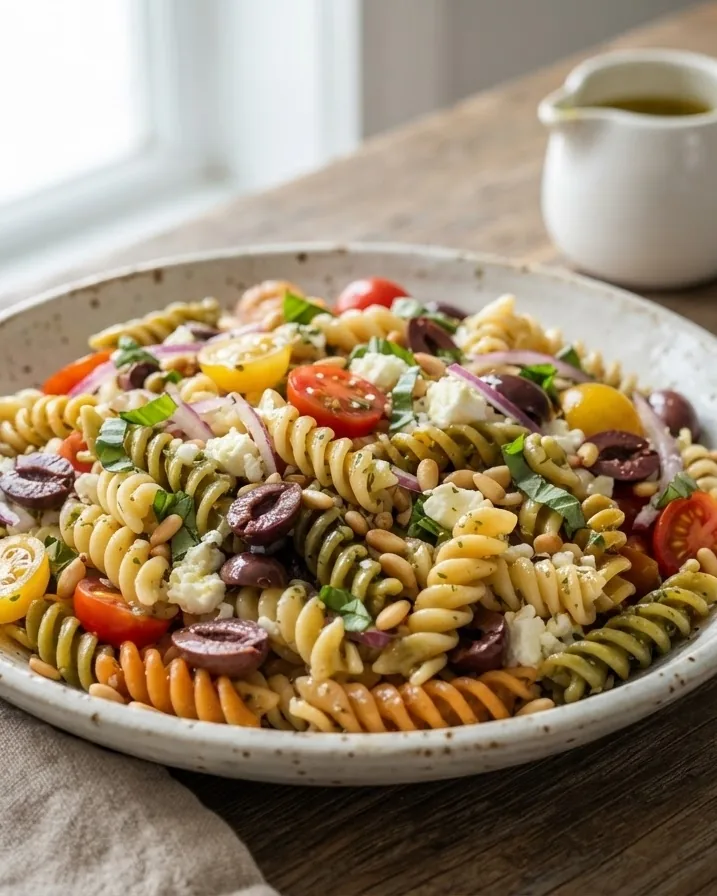
Pasta salad is already a starch, so the single most useful rule is simple: do not double up on heavy starches. Serve a bread or a potato side, not both, and let the rest of the plate lean on vegetables and protein. That one restraint keeps a cookout spread from feeling like a carbohydrate avalanche and is the easiest fix whenever a menu looks stodgy on paper.
With that guardrail in mind, the breads that finish the table well are garlic bread, a crusty baguette, focaccia, soft dinner rolls, and cornbread when there is BBQ in play. For the non-starch sides that add color and crunch, good options are grilled corn on the cob, a sharp coleslaw, sliced watermelon or a fruit salad, deviled eggs, and a tray of grilled vegetables. The goal is contrast: something warm against the cold salad, something crisp against the soft pasta, something bright against anything rich. A plate that varies temperature and texture always eats better than one that does not, and the pasta salad is usually the coolest, softest thing on it, so build the rest to push the other way.
Pairing by the occasion, from cookout to weeknight
The right pairing shifts with the event, because a potluck has different constraints than a Tuesday dinner. At a cookout or BBQ, the salad is your make-ahead cold side while burgers, dogs, ribs, and grilled chicken come off the fire. At a potluck, pasta salad is a hero precisely because it transports well and serves fine at room temperature, so pair it with sliders, a turkey pesto panini, or anything else that does not need to stay piping hot. For a picnic, pack it in a cooler and pair it with sandwiches and fruit. And on a weeknight, pair it with one fast protein, or add a protein and let it be the whole meal.
Here is how to build a cookout spread so the pasta salad has the right company, start to finish:
- Step 1 – Make the pasta salad a day ahead and chill it, so the only thing you cook on the day is the main.
- Step 2 – Pick one protein off the grill or smoker and match it to your salad’s dressing, creamy with smoky, vinaigrette with charred.
- Step 3 – Add exactly one bread or potato side, then two lighter sides like corn, slaw, or fruit for contrast.
- Step 4 – Keep the cold salad on ice at the table and set out a serving spoon that stays with it, so nobody uses the same one for raw and cooked food.
- Step 5 – Watch the clock on anything perishable, because at a summer cookout the safe window is short.
That last step is not optional, and it is where things most often go wrong: a beautiful pasta salad left in the sun all afternoon. The safe window is short, and according to USDA guidance perishable food should not sit at room temperature for more than 2 hours, and that window drops to just 1 hour when it is above 90 degrees Fahrenheit, which describes most July picnics. Bacteria multiply fastest in the danger zone between 40 and 140 degrees Fahrenheit, so keep the salad at or below 40 degrees by nesting the bowl in a larger one full of ice. The FDA lays out the same outdoor rules clearly in its guidance on handling food safely while eating outdoors, and the broader USDA food-safety basics are worth a read before any big gathering. A salad that looks and smells fine can still be unsafe after too long out, so when in doubt, toss it.
Drinks, wine, and a balanced plate
Drinks are the easy finishing touch, and the same dressing logic that guided the main guides the glass. A light, vegetable-forward or vinaigrette pasta salad sings next to a crisp Pinot Grigio or a Sauvignon Blanc, where the wine’s acidity cleanses the palate and its citrus notes meet the tomato and lemon in the bowl. A Greek or tomato-and-feta salad is made for a dry rose or a Prosecco rose, whose red-fruit character plays off the sweetness of ripe tomato. When the salad is creamy and sitting beside smoky BBQ, a light chilled red like a Beaujolais or Gamay bridges both, and a cold lager never hurts. For a no-alcohol table, iced tea, lemonade, and sparkling water with lemon or cucumber all keep the meal feeling light.
Zoom out to the whole plate and the goal is balance, not just flavor. MyPlate guidance suggests filling half your plate with vegetables and fruit, about a quarter with lean protein, and about a quarter with grain, and pasta salad slots neatly into that grain quarter. That framing is a useful check: if the pasta salad is your only vegetable, add a green side or load the salad itself with more produce. You can see the full breakdown at MyPlate, and if you are trying to keep the whole meal on the lighter side, the notes on healthier pasta cover how to lighten the bowl without losing what makes it good. Balance the plate this way and the pasta salad reads as part of a real meal instead of the whole beige story.
Frequently asked questions
What main dish goes best with pasta salad?
Grilled chicken is the single most reliable main, because it suits nearly every style of pasta salad and cooks in minutes to a safe 165 degrees Fahrenheit. Past that, match the main to the dressing: creamy salads pair with smoky BBQ ribs, pulled pork, or fried chicken, while vinaigrette and Greek salads pair with grilled sausage, kebabs, or salmon. One well-chosen protein beats a crowded table every time.
Is pasta salad a side or a main?
Either, and the portion is what changes. As a side alongside a protein, plan about 3/4 cup per person. As a main, plan closer to 1.5 cups per person and fold in a real protein like grilled chicken, tuna, shrimp, or chickpeas so it eats like a meal. One pound of dry pasta makes roughly 8 side servings, which is a handy number for scaling up for a group.
What meat goes with pasta salad?
Almost any grilled or smoked meat works, so let the salad’s dressing decide. Creamy, mayo-based salads pair best with rich and smoky meats such as ribs, pulled pork, brisket, and fried chicken. Brighter vinaigrette and Greek salads pair best with grilled chicken, Italian sausage, lamb kebabs, and burgers. The cool salad balances the fat and char of the meat, which is the whole point of the pairing.
What can I serve with pasta salad besides meat?
Plenty. Grilled halloumi, marinated tofu, and a big pan of roasted vegetables all carry the protein load without meat, and stirring chickpeas or white beans directly into the salad adds staying power with no extra cooking. Round the plate with grilled corn, coleslaw, fruit, deviled eggs, and one bread. A meatless plate built this way is a full, satisfying meal, not a compromise.
How long can pasta salad sit out at a cookout?
Not long in the heat. Perishable food, including mayo-based and dressed pasta salad, should not sit at room temperature for more than 2 hours, and only 1 hour when it is above 90 degrees Fahrenheit. Bacteria grow fastest between 40 and 140 degrees Fahrenheit, so keep the bowl at or below 40 degrees by nesting it in ice. When the time is up, discard it even if it looks and smells fine.
What wine goes with pasta salad?
Reach for something crisp and cold. A light, veggie-forward or vinaigrette salad pairs beautifully with Pinot Grigio or Sauvignon Blanc, whose acidity refreshes the palate. A Greek or tomato-and-feta salad loves a dry rose or Prosecco rose. If the salad is creamy and served with smoky BBQ, a light chilled red such as Beaujolais bridges both. For no-alcohol tables, iced tea or sparkling water with lemon keeps things light.
The bottom line
What goes with pasta salad comes down to one habit: read the dressing before you pick the partner. Creamy bowls want smoky, rich, or fried mains that they can cool and cut; bright vinaigrette and Greek bowls want grilled and charred proteins that echo their acid and char. Serve one main, one bread or potato, and a couple of lighter sides for contrast, plan about 3/4 cup of salad per person as a side, and pour something crisp. Then respect the clock, because the safe window outdoors is 2 hours, or just 1 hour once it passes 90 degrees. Get those few things right and the humble make-ahead bowl stops being an afterthought and becomes the piece that makes the whole meal feel easy.