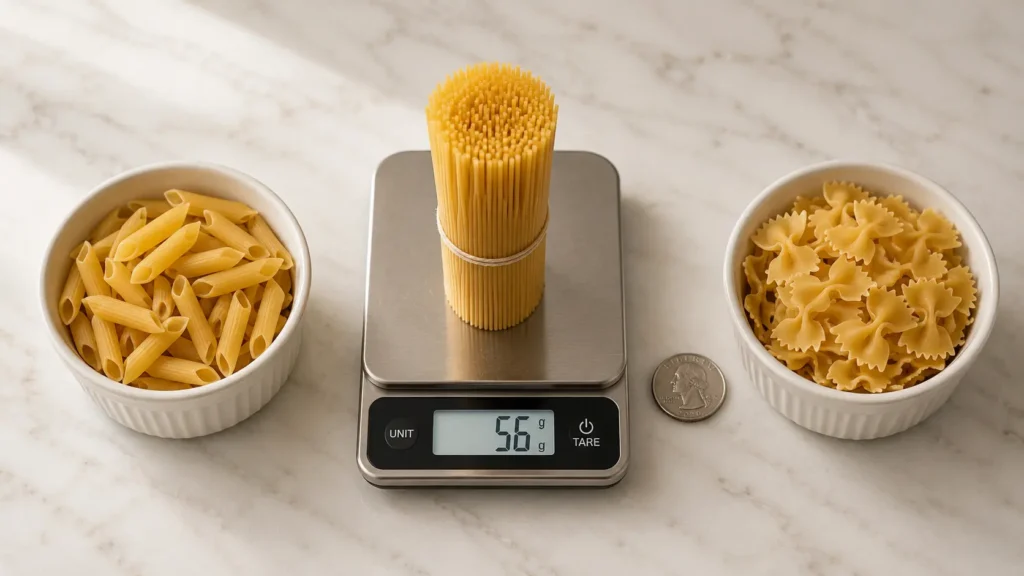
How big is a serving of pasta? The short answer: 2 ounces (56 grams) of dry pasta per person, which cooks up to about 1 to 1.25 cups on the plate. That’s the standard the box’s nutrition label runs on, and it’s the number everything else is built from. The trouble is that nobody owns a kitchen scale at the exact moment they need one, dry shapes measure out to wildly different cup amounts, and years of restaurant plates have quietly convinced us all that a “real” serving is double that. So here’s what this guide actually does for you. It shows what 2 ounces looks like for spaghetti versus penne versus shells. It hands you a few no-scale ways to measure a portion that genuinely work. And it scales the whole thing, cleanly, for a side dish, a hungry main, a couple of kids, or a table of twelve on a holiday. Weigh it once against the charts below and you’ll read it by eye for the rest of your cooking life.
The Short Answer, and Why Pasta Tricks Your Eye
A single serving of dry pasta is 2 ounces, or 56 grams. It looks alarmingly small in the box because dry pasta roughly doubles in weight and volume as it absorbs water, so that modest handful becomes a full, satisfying plate. A 1-pound box (16 ounces) therefore holds 8 servings by the official count, though most cooks realistically stretch it to 4 to 6 real-world plates. The reason “how big is a serving of pasta” feels so slippery is that the honest answer depends on whether the pasta is the whole meal or a sidekick, and on who is sitting down to eat it. We’ll pin all of that down in a moment, with charts you can keep coming back to, but hold on to this one fact first: 2 ounces dry is the anchor that every other number on this page hangs from, so it is the only figure you truly need to memorize.
Dry to Cooked: What 2 Ounces Actually Looks Like
Because shapes pack differently, 2 ounces of dry pasta is a different cup amount for almost every shape. Here is a per-serving reference for the most common ones.
| Pasta shape (2 oz / 56 g dry) | Dry measure | Cooked yield |
|---|---|---|
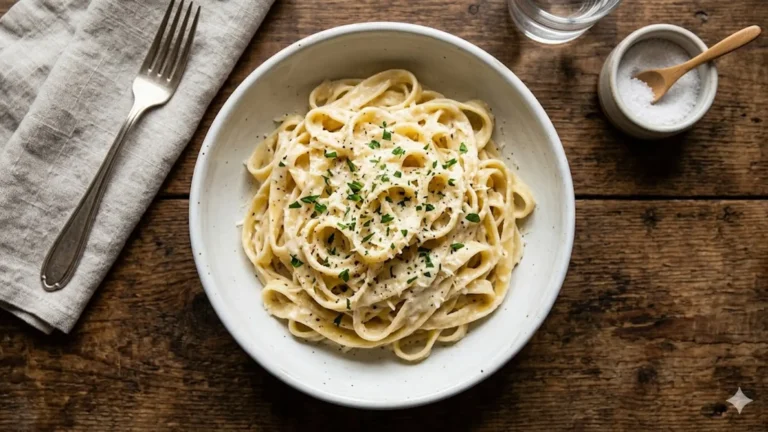
| Spaghetti / angel hair / linguine | 2-inch (quarter-size) bundle diameter | ~1 cup |
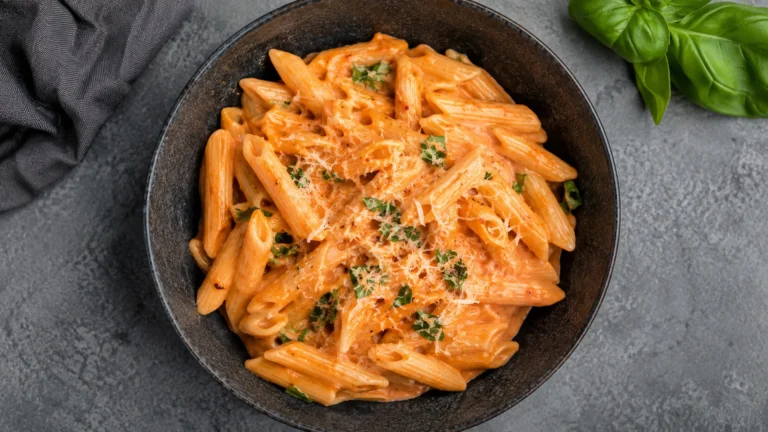
| Penne / ziti / rigatoni | ~1/2 cup | ~1.25 cups |
| Elbow macaroni / small shells | ~1/2 cup | ~1 cup |
| Egg noodles | ~1 cup | ~1 cup |
| Farfalle / rotini / fusilli | ~3/4 cup | ~1.25 cups |
The lesson buried in that table: measuring short pasta by the cup is fine, but it is only an approximation, because air gaps between rigatoni tubes lie to you in a way that 56 grams on a scale never will. When precision matters, weigh. For everyday cooking, the cup column gets you comfortably close.
How to Measure a Serving Without a Scale
No scale, no box, no problem. Each pasta family has a trick that lands within a few grams of a true serving.
Long Pasta: The Coin Trick

Stand a bunch of spaghetti up and squeeze it into a bundle. When the diameter of the bundle is about the width of a U.S. quarter (roughly 1 inch / 2.4 cm), that is very close to one 2-ounce serving. A standard wine-bottle opening or the hole in many spaghetti measuring tools is calibrated to the same diameter, so if you have either on hand, use it. For two servings, double the diameter to about the width of a wine cork lying on its side. The trick works because long strands pack together with almost no air gaps, so a fixed circle of them weighs out remarkably consistently from one batch to the next. It is the single most reliable no-scale method there is, far steadier than guessing by the handful, and once you have checked it against a scale a single time you will trust your eye on it permanently. Keep a cheap spaghetti measure in the utensil drawer and the whole question disappears.
Short Pasta: The Cup or the Fist
For penne, shells, macaroni, and the rest, a dry measuring cup is your friend: roughly 1/2 to 3/4 cup of dry short pasta per person, per the chart above. With no measuring cup, a cupped adult hand holds close to a single serving of small shapes. These hand and cup methods drift a little by shape, so treat them as a confident estimate rather than a lab measurement. The drift comes from how each shape stacks: hollow rigatoni and curled cavatappi trap pockets of air that puff up the cup reading, while dense little ditalini or orzo pack tight and read low. When a recipe lives or dies on exact amounts, like a baked pasta where the sauce-to-noodle ratio is locked in, reach for a scale and weigh the 2 ounces. For a quick weeknight pan where close enough is genuinely close enough, the cup and the cupped hand will serve you well for years.
Side Dish, Main Course, or Kids: Adjusting the Portion

The 2-ounce standard is a baseline, not a ceiling. What you actually cook depends on the role pasta plays at the table.
| Eater / role | Dry pasta per person |
|---|---|
| Side dish | 2 oz (56 g) |
| Main course, average appetite | 3 to 4 oz (85 to 113 g) |
| Main course, big appetite | 4 to 5 oz (113 to 140 g) |
| Child (under ~10) | 1 to 1.5 oz (28 to 42 g) |
A rich, protein-heavy sauce lets you lean toward the smaller end, because the plate is doing more than just pasta. A simple weeknight bowl of pesto pasta with little else on the plate pushes you toward the larger end. Use the role of the dish, not just the eater, to choose. Appetite is real, too: a teenager after practice and a grandparent grazing at lunch should not get the same scoop, and there is no shame in cooking an extra ounce or two of dry pasta when you know the table runs hungry. The safest habit is to portion to the average appetite, cook one modest spare serving for the outliers, and let anyone who wants seconds come back for them rather than over-plating everyone at the start.
Cooking for a Crowd: Scaling Pasta by the Number
Scaling is just multiplication once you trust the per-person number. Here is the math done for you, using a main-course portion of about 3 ounces per person.
| People (main course) | Dry pasta | 1-lb boxes |
|---|---|---|
| 2 | 6 oz (170 g) | ~1/2 box |
| 4 | 12 oz (340 g) | ~3/4 box |
| 6 | 18 oz (510 g) | ~1 box + a bit |
| 8 | 24 oz (680 g) | ~1.5 boxes |
| 12 | 36 oz (1 kg) | ~2.25 boxes |
For a baked dish like a baked caprese rigatoni, round up rather than down, since casseroles reheat well and a tray that comes up short is a worse problem than leftovers. And always boil pasta in plenty of water: about 4 to 6 quarts per pound, no matter how you scaled the portion, or the strands clump and cook unevenly.
Why a 1-Pound Box “Serves 8” but Feeds 4
Pick up almost any box of dried pasta and the label promises eight servings. Stand at the stove on a Tuesday night and that same box feeds a family of four with barely a bowl left over. Both numbers are true; they are just answering different questions. The label uses the official 2-ounce nutritional serving, the same baseline dietitians and packaged-food rules are built around. Real dinners, especially American ones, run on a main-course portion closer to 3 or 4 ounces, which quietly halves the box’s headcount.
Restaurants nudged that expectation even further. A plate of pasta served as a main in a restaurant often holds 4 to 6 ounces of dry pasta, two to three times the label serving, which is why a portion that looks “normal” to most of us is genuinely large by the numbers. None of this means the label is wrong. It means you should treat “serves 8” as “contains eight 2-ounce servings” and then decide, based on the role of the dish and the appetites at your table, how many of those servings each person actually gets. Once you make that mental translation, the box stops lying to you and starts being a useful measuring tool.
How Much Sauce Goes With a Serving of Pasta
Portioning the pasta is only half the plate. The classic ratio is about 1/2 cup (4 ounces) of sauce per 2-ounce serving of dry pasta, though it flexes with the sauce. A thin, oil-based or garlic-and-oil dressing needs less, perhaps 1/3 cup, because it is meant to coat rather than pool. A chunky, meaty ragu or a creamy sauce can take a touch more without drowning the strands. A useful gut check: the sauce should cling to and lightly coat every piece when tossed, with just a whisper left at the bottom of the bowl, not a soup the pasta is swimming in.
This is also where reserving a splash of starchy pasta water earns its keep. A few tablespoons of that cloudy water, added as you toss, loosens a too-thick sauce and helps it emulsify and grip the pasta, so a slightly under-portioned sauce still covers the whole serving. Scale the sauce alongside the pasta on the crowd chart and you avoid the two saddest outcomes: naked noodles, or a pan of sauce with no pasta left to carry it.
Three Portion Mistakes That Throw Off Your Count
Most portioning misfires trace back to the same handful of habits. First, measuring short pasta by eye in the pot: dry shapes look sparse in a big pot and tempt you to add “just a little more,” which is how four servings becomes seven. Measure before the pasta goes anywhere near the water. Second, forgetting that pasta doubles: a bowl that looks right while dry will overflow once cooked, so trust the small dry amount. Third, ignoring the sauce and sides: a 4-ounce main-course portion makes sense with a light dressing, but alongside garlic bread, a salad, and a rich sauce it becomes too much food. Read the whole plate, not just the pasta, and the portion almost chooses itself.
Fresh, Filled, and Gluten-Free Portions
Not all pasta weighs in the same. Fresh pasta holds more water than dried, so a serving runs a little heavier, around 3 to 4 ounces (85 to 115 grams) per person. Filled pasta such as ravioli or tortellini is denser still, so 4 to 5 ounces (115 to 140 grams), or roughly 8 to 10 medium pieces, makes a main-course serving. Gluten-free pasta made from corn, rice, or legumes uses the same 2-ounce dry baseline, but it tends to expand a touch less and firm up faster, so portion by weight and taste it early; a pot of gluten-free pasta rewards a closer eye than a wheat one.
Calories and Nutrition in a Serving
A standard 2-ounce serving of dry wheat pasta runs about 200 calories, with roughly 42 grams of carbohydrate, 7 grams of protein, and around 2 grams of fiber before any sauce joins the party. Whole-wheat pasta lands in the same calorie range but adds fiber and protein, and legume-based pastas made from chickpea or lentil flour climb higher on both protein and fiber while staying close on calories. The number people actually eat is usually higher, simply because a real plate is closer to 3 or 4 ounces and the sauce, cheese, and oil add up fast.
That last point matters more than the pasta itself for most plates. Two ounces of dry pasta is a steady 200 calories, but a ladle of creamy alfredo, a heavy hand with grated cheese, or a generous pour of finishing oil can add as many calories as the pasta did, or more. If you are watching intake, the move is rarely to shrink the pasta dramatically; it is to portion the pasta honestly at 2 to 3 ounces and keep the rich extras measured. The dry weight is the honest place to start, which is exactly why pasta nutrition labels are written per 2-ounce dry serving rather than per unpredictable cooked cup.
FAQ
How big is a serving of pasta in cups?
About 1 to 1.25 cups of cooked pasta per person, which comes from roughly 2 ounces (56 grams) of dry pasta. Short shapes like penne yield a bit more cooked volume than long strands like spaghetti.
How much dry spaghetti is one serving?
Stand the spaghetti in a bundle: when its diameter is about the width of a U.S. quarter, roughly 1 inch, that is one 2-ounce serving. A wine-bottle opening is calibrated to the same width.
Is 2 oz of pasta enough for a meal?
As a side dish, yes. As a standalone main course, most adults want 3 to 4 ounces of dry pasta. Pair 2 ounces with a hearty sauce and protein and it can still anchor a light meal.
How many servings are in a 1-pound box of pasta?
Eight 2-ounce servings by the label. In practice, most households get 4 to 6 real-world plates from a 1-pound box, depending on appetite and whether it is a main or a side.
How much pasta do I need for 6 people?
For a main course, about 18 ounces (510 grams) of dry pasta, which is a little over one 1-pound box. Round up for baked dishes and big appetites.
Does pasta double when cooked?
Roughly, yes. Dry pasta absorbs water and about doubles in weight and volume, which is why a small dry portion becomes a full cooked plate.
How much pasta should I cook per child?
About 1 to 1.5 ounces (28 to 42 grams) of dry pasta per young child, a little over half an adult side portion. Older kids and teens eat closer to an adult serving, so judge by appetite rather than age alone.
How much sauce do I need per serving of pasta?
Roughly 1/2 cup (about 4 ounces) of sauce per 2-ounce serving of dry pasta. Use a little less for thin oil-based dressings and a little more for chunky or creamy sauces, aiming to coat the pasta rather than drown it.
Bottom Line
In the end, how big a serving of pasta is comes down to one number you can push in any direction: 2 ounces of dry pasta per person, about a cup once it’s cooked. Treat that as your side-dish baseline, climb to 3 or 4 ounces when pasta is the main event, shrink it for the kids, and run straight down the crowd chart when you’re feeding a table. Do the weighing once. Learn what the quarter-width spaghetti bundle and the half-cup of penne feel like in your own hand, and after that you’ll portion pasta on instinct, without the sad half-empty pot or the fridge slowly filling with forgotten leftovers ever again.