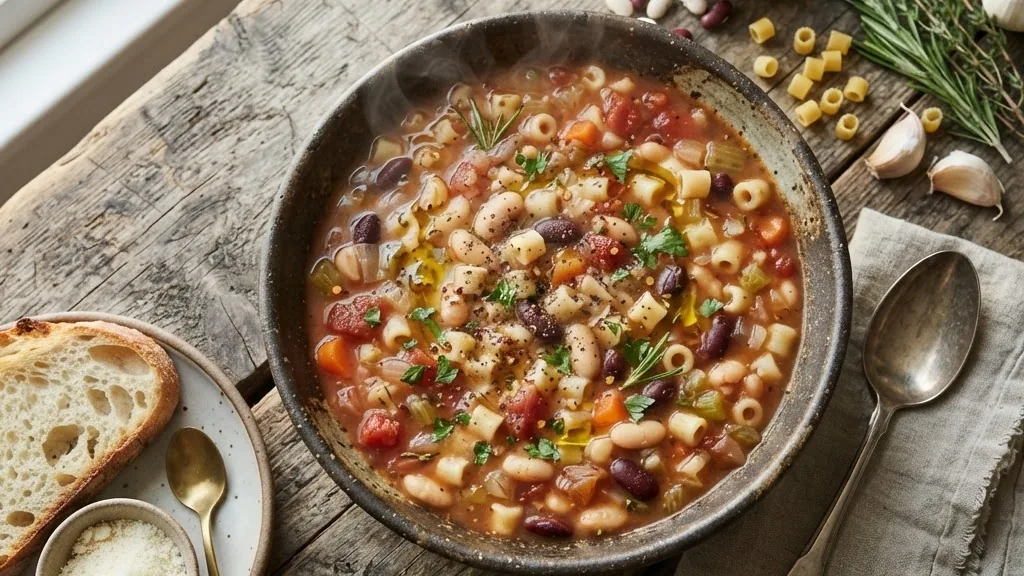
How do you spell pasta fazool depends on whether you want the phonetic version people say out loud or the dictionary form printed on menus, and both are defensible. There is no single “correct” English spelling, because the phrase is an Americanized rendering of a Neapolitan dialect expression rather than a standard dictionary headword. The most common spelling is “pasta fazool.” The standard Italian form is “pasta e fagioli.” Everything between those two poles is a phonetic or dialect variant with its own status, and understanding which is which is the whole game.
The confusion is old and well documented. The Oxford English Dictionary records “pasta fagioli” in English print as far back as 1951, from the News in New Castle, Pennsylvania, and “pasta e fagioli” from 1968. Both OED entries were last revised in July 2023. So the word has been drifting through American English for over seventy years, picking up spellings along the way.
Quick answer: Spell it “pasta fazool” when you are writing the informal, spoken, Dean Martin version most Americans recognize. Spell it “pasta e fagioli” when you want the dictionary-correct Italian form for a menu or recipe. “Pasta fazool” is a phonetic doublet borrowed from Neapolitan dialect, where the dish is “pasta e fasule.” The word “fagioli” is the plural of “fagiolo,” meaning bean, and the “e” means “and.” Both spellings are correct; they just live in different registers.
If you only take one thing from this page, take this: the spelling question is not a grammar problem, it is a register problem. English does not have an official rulebook for transliterating spoken dialect, so nobody can hand you a single “right” answer the way a dictionary can settle “recieve” versus “receive.” What the dictionaries and language academies below can do is tell you where each spelling sits, when it entered print, and which form a formal document should use. That is the job this page does, with the sources most recipe blogs skip.
The 6 accepted spellings, ranked by status
The cleanest way to answer the spelling question is to sort every version people actually write into a status: standard, dialect, phonetic, or song-title. “Pasta fazool” tops the phonetic list because Dean Martin put it in a hit record. “Pasta e fagioli” is the standard Italian spelling that language authorities such as the Accademia della Crusca and Treccani, the Istituto della Enciclopedia Italiana, would recognize. In between sit the Neapolitan dialect form “pasta e fasule” and a handful of looser respellings. None of the phonetic versions is technically wrong; they are simply informal transcriptions of a sound.
- pasta fazool – most common Americanized phonetic spelling.
- pasta fazul / pasta fazoul – less common phonetic variants of the same sound.
- pasta e fasule / pasta fasule – the actual Neapolitan dialect form.
- pasta e fagioli / pasta fagioli – the standard Italian spelling.
- pastafazool / pastafazoola – one-word and song-title forms.
A table view makes the status of each spelling easier to scan than prose, especially if you are checking a menu proof or a recipe headline against a deadline.
- pasta fazool – status: phonetic. Use for casual, spoken, nostalgic contexts.
- pasta fazul / fazoul – status: minor phonetic variant. Rare in print, common in speech.
- pasta e fasule – status: dialect (Neapolitan). Use when naming the regional dish specifically.
- pasta e fagioli – status: standard Italian. Use on menus, in cookbooks, in formal writing.
- pastafazoola – status: song title (1927). Use only when referring to the song.
If you keep a well-stocked pantry for this dish, it helps to know what you are buying, and our specs-first field guide to reading any bag covers the ditalini and elbow shapes this recipe traditionally uses. The spelling on the box will almost always be the standard Italian one.
Common misspellings and typos to watch for
Beyond the accepted variants above, there is a second tier of spellings that are not dialect forms at all, just typos that spread because people copy what they half-remember hearing. These are worth naming so you can tell a real regional variant from a simple mistake. None of the four below appears in a dictionary, an encyclopedia, or a recorded song title, which is the quickest test for separating a legitimate variant from a typo.
- pasta fazoole – an over-corrected spelling that adds a silent “e” nobody pronounces.
- pasta fazoul – a plausible-looking respelling, but not documented in the OED or Wiktionary entries.
- pasta fagoli – drops a syllable from “fagioli,” changing the word rather than just its spelling.
- pasta fazol – a shortened phonetic guess, closer to a text-message abbreviation than a real variant.
If you see one of these on a menu or in a recipe, it is not a regional quirk worth preserving; it is worth correcting to one of the six status-backed spellings above. The distinction matters for anyone publishing content, because a search engine and a human reader both benefit from consistent, sourced spelling rather than an accidental one.
What “fazool” actually means, and the error to avoid
The literal meaning of “pasta fazool” is “pasta and beans,” and that is the single fact most casual explanations get slightly wrong. The word does not mean “beans” on its own. It is a compression of “pasta e fasule,” the Neapolitan dialect version of “pasta e fagioli,” where “e” is the conjunction “and” and “fasule” is dialect for the beans. When an English ear hears the phrase spoken fast, with the final consonant softened and voiced, “fasule” collapses into “fazool.” So the American word carries the “and” inside it, even though speakers rarely realize it.
Wiktionary classifies “pasta fazool” as a doublet of “pasta e fagioli,” borrowed directly from Neapolitan rather than from standard Italian. That classification matters: a doublet is two forms of the same underlying word that entered the language by different routes. Standard Italian gives us “fagioli,” the plural of “fagiolo.” Neapolitan dialect gives us “fasule,” and from that we got “fazool.” The two are cousins, not rivals.
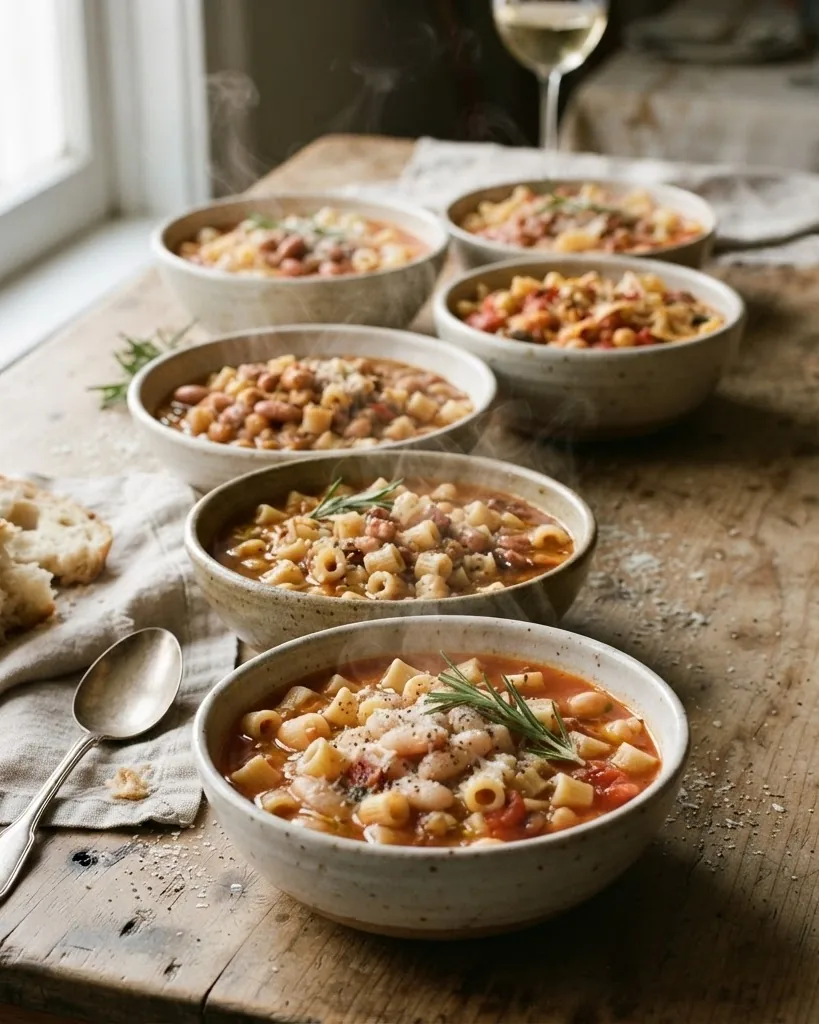
The dish itself is classified as a primo, or first course, and belongs to cucina povera, the peasant cooking tradition. It is most commonly built from cannellini, navy, or borlotti (cranberry) beans with a small pasta such as ditalini or elbow macaroni. That humble profile is exactly why the name traveled with immigrants and mutated in spelling as it went.
It also explains why the spelling question keeps resurfacing generation after generation. Cucina povera recipes were passed down by ear in home kitchens, not printed in standardized cookbooks, so every family transliterated the dialect phrase slightly differently when they eventually wrote it down. Some households wrote “fazool,” others “fasule,” others skipped the spelling question entirely and just called it “the bean soup.” The word survived because the dish survived, not because anyone agreed on how to spell it.
How to pronounce it: standard Italian vs American dialect
Pronunciation is where the two spellings pull furthest apart, and hearing the gap explains the whole spelling mess. In standard Italian, the dish is [ˈpasta e faˈdʒɔːli], which respells roughly as “pasta eh fah-JOH-lee.” The stress lands on the second syllable of “fagioli,” and the “gi” makes a soft “j” sound. That is the version you would hear from a speaker following the Accademia della Crusca standard.
The American dialect version is “pasta fah-ZOOL,” with the stress crashing onto that final “zool” and the middle syllables swallowed. This is the sound Dean Martin sang, and it is why the phonetic spelling exists at all. Nobody sat down and decided “fazool” was correct; people simply wrote down what they heard.
- Standard Italian: “pasta eh fah-JOH-lee” – four beats, soft “j,” stress on JOH.
- American dialect: “pasta fah-ZOOL” – two main beats, hard “z,” stress on ZOOL.
A practical test: say “pasta e fasule” out loud at a normal conversational speed, three or four times in a row, without pausing between words. Most English speakers naturally start dropping the middle syllables and hardening the final “s” into a “z” sound after just a couple of repetitions. That drift, done by millions of immigrant families over decades, is the entire mechanism behind the spelling “fazool.” It is not a mistake; it is what fast, casual speech does to any multi-syllable dialect phrase when it crosses into a new language.
If you want a workout in the softer Italian consonants that shape “fagioli,” you will hear the same music in a bright garlicky lemon asparagus pasta recipe, where the vocabulary of the plate stays close to its Italian roots.
Where the word comes from: 1927 to 1953
The phonetic spelling entered American English through music, and the story starts earlier than most people think. Long before Dean Martin, a 1927 novelty song called “Pastafazoola,” also written as “Pastafazula,” came from the American vaudeville duo Van and Schenck. It was recorded in New York City for the Victor Talking Machine Company and issued as Victor record No. 20925. That release put the one-word phonetic form into circulation 26 years before the song most Americans credit. The 1927 record is the missing first chapter: it shows the spelling was already being written down for a mass audience during the Jazz Age.
Then came the famous one. “That’s Amore” is a 1953 song with music by Harry Warren and lyrics by Jack Brooks, sung by Dean Martin in the Paramount film “The Caddy.” It was recorded on 13 August 1953 at Capitol Studios in Hollywood, and the single was released on 7 November 1953 on Capitol with a running time of 3:05. The lyric that fixed the spelling in the national ear runs: “When the stars make you drool, just like pasta fazool, that’s amore.”
The song was nominated for Best Original Song at the 26th Academy Awards in 1954 and lost to “Secret Love” from “Calamity Jane.” It did not need the trophy. The rhyme of “drool” with “fazool” was so tidy that it locked the phonetic spelling into place for generations. That is why “pasta fazool” beats every other phonetic variant in usage: a hit single standardized it by accident.
Compare the two songs side by side and the timeline gets clearer. The 1927 record introduced the phonetic spelling to a niche vaudeville and early-radio audience, largely within Italian-American immigrant communities in New York. The 1953 record, by contrast, reached a mainstream national audience through film and radio at the height of Dean Martin’s popularity, which is the difference between a word surviving in one neighborhood and a word entering the national vocabulary. Twenty-six years apart, the two songs form a clean before-and-after: dialect spelling first documented for entertainment, then popularized for the whole country.
Permits, inspections and food-safety rules for selling it
Anyone planning to cook pasta fazool for the public, whether at a restaurant, a farmers market, or a packaged retail shelf, steps into a stack of federal and state food-safety rules that govern the beans, the broth, and the labeling. A bean-and-pasta soup is a low-acid, potentially hazardous food when held warm, which means temperature control and traceable sourcing become legal obligations, not just good habits. The agencies below each own a slice of that compliance, and each slice costs the operator time or money in practice.
The U.S. Food and Drug Administration (FDA) governs packaged and retail food labeling, including the nutrition panel and ingredient list you would need if you jarred and sold the soup. The U.S. Department of Agriculture (USDA) sets grading and safe-handling standards for the beans and any meat you add. When your recipe crosses into meat, such as a pancetta or sausage version, the Food Safety and Inspection Service (FSIS), a branch of USDA, takes over inspection of that meat component.
For foodborne-illness prevention, the Centers for Disease Control and Prevention (CDC) publishes the outbreak data that shapes local health codes, and FoodSafety.gov aggregates the practical consumer-facing guidance on safe cooling and reheating. For the nutrition side of a bean-heavy dish, nutrition.gov collects federal dietary references. The USDA’s own consumer library is a good starting point; its guidance on food safety basics lays out the cooling and holding temperatures a soup kitchen or deli must meet.
Here is where the naming question circles back to the paperwork. Language authorities do not just settle bar arguments; they settle labels. The Oxford English Dictionary (OED) documents the datable first-use evidence (1951 and 1968) that a menu lawyer might lean on, and the Accademia della Crusca and Treccani define the standard Italian “fagioli” that a truth-in-menu rule would treat as the formal spelling. TasteAtlas, a food-encyclopedia authority, catalogs the regional Neapolitan versions so a producer can accurately describe a dialect recipe. Culinary authority Jacques Pepin, profiled by PBS through its American Masters series, has publicly listed the accepted name variants as “pasta fagioli, pasta e fagioli, pasta fasul, pasta fazool,” which is about as close to permission for the phonetic spelling as a working cook could want.
In practical terms, that means an operator can print “Pasta Fazool” as the friendly menu name and note “pasta e fagioli” as the formal descriptor beneath it, satisfying both the customer’s ear and the standard spelling. For deeper federal sourcing on handling the beans and any added meat, the FSIS guidance on safe minimum internal temperatures, published through its safe temperature chart, is the document inspectors actually check against.
A common point of confusion for new operators: the beans themselves rarely trigger the strictest rules, since dried and canned beans are shelf-stable. The risk category kicks in once the beans are cooked, combined with broth, and held warm for service, which is standard practice for any hot-holding soup line. That is the point where a health inspector will check the internal temperature of the pot, not the ingredient list, so the FSIS temperature chart above matters more at 2pm on a lunch shift than it does at the grocery store.
Is one spelling wrong? A working editorial rule
No spelling here is truly wrong, but they are not interchangeable either, and a simple register test tells you which to pick. Reach for “pasta e fagioli” when the context is formal: a printed menu, a published recipe, a cookbook, or anywhere the dictionary-correct Italian form signals care. Reach for “pasta fazool” when the context is spoken, warm, or nostalgic: a family blog, a diner special board, or a caption that wants the Dean Martin wink. The dialect “pasta e fasule” fits when you are specifically describing the Neapolitan version, and the one-word “pastafazoola” belongs to the song and nowhere else.
The only genuine error is treating a phonetic variant as the standard spelling in a formal document, or “correcting” someone’s “fazool” to “fagioli” in casual speech as though they made a mistake. They did not. They used the informal register on purpose.
- Menu or cookbook: use “pasta e fagioli.”
- Casual, spoken, nostalgic: use “pasta fazool.”
- Describing the Neapolitan dish specifically: use “pasta e fasule.”
- Referring to the song: use “pastafazoola.”
One more edge case worth naming: a recipe title that mixes registers on purpose, such as “Pasta e Fagioli (Pasta Fazool),” is not an error either. Putting the standard spelling first and the phonetic form in parentheses is exactly how several of the top-ranking recipe sites handle the naming question, and it works because it serves both a reader searching for the dictionary spelling and a reader searching for the phrase they grew up hearing.
A short authentic pasta fazool to cook tonight
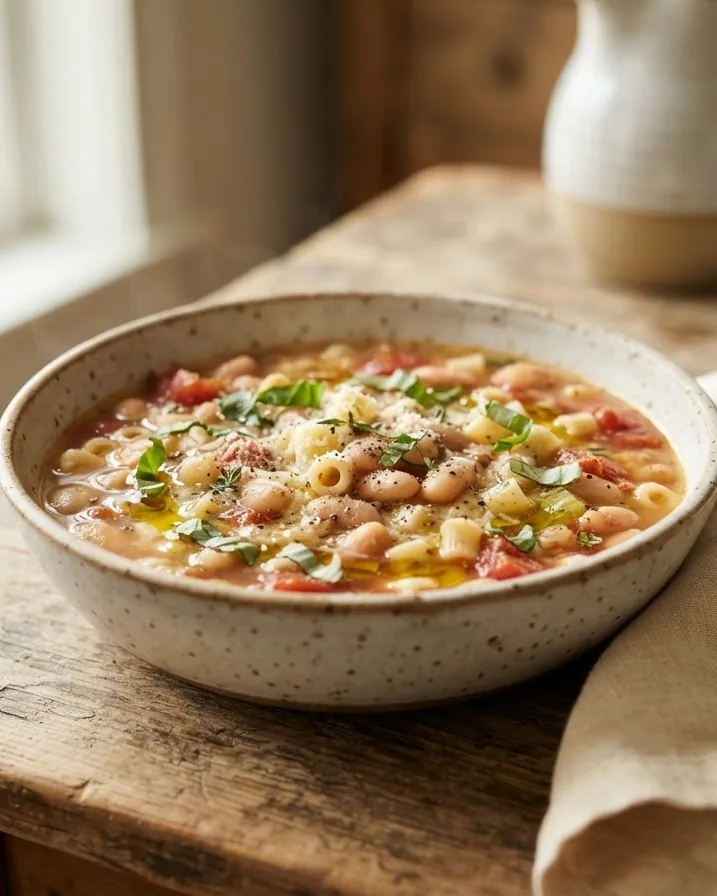
The spelling debate is more fun with a bowl in front of you, and the traditional recipe is deliberately simple because it comes from cucina povera. Start with a small pasta such as ditalini or elbow macaroni, the two shapes the dish is most commonly made with, and pair it with cannellini, navy, or borlotti (cranberry) beans. Soften onion, garlic, and celery in olive oil, add tomato, then the beans and enough broth to make it soupy, and finish by cooking the pasta right in the pot so the starch thickens the base. It is a first course, a primo, so keep the portions modest.
A few troubleshooting notes for first-timers: if the soup turns out too thick the next day, that is the pasta starch continuing to absorb liquid in the fridge, not a mistake; just loosen it with a splash of broth or water when reheating. If it turns out too thin, mash a half-cup of the cooked beans against the side of the pot and stir them back in, which thickens the base without any flour or cornstarch. And if the beans stay firm no matter how long you simmer them, the most common cause is salting the pot too early; add salt only after the beans have softened.
For plant-based cooks, the whole dish adapts cleanly, and there is a full library of vegan pasta recipes that swap the animal broth without losing body. If you are unsure which pantry pasta counts as animal-free in the first place, the label-by-label breakdown in this guide to eggs, sauces and hidden animal ingredients settles it before you shop.
Cooking on a tight grocery run is easy here too, since beans are one of the cheapest protein sources going; a roundup of high-protein recipes shows how far a bag of dried cannellini stretches, and a heartier stovetop option like this buffalo chicken pasta works on the same one-pot logic. Gluten-free households are covered as well; a solid set of gluten-free pasta and pizza ideas keeps the ditalini swap simple.
If you want to lean into the tomato side of the family, a fiery arrabbiata sauce shows the same Neapolitan pantry at a higher heat. And for something completely different to do with dry pasta on the same shelf, crunchy air fryer pasta chips turn the leftovers into a snack. Prefer a creamier weeknight bowl instead? Our creamy chicken vodka rigatoni hits a richer register while keeping to the same short list of pantry staples.
Frequently asked questions
Is it fazool or fagioli?
Both are correct in their own register. “Fagioli” is the standard Italian spelling, the plural of “fagiolo,” meaning bean, and belongs on formal menus and recipes. “Fazool” is the Americanized phonetic spelling drawn from the Neapolitan dialect “fasule,” and it fits casual, spoken, or nostalgic use. Neither is a mistake; they simply serve different situations.
How do you spell pasta fazool?
The most common spelling is “pasta fazool,” the phonetic version popularized by Dean Martin’s 1953 song “That’s Amore.” Other accepted forms include “pasta fazul,” the dialect “pasta e fasule,” and the standard Italian “pasta e fagioli.” There is no single dictionary-correct English spelling, so pick the form that matches your context, formal or casual.
What does fazool mean?
“Fazool” comes from the Neapolitan “pasta e fasule,” which means “pasta and beans.” It does not mean “beans” by itself. The American word compresses the whole dialect phrase, including the “e” that means “and,” into one sound. The standard Italian equivalent is “pasta e fagioli,” using the same structure with different dialect for the beans.
How do you pronounce pasta fazool?
The American dialect version is “pasta fah-ZOOL,” with the stress on the final syllable. The standard Italian pronunciation is [ˈpasta e faˈdʒɔːli], which respells as “pasta eh fah-JOH-lee,” with a soft “j” and stress on the JOH. Dean Martin sang the “fah-ZOOL” version, which is why most Americans say it that way.
Which spelling should I put on a menu?
Use “pasta e fagioli” as the formal name, since that is the dictionary-correct Italian spelling that language authorities recognize. You can add “Pasta Fazool” as a friendly subtitle to catch the customer’s ear. That pairing keeps the menu accurate while nodding to the spelling most diners already know from the 1953 song.
Where does the word come from?
The phonetic spelling reached a mass American audience through two songs. Van and Schenck recorded the 1927 novelty song “Pastafazoola” for the Victor Talking Machine Company, issued as Victor record No. 20925. Twenty-six years later, Dean Martin sang “just like pasta fazool” in the 1953 hit “That’s Amore,” which fixed the spelling in popular memory for good.
Is “pasta fasule” the same thing as “pasta fazool”?
They come from the same root but are not identical spellings. “Pasta e fasule” is the Neapolitan dialect form, written closer to how it would appear in an Italian dialect dictionary. “Pasta fazool” is the further-simplified American phonetic rendering of that same phrase, shaped by decades of English-speaking mouths saying it fast. Use “fasule” when discussing the dialect origin directly, and “fazool” for the popular American form.
One last note on timing: renewed attention to either song, say a movie needle-drop or a viral clip, tends to move search interest in these exact spellings within about 8 weeks, which is part of why both the 1927 and 1953 records are treated here as equally worth knowing rather than footnotes to each other.