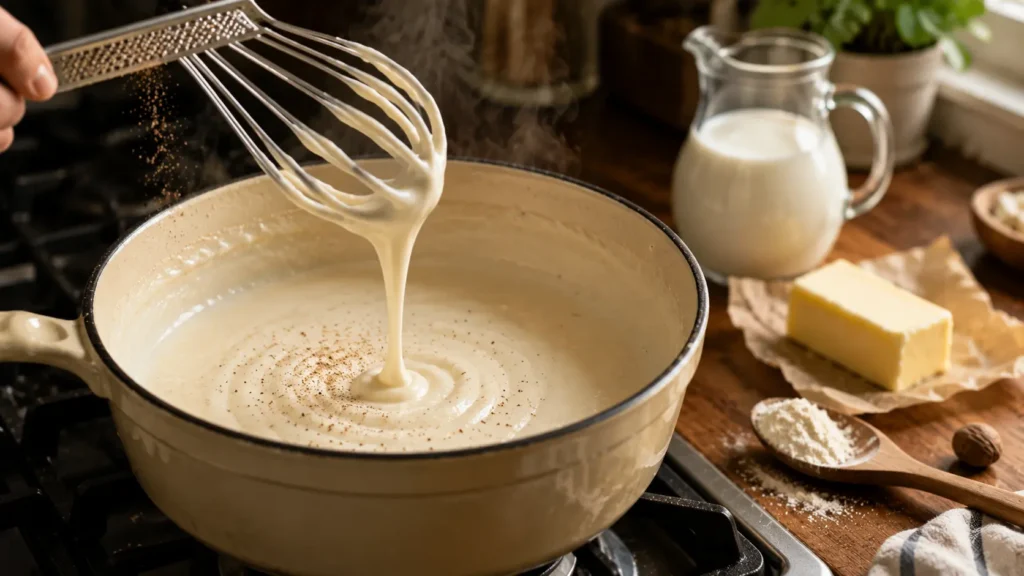
How can I make white sauce for pasta that’s smooth, creamy, and lump-free instead of a pasty, floury mess? It comes down to three ingredients and one technique. Melt butter, whisk in an equal amount of flour to make a roux, cook it for a minute or two, then pour in milk a little at a time, whisking constantly until it thickens into a velvety sauce. Season with salt, pepper, and a whisper of nutmeg, and you have béchamel, the French mother sauce that’s the backbone of mac and cheese, lasagna, and a hundred creamy pasta bakes. The whole thing takes about ten minutes and asks for nothing fancier than a whisk. The only way it goes wrong is rushing the milk or skipping the whisk, and this guide walks every step so it comes out silky every single time, plus how to turn it into cheese sauce, make it dairy-free, and rescue it when it clumps.
The Short Answer: White Sauce Is Just Roux Plus Milk
Strip away the French name and white sauce is almost embarrassingly simple: a paste of equal parts butter and flour, loosened with milk and cooked until thick. That butter-flour paste is called a roux, and it’s the thickener that does all the work. Cook the roux briefly so it loses its raw-flour taste, then add the milk gradually while whisking so it stays smooth, and the starch in the flour swells and thickens the milk into a sauce. Everything else, the cheese, the nutmeg, the seasonings, is a variation on that one move. Understand the roux and you understand not just white sauce but gravy, cheese sauce, and the thickening behind countless dishes. It really is the same three ingredients every time, in the same order.
The Three Ingredients and Their Ratios
Béchamel is butter, flour, and milk, full stop. What changes is the ratio, which controls how thick the finished sauce is. Use equal weights of butter and flour, and adjust the milk to your purpose.
| Consistency | Butter + flour | Milk | Best for |
|---|---|---|---|
| Thin (pourable) | 1 tbsp each | 1 cup | Light coating, soups |
| Medium (sauce) | 2 tbsp each | 1 cup | Pasta sauce, mac and cheese |
| Thick (binding) | 3 tbsp each | 1 cup | Lasagna, croquettes, bakes |
For coating pasta, the medium ratio is your default. Whole milk gives the richest result, but 2% works fine, and swapping part of the milk for cream or half-and-half makes it more luxurious still. Use the thick ratio when the sauce needs to hold its shape, as in the layers of a lasagna.
Step by Step: Making White Sauce Without Lumps

Lumps are the only real enemy, and they’re entirely preventable. Here’s the lump-free method.
First, melt the butter in a saucepan over medium heat until it foams but doesn’t brown. Second, add the flour all at once and whisk it into a smooth paste, then cook this roux for one to two minutes, whisking, until it smells faintly nutty; this cooks out the raw-flour taste. Third, and this is the crucial part, add the milk gradually in a thin, steady stream, whisking constantly the entire time. Adding it slowly lets the roux absorb the liquid smoothly instead of seizing into clumps. Warming the milk first helps even more. Fourth, keep whisking as the sauce comes to a gentle simmer and thickens, which happens fairly suddenly after a few minutes. Finally, season with salt, white or black pepper, and a small grating of nutmeg, the classic finishing touch that makes a béchamel taste finished rather than flat. Whisk, go slow with the milk, and lumps simply never form.
Turning White Sauce into Cheese Sauce (Mornay)

Here’s where white sauce earns its keep on pasta. Stir a couple of handfuls of grated cheese into a finished béchamel off the heat and it becomes Mornay sauce, the glossy cheese sauce behind real macaroni and cheese. Cheddar, Gruyère, Parmesan, or a blend all work; add the cheese once the sauce is off direct heat so it melts smoothly without going stringy or grainy. A teaspoon of mustard or a pinch of cayenne sharpens it nicely. Pour Mornay over cooked pasta, fold it through, and you have an instant mac and cheese; bake it with a breadcrumb top and it’s the comfort-food classic. It’s the same backbone as a creamy salmon alfredo, just thickened with roux instead of reduced cream, which makes it more forgiving and budget-friendly than a pure cream sauce.
To make stovetop mac and cheese from scratch in one go: make a medium béchamel, pull it off the heat, and stir in two big handfuls of grated cheese until glossy, then fold in a pound of cooked, drained macaroni and a splash of pasta water to loosen. Taste and adjust the salt, because cheese sauces need more than you’d expect. That’s a from-scratch mac and cheese in under fifteen minutes, no boxed powder in sight, and it’s miles ahead of anything from a packet. The same sauce, made thicker and layered with cooked pasta and a crumb topping, bakes into the kind of bubbling, golden dish people fight over the corners of.
Using White Sauce on Pasta
Béchamel and its cheesy cousin are workhorses across pasta cooking. The obvious use is macaroni and cheese: make a medium béchamel, melt in cheese, fold through cooked macaroni, and bake. It’s the structural glue in lasagna too, where a thick white sauce layered with tomato and pasta sheets gives that creamy richness no jar can fake, which is why it shows up in a baked lasagna. It also makes a fast weeknight creamy pasta all on its own, dressed up with sautéed mushrooms, peas, ham, or a handful of spinach stirred in at the end. Because it starts from pantry staples rather than a carton of cream, it’s the creamy sauce you can always make, even when the fridge is nearly bare. That reliability is the quiet reason béchamel has survived for centuries in home kitchens: butter, flour, and milk are almost always on hand, while fresh cream is a special trip. Learn this one sauce and you’ve given yourself a creamy pasta dinner for any night, no shopping required, which is worth more in real life than a dozen recipes that each need their own special ingredient.
Dairy-Free White Sauce
You can make a genuinely good white sauce without any dairy, using the exact same roux method. Swap the butter for olive oil or a plant-based butter, and the milk for an unsweetened, unflavored plant milk such as oat, soy, or cashew; oat milk’s natural creaminess makes it a favorite here. A spoonful of nutritional yeast adds a savory, cheesy depth that stands in for Parmesan, and a little extra salt and a pinch of nutmeg keep it tasting rich. The technique doesn’t change at all: roux, gradual liquid, constant whisking. It’s the base for a creamy cream sauce that anyone avoiding dairy can enjoy, and most people can’t tell a well-made oat-milk béchamel from the original.
Fixing Lumpy, Thin, or Thick White Sauce
Even a clumpy sauce is rescuable, so don’t pour it out. If your sauce went lumpy, whisk hard off the heat, and if that doesn’t smooth it, pour it through a fine strainer or give it a quick blitz with an immersion blender; both fixes work like magic. If it’s too thin, let it simmer a little longer to reduce, or whisk in a tiny extra bit of roux made separately, never raw flour, which clumps. If it’s too thick, simply whisk in more warm milk a splash at a time until it loosens to where you want it. And if it tastes floury, it didn’t cook long enough; let it simmer another minute or two and the raw edge cooks away. Almost nothing that goes wrong with béchamel is fatal.
Why the Roux Matters: The Science of Smooth
It helps to understand why this works, because then the rules make sense instead of feeling arbitrary. Flour thickens because it’s full of starch, and starch granules swell and burst when heated in liquid, trapping water and turning a thin milk into a thick sauce. The catch is that dry flour dropped straight into milk clumps instantly, because the outsides of the clumps gel and seal the dry flour inside. Coating the flour in fat first, which is exactly what the roux does, keeps each particle separate so it can disperse evenly through the milk before it gels. That’s the whole reason a roux exists. Cooking the roux briefly also breaks down some of the raw, pasty flavor of uncooked flour and lightly toasts the starch, which is why even a minute or two on the heat makes a noticeable difference in the finished taste. Add the milk gradually and the starch hydrates in stages, smoothly, rather than all at once in a panic of lumps.
This is also why temperature matters. A roux that’s screaming hot meeting cold milk can shock and seize, while warm milk added to a warm roux blends like a dream. You don’t need a thermometer; you just need to avoid the two extremes and keep whisking. Once you’ve felt a sauce come together this way a couple of times, the motion becomes automatic and you’ll never again fear the lumps that send people running back to the jar.
Flavor Variations to Try
A plain béchamel is a blank canvas, and a few classic moves turn it into something special. The traditional French upgrade is to infuse the milk first: gently warm it with a bay leaf, a few peppercorns, a clove, and a slice of onion, then strain before adding it to the roux, which gives the sauce a subtle, savory depth. Beyond that, stir in a spoonful of Dijon mustard for tang, a handful of fresh herbs like thyme or chives, a little roasted garlic mashed to a paste, or a grating of fresh nutmeg beyond the usual pinch. For pasta specifically, folding in sautéed mushrooms, wilted spinach, or crisped bacon turns the sauce into a complete dish. Each of these starts from the same plain white sauce, which is exactly why learning the base is worth so much: every variation is just one or two additions away.
Make-Ahead and Storage
White sauce keeps well, with one quirk to manage. Stored in the fridge it lasts 3 to 4 days, but it thickens considerably as it cools and forms a skin on top. To reheat, warm it gently over low heat and whisk in a splash of milk to bring it back to a pourable, smooth consistency. Pressing plastic wrap directly onto the surface while it cools stops the skin from forming. Béchamel can be frozen for a couple of months, though it sometimes separates slightly on thawing; a vigorous whisk over gentle heat usually pulls it back together. Cheese sauces are a little less freezer-friendly than plain béchamel, so if you’re making ahead for the freezer, freeze the plain white sauce and stir the cheese in fresh when you reheat.
Common White Sauce Mistakes
Nearly every béchamel failure traces to one of a few habits. Adding milk too fast is the big one; dump it in all at once and the roux seizes into lumps, so go slow and whisk. Skipping the roux’s cook time leaves a raw-flour taste, so give it a minute or two before the milk. Letting it boil hard or walking away means scorching on the bottom, so keep the heat moderate and the whisk moving. Adding cheese over direct heat turns it stringy and grainy, so always melt cheese into the sauce off the burner. And under-seasoning leaves it bland, because a plain white sauce needs a confident hand with salt and that classic pinch of nutmeg. Sidestep those five and a perfect sauce is genuinely hard to miss.
FAQ
How can I make white sauce for pasta without lumps?
Cook the butter-and-flour roux for a minute or two, then add the milk slowly in a thin stream while whisking constantly. Warming the milk first helps. If lumps still form, strain the sauce or blitz it with an immersion blender to smooth it out.
What are the three ingredients in white sauce?
Butter, flour, and milk. Equal weights of butter and flour make the roux, and milk is whisked in to reach the consistency you want. Salt, pepper, and a little nutmeg are the classic seasonings.
How do I make white sauce thicker or thinner?
More roux, meaning more butter and flour per cup of milk, makes it thicker; more milk makes it thinner. You can also simmer a thin sauce to reduce it, or whisk warm milk into a too-thick one to loosen it.
How do I turn white sauce into cheese sauce?
Stir grated cheese into the finished béchamel off the heat until it melts smoothly. This is called Mornay sauce and is the base of real macaroni and cheese. Adding cheese off direct heat keeps it from going stringy.
Can I make white sauce without dairy?
Yes. Use olive oil or plant butter for the roux and an unsweetened plain plant milk such as oat or soy. A spoonful of nutritional yeast adds savory depth. The roux method is exactly the same.
Why does my white sauce taste floury?
The roux didn’t cook long enough before the milk went in. Let the finished sauce simmer another minute or two, whisking, and the raw-flour taste cooks away.
What’s the difference between white sauce and alfredo?
White sauce, or béchamel, is thickened with a butter-and-flour roux, while a classic alfredo is butter and cream reduced with Parmesan and no flour at all. Béchamel is more forgiving and budget-friendly, and it’s the base most baked pasta dishes rely on.
Can I use cornstarch instead of flour for white sauce?
You can, for a gluten-free version. Make a slurry of cornstarch and cold milk, whisk it into warm milk, and heat until it thickens, skipping the butter-flour roux. The texture is slightly more gelatinous than a classic roux-based béchamel but works well on pasta.
Bottom Line
So, how can I make white sauce for pasta that comes out silky every time? Build a roux from equal parts butter and flour, cook it a minute to lose the raw taste, then whisk in milk slowly until it thickens into a smooth, creamy béchamel. Season it confidently, melt in cheese for a Mornay, or swap in plant milk to go dairy-free, and you’ve unlocked mac and cheese, lasagna, and endless creamy pasta from pantry staples alone. Go slow with the milk, keep the whisk moving, and the lumps that scare people off simply never arrive. Make it twice and it stops being a recipe and becomes a reflex you’ll lean on for the rest of your cooking life.